
 A weekly magazine-style radio show featuring the voices and stories of Asians and Pacific Islanders from all corners of our community. The show is produced by a collective of media makers, deejays, and activists.
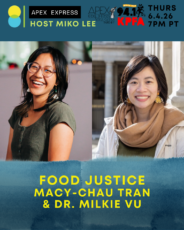
Tonight’s APEX Express show is focused on food justice and Asian America. First, Host Miko Lee talks with artist Macy Tran about their work on food as a form of resistance, and then she speaks with researcher Dr. Milkie Vu around her work on food insecurity and Asian American communities.
Show TRANSCRIPT
[00:00:00] Opening: Apex Express Asian Pacific expression. Community and cultural coverage, music and calendar, new visions and voices, coming to you with an Asian Pacific Islander point of view. It’s time to get on board the Apex Express.
[00:00:30] Miko Lee: Welcome to Apex Express. I’m your host, Miko Lee, and tonight we’re talking about food justice and Asian America. First, we talk with artist Macy Tran about their work on food as a form of resistance, and then we speak with researcher Dr. Milkie Vu around her work on food insecurity and Asian American communities. Join us tonight as we delve into food justice. Welcome to Apex Express, Macy Tran, I’m so happy to meet you.
[00:01:03] Macy Tran: I’m happy to meet you as well, Miko. Thanks for having me.
[00:01:06] Miko Lee: I just wanna start with the question I ask all of my guests, which is, who are your people and what legacy do you carry with you?
[00:01:13] Macy Tran: I come from a legacy of powerful Vietnamese people who were born and raised in Vietnam and now are part of the diaspora in Minnesota. I come from food peoples and healers and chefs and creatives of all sorts who have learned how to make ends meet and to adapt and to work with what they have. I come from a long line of people who have loved through food and who have used food as a means of cultural preservation and education and survival, which has now been passed on to me. There’s so much to say about who I come from. My grandparents have stories of survival and resilience throughout the American War in Vietnam. And it’s only because of just their love and the decisions they’ve made on behalf of their love that I am here today. My parents own a restaurant in Minneapolis, Minnesota, Vietnamese restaurant called Pho 79/Caravelle That has a 40 plus year legacy of serving Chinese and Vietnamese food to the Minneapolis community. It started with my grandma’s brother, and then it passed down to my grandma. And now my grandma has since passed and has passed it down to my father and my mother. And so I like to say that it’s restaurant people who raised me. I grew up sleeping in the booths and all of the aunties, even though they weren’t blood aunties were my aunties. Because our survival was just so foundationally just predicated on food and what we served and shared with others, and also what we ate at home and the celebrations that we would have both at the restaurant and at home. This is really what makes me.
[00:03:20] Miko Lee: Thank you for sharing. Do you wanna talk more about the legacy part?
[00:03:24] Macy Tran: I carry a legacy of peoples who really know the importance of food and the way we use food to care and support each other. Even in the most hard of times when my family was. On a boat with 200 other people and didn’t know if they were going to survive when they kind of landed abroad. The shores of Indonesia, food has been with them throughout it all, and it is how I was raised to love and care for people. I see the ways that food is not just a means for sustenance, but also as joy, as creativity, as love, and I carry all of those, decisions and skills with me.
[00:04:19] Miko Lee: Thank you so much. I learned first about your book when I read a piece that you wrote for 18 million Rising, and I’m wondering if you could just talk about how that piece around food as a form of resistance, how did that come about?
[00:04:33] Macy Tran: I have a friend who works with 18 million Rising, and since the federal occupation in Minneapolis, I’ve been doing a lot of food justice organizing here. And it has been a way in which I have seen and expressed just the skills and love that I give to my community. I was just feeling compelled to give food. That was what I knew. In the past two months as my friends have been going out on the streets following ICE agents around legally observing, I have felt that my role in this movement is to feed frontline folks who are out doing the work and also feeding our community during a time in which it’s very scary and difficult to leave your home without fear of being abducted. In Minneapolis we have created systems of, food resource sharing that have been really powerful to witness and experience and to get engaged with. And so one way that I’ve been doing it is I’ve been cooking community meals most Sundays, sometimes Saturdays that feed 200 plus people.
[00:05:47] I am providing delicious food for my friends who are out on the streets and coming home and hungry and cold. And I also helped facilitate and organize a food distribution at my parents’ restaurant after the murder of Alex Preti I really wanted to not just be involved in like acting and responding to what was happening but as an artist, as a creative, I felt the need for also remembering and preserving and reflecting about what’s been going on in Minneapolis. I kept being pulled in all these different directions and was organizing over here and supporting this community and doing this. And then when my friend reached out to me at 18 million Rising,. It was such a great opportunity for me to really reflect on my practice of food as resistance and food as justice. I’ve been a food writer in the Twin Cities for about the past three years. Food, events, I mostly cover restaurant stories and festivals and theater and all that sort of stuff in the BIPOC community here in the Twin Cities. And I realized writing this piece that this was the first time in a while, that I had written something actually for myself from my heart that was in my voice. Without an editor saying, no, you have to say it this way. No, we have to cut that part out. No, you use too many words here, and so I really took this piece as an opportunity to share what my life was like here in my own words and my own experiences. And just use it as a moment to really reflect and share the things that I’m learning and the way that I am practicing and using food as a bridge to healing and transformation during this time in which we are ripe for needing that.
[00:07:47] Miko Lee: Can you roll back a little bit and talk to me about how you got started as an organizer? What, when you first learned about social justice work and what pulled you in?
[00:07:56] Macy Tran: It definitely wasn’t the way that I was raised. I was born in the us my parents were born in Vietnam and then came over to the US and they really raised me with the mentality of you just put your head down and you work hard and you don’t really get involved. And like, yeah, you care for others, but mostly you care for your family. I was actually someone who was always butting heads with my family because I was like, do you not see all of these issues that are happening in the world? Like the issue, the systems that were implicated in. We have to care beyond just ourselves, and we would always butt heads about that.
[00:08:33] Miko Lee: At what age did that start?
[00:08:35] Macy Tran: Oh, probably when I was a teenager. around that time I was finding my voice. and it wasn’t until college that I really started putting words and frameworks and theory into what I have already witnessed in my family and my community, which is just community care and the ways that facilitates justice and transformation I would say since college that I really started actively organizing primarily on campus. I went to a smaller liberal arts school. So organizing and just getting involved in our community in that way was pretty easy. And like after I graduated college, I spent five years in Southeast Asia, one year in Vietnam, and then four years in Thailand where I was primarily working at the intersections of education and refugee justice and environmental justice. I got to meet all sorts of organizers and activists from across the region who have taught me. Really everything, a lot of what I know about organizing and what it means to show up specifically within a Southeast Asian context and how to use kind of my feet in both worlds, both my American political identity and my Southeast Asian political identity.
[00:09:59] And to merge those for the better and for my community. So I would say that. I’ve always had a big heart ever since I was little. And actually my parents were always like, you are too trusting. You people are gonna take advantage of you in the world. And I was like, I just wanna live in this world with so much love. And the way that they taught me to do that was. Through food and through reliability and just what it means to show up consistently for my people. And so in some ways it was all baked into me, even though they might not see that and they might not have raised me in that way. I see the ways in which they have sacrificed for love and nourished their families through food and made incredibly scary risks for the freedom of their family and for their people, and for a new life. And I just feel like I’m walking in their footsteps, doing the same even if they might not feel that way.
[00:11:09] Miko Lee: So did you have to talk your family and the restaurant into getting involved in the food support work for activists in Minnesota?
[00:11:18] Macy Tran: it wasn’t a challenging conversation to have and I was surprised by that.
[00:11:22] Miko Lee: Oh, great.
[00:11:23] Macy Tran: Um, yeah, my parents have been, actually, this is the most politically active and vocal I have seen them. It’s really incredible. I would say that for a lot of actually the Vietnamese community that I’ve been witnessing in Minneapolis, like they’re saying things that I never thought that they would say. They’re putting analysis like what together? The Vietnamese community is, I would say, skews at least the older generation, I should say. The older generation of Viet folks skews pretty right wing, conservative Republican, Trump supporting. And I’m just seeing dissent for the first time. It’s not always like that explicit, but it is, I would say in the past what I’ve seen is just like. When kind of rightwing or more Republican opinions come up, if people disagree with that, it’s just like you’re just quiet. But now I’m seeing a way in which like people are responding, commenting on social media, like posting publicly about it. It’s just been really, really powerful. When I first started organizing in response to the federal occupation, my parents were really quite worried and they did not want me to get involved. And they didn’t really understand why I felt compelled to do this. And then when Alex Prety was murdered, I. It was actually my auntie, my mom’s youngest sister that brought up the idea of a food distribution because she was feeling like I just wanna do something and like, what is an avenue in which we can do something? Well, we have this restaurant. Mm-hmm. And so she proposed it to my parents first, which Oh
[00:13:05] Miko Lee: wow.
[00:13:06] Macy Tran: Love, shout out to her because
[00:13:09] Miko Lee: Thank you, auntie.
[00:13:10] Macy Tran: She did right. She did the hard work for me. I think I would’ve been a little more hesitant or would’ve taken a little bit more time to just process, like how to go about asking them, because there’s just a different power dynamic there. Sure. But because my auntie is more of a peer mm-hmm. And she had this idea and she has also worked at the restaurant mm-hmm. For many, many years of her life. I think it really spoke to my parents and I think it really was a moment for them to connect the ways that this restaurant is so important to not only our family and how we show up in community, but also to our community in Minneapolis. Mm-hmm. I have traveled all across the world and have met people who have eaten at Pho 79 and have told me stories of getting engaged there, of getting a tattoo of the, like restaurant on their, on their arm. The, the logo. Yeah, the logo. It’s crazy, you know, like people, and I’ve also heard generations of families like growing up on my parents’ food. Mm-hmm. As we share food with people and they support our business, it’s only because of our community that we’ve been able to survive this far you know?. My parents came to Minnesota with nothing, and it’s only because of the kindness of other Minnesotans and other Vietnamese Minnesotans that we were able to get anywhere.
[00:14:35] In this moment they saw that and they saw that. We can, we have these resources. This won’t be hard for us. We have everything here that we need. This is the channel in which we can work in. And yeah, they were just ready to do it. I think also my parents were ready to take a risk because the business was not doing well, we weren’t, there were not people coming out to eat. Everyone was scared to go out to eat. People were not really spending money. And this was really ever since the pandemic and the way that has impacted the restaurant industry and particularly immigrant businesses, and then also the George Floyd uprisings and the way that just the, violence and also the transformation that happened to the street that we were on Eat Street. It just really changed the ways people saw that corridor, that business corridor. And it was a really big business impact. And so my dad was just, I think, in a place where he was really willing to take a risk and a stand for what he believed in. And my mom as well. As a way to also just like. Really be present in community and show that, hey, like we are out here and we believe in loving our community and seeing the ways that people are showing up for our community as and for our business as well. And honestly, since the food distribution business has been steady and I think. My parents are, I mean, they’re definitely feeling relieved, but I’m just feeling so grateful that they stood on their values, you know, and they stood grounded in that. And as a result, like the community is reciprocating. and that is such a beautiful thing that I don’t, I think my dad took a risk not knowing what would happen, because more exposure is not always good. And I’ve been telling him that, you know, especially with the Vietnamese community being, of, of his genera generation being more right wing and more conservative. He recognizes that and he recognizes that we had to do something. So I feel so proud of them for just being really chill and okay, and actually impassioned and compelled to do something.
[00:16:57] Miko Lee: It sounds like it brought you a little bit closer with your family too.
[00:17:00] Macy Tran: Definitely. Definitely did. Yeah. I feel like me and my family have never really been able to sit at a table and talk about politics and what’s going on in the world without one of us just like getting activated or feeling defensive or not seeing each other. It is a terrible thing what has happened and what continues to happen in our city, under federal occupation and so much beauty and creativity and love has come from it. And I even feel that at the most micro scale between me and my parents.
[00:17:39] Miko Lee: Can you, share with us that are not located in Minnesota, what the experience is like of this federal occupation on a day to day? Like, we’re talking today on March 2nd, and I say that because our world, everything’s changing every day and this is gonna air on a separate day. So I wanna name that. So right now, what is it like when you’re just walking through the streets in downtown Minneapolis ?
[00:18:01] Macy Tran: Yeah. It’s interesting because when you ask me this, I think about my experience like a month ago and how different it was and it felt to walk around a month ago compared to now. A month ago. It. I was seeing a neighbor on every corner of major streets, like looking for ice. You know, I was seeing car caravans, honking and following ICE agents. It’s interesting ’cause like I actually just had a friend visit from Milwaukee and. She was nervous about ice. She’s Asian American as well, and she was like, should I be scared? What’s actually going on? And I told her, actually, yes, what’s going on is scary and violent. And I feel so safe because I am meeting neighbors I have never met before. I’m making small talk with people who are just. Out on the streets walking their dog in a way that they would not normally, I’m talking to business owners, we’re talking about the impacts of this occupation. Everywhere I go, there were eyes and that felt really powerful and strong. And now that operation Metro Surge is technically over they are supposed to be withdrawing ICE agents from the city. I would say there is definitely a decrease in the number of ICE agents in our city. Activity is much slower. However I would say out in the suburbs of Minneapolis and St. Paul, they are seeing action and enforcement from ICE agents. That is. Either at the, kind of the same amount that we were receiving or escalated. The concentration is higher out in the suburbs And so even though things were quieter in the city, they were elsewhere. And
[00:19:57] Miko Lee: yeah, I just saw videos this morning of protesters that were peacefully marching that just got tackled. Actually by Minnesota Sheriff’s department working in conjunction with ice. I know every state in every region is a little bit different. But I thought that was something that Governor Waltz was working on right?
[00:20:15] Macy Tran: So actually the city ordinance that you are talking about is actually on a Minneapolis City level. So that was a decision made by Mayor Fray. Oh, that’s only city. So it’s only MPD, Minneapolis Police Department, who is not supposed to assist in, federal and right. Federal enforcement. However, on a county level, that’s different. I see. So sheriffs might be working with, I know it’s like, so complic, what a mess complicated. I
[00:20:41] Miko Lee: know. This is the same, I mean, this is the same everywhere, right? Mm-hmm. It’s all broken down. Okay. So, so I think I hear you saying that ICE has kind of moved on with the targeted big city approach and they’re going out into the suburbs instead. Is that right?
[00:20:57] Macy Tran: Yes. There are still protestors, and observers going every day to the Whipple building. The Whipple building is where ICE agents are coming from, and so they have definitely recorded a decrease in the number of ICE vehicles. So the volume isn’t as high, but the cars are still coming and we’re still seeing enforcement and violence in our neighborhoods. Just the other day, just a few streets down, a person was abducted in our neighborhood in Minneapolis. And because the volume isn’t as high, they’re not as easily able to track. And so they’re working a lot more under the radar. Yeah. Mm-hmm. And their tactics have become just a lot more. Under the radar as well. In the early days in January, it was really easy to identify ICE out-of-state license plate, tinted windows. Big vehicles like super easy. Nowadays they’re putting like coexist bumper stickers and little things on their dashboards and like, you know, driving little sedans and it’s definitely not as easy and they’re moving a lot more covertly. And because Operation Metro Surge has technically decreased and because many of our frontline activists have been working at this for months and are getting tired. Mm-hmm. There is a really interesting transition period happening here. Mm-hmm. Where I think we’re all trying to align on what is the next.
[00:22:31] What’s the next step? Mm-hmm. How? How are we, what is the best way to move given that this is the way that ICE is operating now? Yeah,
[00:22:40] Miko Lee: right. Just
[00:22:41] Macy Tran: under reflection. Mm-hmm.
[00:22:42] Miko Lee: Under such sneaky circumstances, like what they recently did in New York at Columbia, showing up at Columbia University with a missing child picture of a little kid. And that’s how they got entry into the dorms, which is so wrong to terrible get a student. So that’s actually illegal to like misrepresent being a police officer when they’re not, they’re a nice officer and
[00:23:05] Macy Tran: mm-hmm.
[00:23:06] Miko Lee: Showing a photo, I mean, it’s so awful.
[00:23:08] Macy Tran: Mm-hmm.
[00:23:09] Miko Lee: I’m wondering how people that don’t live in Minnesota can get involved.
[00:23:14] Macy Tran: Hmm. The, greatest frontier currently that is in need of support is rent support. There are, probably hundreds of maybe thousands of people who are likely at risk of eviction in the Twin Cities, because they have not been able to work for the past two months without fear of being abducted. We’re calling on Governor Waltz for an eviction moratorium, which would prevent folks from being evicted. Governor Waltz is the only person who really has jurisdiction to implement an immediate rental moratorium, and he’s done that before during the pandemic, and so we’re trying to make arguments that this is. A state of emergency people are like not able, they weren’t able to work. Like people are going to get evicted putting calls to his office, sending emails. So that’s one way to get involved from abroad, uh, or not abroad outside of Minnesota, but also abroad if you’re abroad And listening to this. The other way was, is that there’s a lot of hyper-local organizing that is happening within Minneapolis that I can speak to every. Neighborhood and corner, I feel like, of Minneapolis is being accounted for usually by a team of just volunteer mutual aid groups who are fundraising for rent, who are fundraising for groceries who are fundraising for utilities.
[00:24:45] And these are all like live fundraising pages on the internet. And if you have even just 10, $20 to spare to help a Minneapolis resident, um, not get evicted in the next month. Um, every dollar matters. In this moment, rent is due. Soon, we’re just at the beginning of March. And if folks aren’t able to pay rent now and they haven’t been able to pay rent in the last couple of months, like this is only going to have a snowball effect. We cannot risk vulnerable neighbors migrants, immigrants being, like more of them being unhoused at this moment. We already in our city have so many unhoused people who are not being cared for by our city officials, who are having their encampments being taken down and who are already not receiving adequate support. Our system cannot handle an influx of more unhoused people and we can prevent this. I would say that is kind of the biggest frontier at the moment in terms of what I’m seeing organizing on the ground.
[00:26:01] Miko Lee: Would you have links that you could share with us definitely for rent support. That would be really great if, and I’ll definitely, I’ll add them to the Apex Express show notes so folks that wanna get involved can contribute and help support community. You wrote in your piece about books, lovely books and podcasts and things that inspired you, which I always love hearing about those things. And one of the books you wrote about was Rice and Baguette, A History of Food in Vietnam. Can you talk a little bit about it, how it deepened your understanding of food legacies and resistance?
[00:26:33] Macy Tran: Mm So I read that book while I was living in Vietnam actually. So it was really cool for me to, what I love about that book, it’s a little like academic. I will say that it is a food history like you are reading history, you know, it’s a little bit like dense at some points, um, for
[00:26:49] Miko Lee: the real foodie audience.
[00:26:51] Macy Tran: For real. I’m like, if, yeah, exactly. And luckily that’s me. I was into it. What I loved about it were, the legends, like there were some what I, so in Vietnam when I was living there, something that I loved and was learning more was that like Vietnamese people have so many legends about folk legends about food, like the origins of the watermelon,, the origins of our bunte cake, which is the cake that we eat, the sticky rice cake we eat during, lunar New Year. There are so many Food origin stories that I just did not grow up being raised on. And so, this book talked about some of like, how did pho even get started, you know, is pho even truly Vietnamese? It’s, that’s a debate I’m not gonna have right now. But. I loved just hearing the greater context in which all of this existed, especially not growing up with those stories and being,
[00:27:55] Miko Lee: Hey, wait, what is the origin of watermelon?
[00:27:58] Macy Tran: So it’s this like funny little. Story where, this prince essentially gets banished to an island with his wife. And then on this random island, he finds this like incredible fruit, the watermelon, and he’s like, whoa, this is so delicious. I want I must show this to the people back at home, but they won’t have me because I’m banished. And then he basically floats the watermelon back to the mainland and they find it and they’re like, oh my gosh, this is so incredible. We must, invite this man back to the mainland.
[00:28:38] Miko Lee: How did they know it was from him? Did he like carve his name in the watermelon?
[00:28:43] Macy Tran: I don’t know. It’s actually been a while since I’ve heard this story, so I could be just like. You know, I don’t know all the details. That’s
[00:28:50] Miko Lee: okay. That’s always better anyway.
[00:28:53] Macy Tran: just stories like that. I love to hear them. I also learned about what it was like to eat and cook during foreign occupation when, oh, you know, the French were colonizers mm-hmm. When the Chinese were colonizers. Mm-hmm. And just the incredible Vietnamese food ways that emerged from those periods of colonization. Mm-hmm. They were both brutal and violent and also full of adaptation and creativity and survival foods. And so the book just talked about all of that, and I just love knowing those stories that help me know the ways in which our people have been able to survive for this long and are now free under, foreign
occupation.
[00:29:40] Miko Lee: Speaking of, you mentioned creativity and adaptability, and you are a multihyphenate person, as an artist, as an organizer, as a writer, as a visual artist, collage maker, I’m wondering how your artistry impacts your organizing and vice versa. How do they speak to each other? How do they influence each other?
[00:30:01] Macy Tran: Hmm. I am someone who, when there is an issue or a problem that arises, I’m often just confronting it with what can I do? What can I like feasibly do? How can I show up? And I think my artistic practices actually help me slow down. Even the ways that I can show up in community and do things in community, I’m very responsive. I’m always like, okay let’s do a thing. Let’s organize it. Let’s get our hands dirty. I am out there, I am organizing people, you know, like tangibly. And I think the ways that my artistic practices partner with that is that my artistic practices help me reflect and remember and deepen and find spiritual grounding and purpose. my art is a way that I bridge conversations with my ancestors and I bridge what it means to know myself and be a person, a community member, a Vietnamese American daughter in this moment, right? And it reminds me of the skills that I have and wanna bring to the world. It also helps me create different narratives for understanding what’s happening and. For finding creative solutions and for collaborating with others. So I think I would honestly be so burnt out and exhausted and sad if it were not for my artistic practices. I think it’s because of my artistic practices that I find energy, that I find belonging, that I find meaning in the work that I’m doing.
[00:31:51] Miko Lee: I love that answer. Can you share, because you brought this up, can you share about a conversation or an interaction you’ve had with an ancestor and how that’s influenced you recently?
[00:32:03] Macy Tran: Hmm. That’s such a great question. I’m going to tie this answer into Lunar New Year because, lunar New Year is a time in which our material world and the spiritual world really can converge in a meaningful way, at least for me. And every year when I celebrate Lunar New Year, I will do something different. I deepen my practices. I just kind of deepen what I know about. Folk tradition and ancestor worship. And every year I learned new things and I wanna try new things. And so this year was the first year that I built a public altar space in my living room. Usually I just have it in my bedroom or in a small corner of my home somewhere that’s like usually private. But I built like. It wasn’t like a tiny little altar, like it was big, you know, like I had photos of all my relatives on there. I had flowers, I had five kinds of fruits. I had, you know, little, every time I ate a meal, I was putting a meal aside for my family to eat with me. And, Some cultures you don’t eat the food that you leave on the altar, but in my family we do. And the reason for that is because we get to become one with our ancestors. We get to embody what our ancestors are and eat as well and their spirits, and so this past Lunar New Year, I actually threw a, I had celebrations on both sides of the family. And then I organized a new year party for my chosen family who came from all walks of life. And the prompt for the party, it was a potluck. The prompt for the potluck was cook something or bring something that your ancestors would be just delighted to eat on the altar. And so we
[00:34:00] Miko Lee: love that.
[00:34:01] Macy Tran: Oh yeah. It was so sweet. People came out with their best work, I should say, like the food was fantastic. Our ancestors were eating well, and I was sitting there. And this altar was full of tiny little plates of food, beautiful flowers. I also asked people to bring pictures, photos of their ancestors or people that they wanna honor. Incense were lit. The room was filled with incense smoke, and I was just, there was a moment where I was just, kinda in the corner of the room just watching, you know, and I had a feeling like, wow, all of our ancestors are hanging out right now. Not only are me and my chosen family, you know, building a community and belonging for ourselves but also like. I could have never, and probably they could have never predicted that my friend’s like Jewish grandpa was hanging out with my Vietnamese grandmother and grandfather, you know, or yeah, my friends like grandparents from Antigua are now hanging out with like my family members and it’s, it was just a moment where I just felt not just the joy.
[00:35:16] And love in the space of connecting with my real, like my friends in that moment. But also just the miraculousness of what it meant to hold all of our ancestors in that space. And so, after that I ended up writing a piece on my substack, actually as a letter to my ancestors. I, I kept the altar up for a week, a week and a half. And on the last day I was ready to take it down and move it back upstairs into my room. But on the last day, I thought, I’m gonna light the incense one more time. And have my ancestors in the space as I write this piece to them. There were so many things I wanted to say to them. And also at the same time, I felt like as I was writing, they were saying things to me, this is what I have to teach you in this moment, is kind of what they were saying to me. This is like, this is what it’s like to celebrate that under occupation. This is what it was like when we thought it wasn’t even possible to celebrate Tet. Like we had literally nothing but rice and water and yet we still did, and my grandma recently passed a I mean, it’s not so recent anymore, but it’s been just over a year now. And she was like, One of the first like major deaths of the elder generation in my family. And Tet was the time that I could commune with her and share love with her. And, I could just feel her presence in the space and I would even, memories felt like a way that she was talking to me. The memory of just the crackle of her sesame balls, like she made the best sesame balls. They were like. Thin and crispy and fluffy, but also like so like they were not skimping on the mung bean on the inside. It was fantastic. So I’m just like, I haven’t had a sesame ball from her in over a year, but I can remember how it tastes and feels, and my mouth and that memory itself is a message from her. To remember what has fed me through so many years, and how important it is to just remember the, not only just the foods that we eat, but the people that have loved that food into existence. And now me, you know,
[00:37:38] Miko Lee: have you made it the dish, the sesame balls.
[00:37:43] Macy Tran: I actually have her recipe books, so I planned to I just didn’t have time, this past Tet, but me and my brother were going to, and then I think we decided we wanted to do it on just like on a lower key day, like instead of like in the midst of just like so much family celebration, there was so much to prepare and we were like, let’s just plan a low key weekend where it’s just me and you and there’s no timeline and we don’t have to get this anywhere and they don’t have to be perfect. Like
[00:38:14] Miko Lee: that sounds lovely. So it’s personal and it’s family and Exactly. And if for a one year anniversary, death anniversary is coming up, that might be a great time to honor her.
[00:38:22] Macy Tran: Exactly. Exactly.
[00:38:24] Miko Lee: I’m wondering what was like some standout dishes from that lovely event to you?
[00:38:29] Macy Tran: Ooh. I mean, I will talk about the dish I made.
[00:38:33] Miko Lee: Okay.
[00:38:36] Macy Tran: Which I thought was fantastic and I think my friends also thought were delicious. Was delicious. Um, but a dish that is commonly eaten during the lunar new year for Vietnamese people is a tit ka, which is a caramelized, braised pork belly. This caramelized, braised pork was stewing for probably three hours. Wow. And so, yeah, and I used coconut water with it. I didn’t like, straight up coconut water and it
[00:39:04] Miko Lee: no Coca-Cola.
[00:39:06] Macy Tran: No Coca-Cola not in this one. And I just made a huge, huge pot and it was basically almost all gone by the end of the night. So that was like a really good feeling. Um, my brother made an incredible duck heart lap. He works at Diane’s Place, actually, it’s a famous Hmong restaurant in Minneapolis. And they processed duck on the menu. And so he had like access to all these duck organs and he made an incredible loup that he brought to the party. And my, one of my little sisters, Iris, she’s Puerto Rican and she made like tostones, like fried plantains and then she also made Puerto Rican rice, and she, she made like three or four dishes. So like, people really went above and beyond for their ancestors. I could really, I mean, it was probably like 20 people who came to this party, so there were so many dishes and they were all. So good. So I, I don’t wanna, once I get into it, I’m gonna go into it, so I’m not gonna chat your ear off.
[00:40:13] Miko Lee: Sounds lovely. Sounds yummy. Mm-hmm. And my last question is, I’m wondering what manifestation for the year of the horse you have for yourself.
[00:40:23] Macy Tran: The 18 million rising essay that I wrote came, it was right before the lunar new year that it got published. And it came during a time where I was already thinking a lot about my creative practice and how in, in relationship my creative practice in relationship with also the ways that I organize and the ways that I cook and, organize around food. And when this opportunity for this essay emerged and just the way it has been received has been such an honor, like, because I haven’t written for myself, you know, in so long and like really with my own voice I just didn’t realize that people were going to resonate with it so much and find like an invitation to engage in food justice themselves and their own ancestry. And also the ways that it made them think about food and their relationship to food. And it was such a blessing for me to receive that resonance from people, you know, and to receive, just the stories that I’ve heard and the way it spoke to them. And I felt like that has been a blessing for me to just really expand my creative practice and be more public with it. I’m like, dang, if this little thing that I wrote impacted people in the way that they think about the world, like. I have so many more ideas I wanna share and like be in partnership with others about.
[00:41:57] And I just launched my Substack, right after the Lunar New Year and I was like, all right, you’re the fire horse. Let’s freaking go. I am ready, I am running. So, I just wanna be creating so much and like act manifesting and actualizing a lot of the dreams that I have, my creative dreams that I have continued to put on the back burner. Things about hosting supper clubs and doing more work around my parents’ restaurant, like helping them create narrative around the restaurant and sharing our restaurant story with people. And just using my words and experiences as a way to connect with the world and also be open to the ways that people wanna connect with me. So that’s kind of the ways that I’m, I’m seeing this year unfold already, and it’s already started with a bang. I also wanna add that year of the fire horse for me is just a lot about movement and progress. And so in this sense movement, I think of social movements and the ways that social this particular social movement against ICE in our city will fundamentally. Impact us for the next lunar year. It happened right at the beginning of the lunar New Year and it’s going to have deep effects into the year, and we will forever be changed by this. And I am so excited to see the ways in which we harness this energy for transformation, for care into something that’s really meaningful.
[00:43:37] Miko Lee: Thank you so much for joining us on Apex Express. It was a delight to talk with you.
[00:43:42] Macy Tran: Thank you, Miko. This was so great. Thanks for having me.
[00:43:45] Miko Lee: Next up, listen to researcher professor, Dr. Milkie Vu, speak on her exploration on Asian Americans and food insecurities. Welcome, Dr. Milkie Vu, assistant professor at Northwestern. Welcome so much to Apex Express.
[00:44:04] Dr. Milkie Vu: Thank you. I’m delighted to be here.
[00:44:07] Miko Lee: Dr. Milkie is a mixed methods researcher focusing on community engagement and health issues, and I’m excited to talk with you today. I wanna start by first asking the question that I ask all of my guests, which is, who are your people and what legacy do you carry with you?
[00:44:24] Dr. Milkie Vu: My people are the Vietnamese community, and when I think of my people, the first word that comes to my mind is resilience. I was raised in Vietnam. I speak Vietnamese fluently and I embrace my culture very deeply. I carry the memory of my parents and grandparents who have lived to colonization multiple world. And the challenge of post-war poverty and the ability to, endure all these hardship is the legacy that I bring with me and in my day to day life it acts as a personal life of hope for me and then professionally in the. Work that I do is really a foundation and it drives my dedication and commitment to working on health solution with Asian American and immigrant communities who have similar stories of hardship, but also perseverance.
[00:45:19] Miko Lee: Thank you so much. I really appreciate how your background has informed the work that you’re doing, and I wonder if you could talk a little bit more about this study, this scoping review on food insecurity among Asian Americans. Can you one first start off by breaking down what a scoping review is.
[00:45:37] Dr. Milkie Vu: Yeah, I’m happy to talk about that. So a scoping review is essentially a methodology that we use to be able to summarize existing scientific literature and try to understand how this literature. Answer research questions that we have.
[00:45:56] Miko Lee: Can you tell me what inspired this study?
[00:45:59] Dr. Milkie Vu: I’ve done community engaged research with, Asian American population for over a decade. In doing so, I have come to realize , as an anecdotal evidence, how food insecurity is a issue in the community. And yet that’s very little that has been, done in terms of research or policy that target this problem., So for example, the US Department of Agriculture, will publish annually a report on food insecurity in America and it will include several, racial and ethnic populations, but Asian Americans are frequently ommitted from that report. So, you know, at the national level, that data doesn’t exist, which then, makes it very difficult to understand what is the severity of the problem and what are some of the solutions that could be done to address them. So that’s why we were interested in doing a deeper dive into summarizing the literature too be able to see what has been done about this problem and what are some of the barriers that exist, towards food security for community members, and what are some of the literature gaps? Our review was published in 2024 was the first scientific review of the literature on food insecurity among Asian Americans.
[00:47:27] Miko Lee: And what did your study uncover?
[00:47:31] Dr. Milkie Vu: We documented several important findings. There is a lack of existing data on this problem. Due to this myth of Asian Americans being the model minority. Assuming that Asian Americans are uniformly successful socioeconomically and thus not experiencing, any challenge including food insecurity. One of the things that we found is the importance of data disaggregation and looking at food insecurity in different Asian origin groups. We found that food insecurity really varied. So for example, if you look at some groups like Japanese Americans, we found the prevalence of between two to 11% of the population reporting food insecurity. But then if you look at some of the Southeast Asian groups, for example, Filipinos or Hmong American or Vietnamese, the rates are much higher. So the studies that we found report, between eight to 41% of food insecurity and among Filipino population. Close to 48% for more Hmong American, and then between 14 or 28% for Vietnamese Americans, so much higher than the rates for other groups.
[00:48:48] Data Dion is important and there shouldn’t be this grouping of different Asian groups in research because then it really erased like the struggles specific communities with food insecurity. I think the other finding that was really important is looking at more systemic or structural barriers that prevent people from being food secure. Our review found that limited English proficiency is a important driver of food insecurity. The lack of appropriate language services, whether that’s food pantry or for things like snap navigation. These could be important target point infusion policy or interventions that could help address food insecurity, community members. We also look at a couple of qualitative studies that found really interesting things. So for example, even when Asian American community members do use food assistance programs like snap, the benefits are often not sufficient. And they have a negative experience. There’s also fear of how that might negatively impact the immigration status or application. Those are important barriers that should be acknowledge.
[00:50:08] Miko Lee: Some of these numbers are so high. You mentioned 48% with Hmong folks with, it’s just so surprising, and I wonder if there’s a sense of the why some of these communities have a higher food insecurity than others.
[00:50:21] Dr. Milkie Vu: Yeah, one of the things that we did point out in the conclusion was the need for just more studies focusing on these, smaller Asian groups or smaller Asian population that are done in like the appropriate language to be. From some of the experience I’ve had, part of it is probably shaped by, the historical conditions to which some of these, communities might have come to the us. For example, thinking about my community Vietnamese, coming to America as refugees, fleeing persecution or free fleeing war and how that, historical conditions might create structural and socioeconomic challenge in Britain, in the community. I am also curious about is the availability of service and program that are linguistically appropriate or, providing culturally relevant food for these communities. So those are important points that we can hypothesize, but obviously more research is needed to understand, the root cause of these challenge and how to address them.
[00:51:28] Miko Lee: And were you focused on specific regions or this was national?
[00:51:34] Dr. Milkie Vu: I’m really glad that you asked about this. So the review itself is, summarizing all published literature focusing on Asian Americans. All of the studies take place in the us. A lot of the, studies probably focus on data that are from the coast. So either on Asian American, on the east coast or the west coast. , But we looked at the study like from a nationwide angle and I’m also happy to talk about some of the new committee organizations in Chicago looking at food insecurity and community-based solutions to address that among Asian Americans. Part of the motivation for the follow-up study was just thinking about the lack of data focusing on the Midwest or Chicago where I live.
[00:52:20] Miko Lee: Please, I’d love to hear more about that
.
[00:52:23] Dr. Milkie Vu: The COVID pandemic, had brought a lot challenges for food insecurity. For people nationwide in general, but then for Asian American, there’s also this, so what I call like the double, almost like a double pandemic, like the waves of entire Asian violence and hate crimes. And so thinking about how that impact food insecurity in general among, Asian American community members. About two years ago, we interviewed around, 13 organizations in Chicago. All of them are either community based organizations, social services or food pantry, working with, primarily with Asian American community members, from diverse groups: korean, Chinese, Vietnamese, Filipino, south Asian, Mongolian, et cetera throughout Chicago. And the question that we asked them was, thinking about what programs they have offered during the COVID pandemic that aim at reducing food insecurity among community members. How did they implement this program? Who are some of the vulnerable populations served by the program? How did the pandemic as far as anti-Asian racism impact the program organization? That was the first study that looked at how community organization in Chicago help address this issue of insecurity on this, the COVID pandemic.
[00:53:57] Miko Lee: And so what is the next step for this study or what is the next piece that you’re working on as connected to this?
[00:54:05] Dr. Milkie Vu: Yeah. Think about the role of the community organization as grassroots organizations that work from the ground up , as opposed to more top down program structure. They’re doing a lot of the heavy lifting to help community members address food insecurity, because they know the community very well. They are able to provide the in language service that community members need. They’re also trusted by community members. So a lot of the time,, certain populations especially say if those with limited their English proficiency or, more newly arrived immigrants, might feel more comfortable going here as opposed to going to this organization as opposed to, another one that are more generic and don’t have the staff that speak the right language. I think the other thing is, staff with the similar cultural backgrounds are able to understand. There was one quote from the study that I did in Chicago. That stuck with me. When we tell them you could go to the food bank, the American food is not quite tailored to their taste. So they will get a big chunk of cheese and they will be like, what is this? Nobody wants to eat this. Again, thinking about the role of committee organization as so important in knowing the language, knowing the cultural preferences. And then just thinking of ways that we can further support, the programs and operations that they do. This is a really challenging time for nonprofits, social service organization, both in terms of providing food as well as other social service to Asian American and immigrant communities. How can research from a place like, researchers, from academia like me, are able to partner with them to further the service that they do and be able to find the funding that support them and community members. I think that’s the important step for me.
[00:56:02] Miko Lee: Dr. Vu, how can folks find out more about your work?
[00:56:06] Dr. Milkie Vu: Yeah, In order to understand more about the work that we do, so we have a website, for our lab that frequently include, you know, like our current projects as well as publications. So you can go to site, so SI ts.northwestern.edu/vu group. and you’ll be able to find more information about the research that we published. We’ve also recently, in the beginning of the year start, to find ways to disseminate research on social media. So we also have a Facebook group for our lab that disseminates our research findings as well as include information about the community members and partners Other trainees in the lab that make this work possible. The labs Facebook group is at facebook.com/maybe give research. and then you can always reach out to me via my email [email protected] So I’m glad to connect with people who have similar research interests or would like to learn more about the work that we do.
[00:57:06] Miko Lee: Thank you so much for joining us and sharing your information about your important work that you’re doing on research with Asian American community. Appreciate hearing from you.
[00:57:15] Dr. Milkie Vu: Thank you so much.
[00:57:18] Miko Lee: Please check out our website, kpfa.org/program/apexexpress to find out more about our show and our guests tonight. We thank all of you listeners out there. Keep resisting, keep organizing, keep creating, and sharing your visions with the world because your voices are important. Apex Express is produced by Ayame Keane-Lee, Anuj Vaidya, Cheryl Truong, Isabel Li, Jalena Keane-Lee, Miko Lee, Miata Tan, Preti Mangala-Shekar and Swati Rayasam. Tonight’s show was produced by me Miko Lee, and edited by Ayame Keane-Lee. Have a great night.