 A weekly magazine-style radio show featuring the voices and stories of Asians and Pacific Islanders from all corners of our community. The show is produced by a collective of media makers, deejays, and activists.
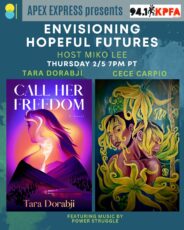
Envisioning Hopeful Futures
Host Miko Lee speaks with two Bay Area artists, activists, and social change makers: Tara Dorabji and Cece Carpio. Both of these powerful people have been kicking it up in the bay for a minute. They worked in arts administration as community organizers and as artist activists.
LINKS TO OUR GUESTS WORK
Tara Dorabji Author’s website
New book Call Her Freedom
Find more information about what is happening in Kashmir Stand With Kashmir
Tabi Tabi Po running at Somarts
SHOW Transcript
Opening Music: Apex Express Asian Pacific expression. Community and cultural coverage, music and calendar, new visions and voices, coming to you with an Asian Pacific Islander point of view. It’s time to get on board the Apex Express.
Miko Lee: Good evening. I’m your host Miko Lee, and tonight I have the pleasure of speaking with two Bay Area local artists, activists, and social change makers, Tara Dorabji and Cece Carpio. Both of these powerful people have been kicking it up in the bay for a minute. They worked in arts administration as community organizers and as artist activists. I so love aligning with these multi hyphenated women whose works you can catch right now. First up, I talk with my longtime colleague, Tara Dorabji Tara is an award-winning writer whose first book Call Her Freedom just came out in paperback. And I just wanna give a little background that over a decade ago I met Tara at a workshop with the Great Marshall Gantz, and we were both asked to share our stories with the crowd. During a break, Tara came up to me and said, Hey, are you interested in joining our radio show, Apex Express? And that began my time with Apex and the broader Asian Americans for Civil Rights and Equality community. So if you hear a tinge of familiarity and warmth in the interview, that’s because it’s real and the book is so great. Please check it out and go to a local bookstore and listen next to my chat with Tara. Welcome Tara Dorabji to Apex Express.
Tara Dorabji: Thank you so much for having me. It’s wonderful to be with you, Miko.
Miko Lee: And you’re actually the person who pulled me into Apex Express many a moon ago, and so now times have changed and I’m here interviewing you about your book Call Her Freedom, which just was released in paperback, right?
Tara Dorabji: Yep. It’s the one year book-anniversary.
Miko Lee: Happy book anniversary. Let’s go back and start with a little bit for our audience. They may have heard you, if they’ve been a long time Apex listener, but you as an artist, as a creator, as a change maker tell me who are your people and what legacy do you carry with you?
Tara Dorabji: Who are my people? My people I would say are those who really align with truth. Truth in the heart. That’s like at the very core of it. And I’m from the Bay Area. I’ve been organizing in the Bay a long time. I started out organizing around contaminated sites from nuclear weapons. I’ve moved into organizing with young people and supporting storytelling. So arts and culture has been a huge part of it. Of course, KPFA has been a big part of my journey, amplifying stories that have been silenced, and I think in terms of legacy, I’ve been thinking about this more and more. I think it goes into two categories for me. One are the relationships and who remembers you and and those deep heart connections.
So that’s one part. And then for my artistry, it’s the artists that come and can create. On the work that I’ve done and from that create things that I couldn’t even imagine. And so I really think that’s the deepest gift is not the art that you’re able to make, but what you create so that others can continue to create.
Miko Lee: Thank you so much for sharing the deep kind of legacy and sense of collaboration that you’ve had with all these different artists that you’ve worked with and it’s, your work is very powerful. I read it a year ago when it first came out, and I love that it’s out in paper back now. Can you tell our audience what inspired Call her Freedom.
Tara Dorabji: Call Her Freedom is very much inspired by the independence movement in Indian occupied Kashmir. And for me it was during the summer uprisings when, and this was way back in, In 2010-2009, after the Arab Spring and for the entire summer, Kashmir would be striking. It would shut down from mothers, grandmothers, women, children in the street.
This huge nonviolent uprising, and I was really drawn to how it’s both one of the most militarized zones on earth. And how there was this huge nonviolent uprising happening and questions about what it could look like, even like liberation beyond the nation state. And so I was really drawn to that. My dad’s from Bombay, from Mumbai, that’s the occupying side of it, and ethnically we’re Parsi.
So from Persia a thousand years ago. And so I think for me, at a personal level, there’s this question of, okay, my people have been welcomed and assimilated for generations, and yet you have indigenous folks to the region that are under a complete seizure and occupation as part of the post-colonial legacy.
And so I went and when I went to Kashmir for the first time was in 2011, and I was there. Right when the state was verifying mass graves and was able to meet with human rights workers and defenders, and there was a woman whose husband had disappeared and she talked to me about going to the graves and she told me, she said I wanted to crawl in and hug those bones.
Those are the lost and stolen brothers, sons, uncles, those are our people. And another woman I spoke to talked about how it gave her hope for the stories to carry beyond the region and for other people to hear them. And so that became a real core part of my work and really what call her freedom is born from.
Miko Lee: Thank you for sharing and I know that you did a film series and I wonder if you could about Kashmir and about what’s going on, and I think that’s great because so many times we in American media don’t really hear what’s going on in these occupied lands. Can you talk a little bit about how the interconnectedness of your film series and the book and was that part of your research? Was it woven together? How did you utilize those two art forms?
Tara Dorabji: I think we’re both accidental filmmakers. That might be another way that our cross, our paths cross. In terms of medium. So for me, I was actually working with Youth Speaks the Brave New Voices Network at that time and doing a lot of short form.
So video content, three minutes, 10 minutes, six minutes. And it was playing really well and what I was seeing coming outta kir by local filmmakers was beautiful, gorgeous, highly repressed work generally, longer form, and not always immediately accessible to an audience that didn’t have context, that hadn’t been, didn’t understand.
And my thinking was this was a gap I could fill. I had experience, not as a filmmaker, but like overseeing film teams doing the work, right? And then here are some of the most silent stories of our time. So when I went back to do book research in 2018, I was like, Hey, why don’t I make some short form films now? I didn’t even know what I was getting into. And also I think. When you go in as a novelist, you’re absorbing your hearing and it takes time. There’s no clock. It was, it’s been the hardest project to get from start to finish. And I couldn’t be like, okay, Miko, like I’ve done it once. Now this is how you do it.
And when people trust you with their story, there’s an urgency. So throughout the whole project, I was always seeking form. So my first trip went straight to KPFA radio. Took the stories, project sensor, took the stories, and so I wanted to build on that. And so the documentary films provided a more some are, I’m still working on, but there was some immediacy that I could release, at least the first film and the second film, and also I could talk about how can this work dovetail with campaigns happening on the ground and how can my work accelerate what human rights defenders are doing? So the first film here still was released with the first comprehensive report on torture from the region. And so it gave that report a whole different dimension in terms of conversation and accessibility. It was a difficult film but necessary, and because I had to spend so much time with.
It was a difficult film but necessary, and because I had to spend so much time with transcribing, watching the footage over and over again, it really did inform my research from the B-roll to sitting and hearing the content and also for what people were willing to share. I think people shared in a different way during video interviews than when I was there for novel research. So it worked really well. And what I am, I think most proud of is that the work was able to serve what people were doing in a really good way, even though it’s really difficult work.
Miko Lee: It built on the communication strategies of those issues like the torture report and others that you’re working on.
Tara Dorabji: Exactly. And in that way I wasn’t just coming and taking stories, I was applying storytelling to the legal advocacy strategies that were underway. And, you make mistakes, so it’s not like there weren’t difficulties in the production and all of that. And then also being able to work with creatives on the ground and at times it just. You, it became increasingly difficult, like any type of money going out was too heavily scrutinized. But for a time you could work with creatives as part of the projects in the region and then that’s also super exciting.
[00:11:18] Miko Lee: Yeah. Can you talk a little bit more, I heard you say something about how the, when people are telling your story for the novel versus telling the story for the video that the cadence changes. Can you share a little bit more about what you mean by that?
Tara Dorabji: Yeah, I think when I’m doing novel research, it’s very expansive, so I’m dealing with these really big questions like, what is freedom? How do you live in it? How do you, how do you choose freedom when your rights are being eroded? And so that conversation, you could take me in so many different directions, but if I am focused on a very specific, okay, I’m doing a short documentary film around torture, we’re gonna go into those narratives.
Or if I’m coming with a film medium, like people just see it differently and they’ll speak and tell their stories differently than with a novel. It’s gonna be fictionalized. Some of it might get in there or not. And also with a novel, I don’t ever, I don’t take people and apply them to fiction. I have characters that like, I guess come to me and then they’re threaded through with reality.
So one character may hold anecdotes from like dozens of different people and are threaded through. And so in that way you’re just taking like bits and pieces become part of it, but. You don’t get to see yourself in the same way that you do with the film. So in some ways. It can be safer when the security environment is as extreme as is as it is right now. But there’s also this real important part of documentary film where it’s people are expressing themselves in their own words, and I’m just curating the container.
Miko Lee: Was there an issue like getting film out during the time that you were doing the documentary work? Because I’ve heard from other folks that were in Kashmir that were talking about smuggling film, trying to upload it and finding different, did you have to deal with any of that, or was that before the hardest crackdown?
Tara Dorabji: I mean there were, there’s been series, so 2019 was abrogation where there was a six month media blockade. And so just your ability to upload and download. And so that was after I had been there. The environment was there was challenges to the environment. I was there for a short time and you just come and you go. You just do what you’re gonna do and you be discreet.
Miko Lee: And what is going on in Kashmir now?
Tara Dorabji: The situation is really difficult. One of the lead leads of the report on torture and coordinator from the human rights group that put, that helped put out that report has been incarcerated for four years Koran Perve.
Miko Lee: Based on what?
Tara Dorabji: His human rights work. So they’ve just been detaining him and the United Nations keeps calling for his release.
Miko Lee: And what do they give a reason even?
Tara Dorabji: They, it’s yeah, they give all kinds of trumped up charges about the state and terrorism and this and that. And also. One of the journalists and storyteller and artists in the first film that I released, Iran Raj, he’s been incarcerated for two years. He was taken shortly after he was married, the press, the media has been dismantled. So there was, prolific local press. Now it’s very few and it’s all Indian State sponsored narrative propaganda coming through.
] Miko Lee: How are concerned folks here in the US able to get any news about what’s happening in Kashmere, what’s really going down?
ara Dorabji: It’s really hard. Stand with cashmere is a really good source. That’s one. There’s cashmere awareness. There’s a few different outlets that cover what happens, but it’s very difficult to be getting the information and there’s a huge amount of repression. So I definitely think the more instagram orgs, like the organizations that go straight to the ground and then are having reels and short information and stories on Instagram is some of the most accurate information because the longer form journalism. It is just not happening right now. In that way people are being locked up and the press is being dismantled and people running, the papers are being charged. It’s just horrendous. Entire archives are being pulled and destroyed. So hard. Really hard. So those, Stand With Kashmir is my go-to source, and then I see where else they’re looking.
Miko Lee: So your book Call Her Freedom is a fictionalized version, but it’s based around the real situation of what’s been going on in Kashmir. Can you share a little bit more about your book, about what people should expect and about what you want them to walk away with understanding.
Tara Dorabji: It’s a mother daughter story. It’s a love story. It’s about love and loss and families, how you find home when it’s taken. And the mom is no Johan. She’s a healer. She’s a midwife. She has a complex relationship with her daughter and she haunts the book. So the story told from multiple points of view, we never get and ignore the mom’s head, but. She comes back as she has a lot to say. And I think it’s interesting too because in this village that’s largely run by men, you have these two women living by themselves and really determining their own fate.
And a lot of it has to do with both nors ability to look at ancient healing practices, but also a commitment that her daughter gets educated. And so she really like positions her daughter in between the worlds and all the while you have increasing militarization. And Aisha starts as a young girl just starting school.
And then at the end of the story, she’s a grandmother. We get to see her relationships evolve, her relationship with love evolve, and a lot of the imperfections in it. And one of the things in writing this is when you’re dealing. Living in occupation, there’s still the day-to-day challenges that so many of us endure. And you have these other layers that are horrific.
Miko Lee: Yeah. And I’m wondering how much of yourself as a mother you embedded into the book as a mother, as an activist, as a mother of daughters, how much of yourself do you feel like you put into the book?
Tara Dorabji: A ton. It’s my heart and spirit in there. And there were some really, there’s this scene where the mom does die, and I actually wrote that before my mom passed away. And I do remember like after my mom died, going through and editing that part. And it was just like. It was really, it was super intense and yeah, I mean it definitely made me cry and it was also like the emotion was already there, which was interesting for me to have written it before but then have it come back and a full circle, I think.
Miko Lee: So did you change it after you experienced your own mom dying?
Tara Dorabji: It was soft edits. In my second novel, there’s a scene and it, that one completely changed ’cause I didn’t hit the emotion. Emotional tenor, right? It’s funny, but in this one it was pretty good. I was like, I did pretty good on that one. But yeah, so it was just like tinkering with it a little. I think also my daughters were about four when I started.
Miko Lee: Oh, wow.
Tara Dorabji: And it came out as, when they’re 18. So the other part was I was able to use their age references constantly throughout it because. I could just map to what it’s like being a mom of a kid that age. So I did ob yeah, definitely used my own. So it’s an amalgam and also it’s fictionalized. So in the book, it’s not Kashmir, it’s Poshkarbal there’s right a village. And so trying to take people out of something that they can identify as reality, but then at the same time, you can see the threads of reality and create a new experience.
Miko Lee: So since you brought that up, tell us about the next book that you’re working on right now.
Tara Dorabji: Yes, it’s still very much in a draft form, but takes place here in the Bay Area. Similar themes around militarization, family secret love, lineage loss, and part of it’s in Livermore Home to one of the world’s nuclear weapons lab. Mm-hmm. Part of it’s in San Francisco, so exploring into the future tech, AI, and. There’s an underpinning around humans’ relationship to technology, and I think at this point. We know that technology isn’t gonna solve the crisis of technology. And so also looking at our relationship to land and culture and lineage. So there’s, it’s about, now I’m looking at about a hundred year span in it.
Miko Lee: Wow. Really?
Tara Dorabji: Yeah. Contained with the geography of the Bay Area
Miko Lee: Toward the future. Toward the past?
Tara Dorabji: both past and future
Miko Lee: Whoa. Interesting.
Tara Dorabji: Yeah.
Miko Lee: I’m reading Empire of AI right now. I don’t know if you’re familiar with that, but, oh, the AI stuff is so deeply disturbing about humanity. You’re really thinking about where we’re going, so I’m curious to find out your fictionalized versions of the impact.
Tara Dorabji: It’s a major change we’re going through. Yeah, and you and I grew up in a time when we didn’t have cell phones and we used maps, and Yeah. If I was gonna meet you, I had to be there and we’d have to make a plan in advance and yeah. It’s just shifting so rapidly. So we went
Miko Lee: through that. Even how to read a, how to read a clock like my girls, I had to show them as adults how to read a clock. Wow, I didn’t realize these things. Our world is so digitized that even the most basic, that concepts ha how are shifting and even fine motor skills. Like most young people do not have good, fine motor skills.
Tara Dorabji: Yeah.
Miko Lee: Because they’re just used to being on their phone all the time.
Tara Dorabji: Yes, and the, and I would give it is during the rain over the holidays, there is just always a family out with a small child in their yellow rain boots. And the kid like reaching into the tree, grabbing, smelling it dad or mom holding them. And so there are these anchors.
Miko Lee: Yeah.
Tara Dorabji: And even though humanity is accelerating in this one way, that’s very scary and digitize. It’s like the anchor of the earth in our community and our relationships still is holding us. Some of, you know, there’s still that pull. And so I think that how people form their communities in the future and the way that.
The choices that are gonna be made are just gonna become increasingly difficult. We faced it in our generation, parenting around cell phones, social media. We’re seeing that impact of the suicidality, all of those things coming up. And that’s gonna accelerate. So I do think it’s, definitely a major change in transition some dark times, but also some really beautiful possibilities still rooting in our communities and in the world.
Miko Lee: And because we both work in movement spaces, I’m really curious I heard you talk a lot about connection and land and I’m just curious in your book. I got this vibe and I know a lot of the work that we do in the community. I’m wondering if you could speak a little bit on the land back movement internationally. In so many of those spaces, women are at the forefront of that. I wonder if you could talk a little bit about that.
Tara Dorabji: That’s one of the most exciting things happening right now is the land back movement. In my younger days when I was studying what determines a woman’s quality of life internationally at a scale, it’s, it was really came down to land ownership. So in societies where land ownership went to women, they were able, and it was like. Outpaced by far, education and those other things is like that access to the land and the resource in that way.
And land back is an acceleration of that, and I think particularly when we’re looking at a lot of questions around philanthropy, spun downs, how it’s done. When you transition an asset back into the community as land and land stewardship, right? Because then there’s like the ownership for the stewardship and yeah, the different ways that it’s done.
But that is a lasting impact for that community. And so often when you’re investing in women. Then it goes not just in terms of their quality of life, but the children, right? And the whole community tends to benefit from that. And I think even looking at Kir in the, one of the things that always has fascinated me is Kashmir during, it was independence was a carve up by the British, so that’s a post-colonial strategy to keep people fighting. That has been very successful in the subcontinent. Kashmir had
Miko Lee: all over the world.
Tara Dorabji: Exactly. And Kashmir had a semi-autonomous status. That’s what was really stripped in 2019, was that article from the Constitution. And so in the very early days when their autonomy was stronger, they started some pretty revolutionary land reforms. And so there was actually clauses where the people that were working the land could have it. And people Kashmiris were transferring land. To two other cashmeres. And so it was this radical re resource redistribution and you have a really strong legacy of feminism and women protesting and leading in Kashmir and I think that part from my perspective is that was a threat. This fear of redistribution of resources, land distribution other areas started to follow suit and the nation state didn’t want that to happen. They wanted a certain type of concentration of wealth. And so I think that was one of the factors that.
There were many, but I do think that was one that contributed to it. So I do think this idea of land backed land reform is extraordinarily important, and particularly looking at our own relationship with it. How do we steward it? How do we stop stripping the land? Of its resources and start realigning our relationship to it where humans are supposed to be the caretakers. Not the ones taking from.
Miko Lee: Thank you for sharing. I was thinking so much about your book, but also about the movement that we live in and the more positive visions of the future. Because right now it’s devastating all the things that are happening in our communities. So I’m trying to be a bit hopeful and honestly just to keep through it make sure that we get through each day. Given so many of our brothers and sisters are at risk right now I’m wondering what gives you hope these days?
Tara Dorabji: Yeah, a lot of things do, I think like when I do try to take the breaths for the grief and the devastation because that loss of life is deep and it’s heavy and it’s real and it’s mounting. So one, not to shy away from feeling it. Obviously not, it’s hard. You don’t want to 24 7, but when it comes in to let it come in and move through. And for me it’s also this idea of not. It’s just like living in hope. How do you live each moment and hope? And so a big part of it for me is natural beauty, like just noticing the beauty around me and filling myself up in it because that can never be taken away. And I think also in some of the most violent acts that are being committed right now, the way people are meeting them with a pure heart.
Miko Lee: Yeah.
Tara Dorabji: It’s like you can’t stop, like that’s unstoppable is like that beauty and that purity and that love. And so to try to live in love, to try to ground in hope and to try to really take in the beauty. And then also like how do we treat each other day to day, and really take the time to be kind to one another. To slow it down and connect. So there are, these are tremendously difficult times. I think that reality of instability, political violence, assassination, disappearances, paramilitary have come visibly. They’ve been in the country, but at a, in the US at a more quiet pace, and now it’s so visible and visceral
Miko Lee: And blatant. Yeah. It’s just out there. There’s no, they’re not hiding about it. They’re just out there saying out there, roaming the streets of Minnesota right now and other states to come. It’s pretty wild.
Tara Dorabji: Yeah. And I think that the practice is not to move in fear. The grief is there, the rage and outrage can be there. But the love and the beauty exists in our communities and and in the young people.
Miko Lee: Yeah.
Tara Dorabji: And our elders too. There’s so much wisdom in our, in the elders. So really soaking up those lessons as much as possible.
Miko Lee: Thank you so much for chatting with me and I hope everybody that checks out your book call Her Freedom, which has gotten some acclaim, won some awards, been out there, people can have access to it in Paper Book. We’ll put a link in our show notes so people can have access to buy it from an independent bookstore.
Tara Dorabji: Thank you so much. Wonderful to catch up and thank you for all your work on Apex as well.
Miko Lee: Thank you. Next up, take a listen to “Live It Up” by Bay Area’s Power Struggle.
MUSIC “Live It Up” by Bay Area’s Power Struggle.
Next up I chat with Visual artist, cultural strategist and Dream Weaver, Cece Carpio about her solo exhibition that is up and running right now at SOMArts through March. Welcome, Cece Carpio to Apex Express.
[00:33:37] Cece Carpio: Thank you for having me here.
[00:33:39] Miko Lee: I am so excited to talk with you, and I wanna start with my very first question that I ask all of my guests, which is, who are your people and what legacy do you carry with you?
[00:33:52] Cece Carpio: That’s a packed question and something I love. just in terms of where I come from, I was born and raised in the Philippines, small little farming village town, and migrated as my first so ground in the United States here in San Francisco. So my peoples consists of many different beings in all track of. The world whom I met, who I’ve loved and fought with, and, relate with and connect with and vision the world with. So that includes my family, both blood and extended, and the people who are here claiming the streets and claiming. Claiming our nation and claiming our world to make sure that we live in the world, that we wanna envision, that we are visioning, that we are creating. I track along indigenous immigrant folks in diaspora. black, indigenous people of color, community, queer folks, and those are folks that resonate in, identify and relate, and live, and pray and play and create art with.
[00:35:11] Miko Lee: Thank you so much. And do you wanna talk, chat a little bit about the legacy that you carry with you?
[00:35:16] Cece Carpio: I carry a legacy of. Lovers and fighters, who are moving and shaking things, who are creating things, who are the healers, the teachers, the artists and it’s a lot of load to carry in some extent, but something I’m very proud of, and those are the folks I’m also rocking with right now. I think we’re still continuing and we’re still making that legacy. And those are the people that are constantly breathing on my neck to make sure that I’m doing and walking the path. And it’s a responsibility I don’t take lightly, but it’s also a responsibility I take proudly.
[00:35:58] Miko Lee: Thank you for sharing. We are talking today because you have an exhibit that’s at SOMArts Space, your first solo exhibit, and it’s running all the way through March 29th, and it’s called Tabi Tabi Po: Come Out With the Spirits! You Are Welcome Here First, tell me about the title and what that evokes for you.
[00:36:18] Cece Carpio: Yes, so Tabi Tabi Po is a saying from the Philippines that essentially. Acknowledge, like it’s most often used when you walk in the forest. And I think collectively acknowledge that there are other beings and spirits there beyond ourselves. So it’s asking for permission. It’s almost kind of like, excuse me, we’re walking your territory right now. And, acknowledging that they’re there and acknowledging that we’re here or present and that, we’re about to. Coexist in that space for that moment. So can we please come through? I think this is also not just like my open idea and choosing this title is not that we’re only just coming through, but we’re actually coming out to hang out for a little while and see what’s happening here and kick it. Opening up space and welcoming folks who wants to come out and play with us and who wants to come and share the space.
[00:37:15] Miko Lee: Ooh. I really love that. I feel that when I walk in the forest to this ancestors that are with us. That’s beautiful. This is your first solo exhibit, so I’m wondering what that feels like. You have been a cultural bearer for a really long time, and also an arts administrator. So what does it feel like to have your first solo exhibit and see so much of all of your work all around?
[00:37:36] Cece Carpio: Well, I’m a public artist. Most of the stuff that I’ve been doing the last decade has been out in public, creating murals and installations and activations, in different public spaces, and went somewhere. Specifically Carolina, who is the curator at SOMA have asked me to do this. To be honest, I was a little bit hesitant because I’m like, oh, it’s a big space. I don’t know. ’cause I’ve done group exhibitions in different parts of the years, but most of the stuff I do are affordable housing to like public activations to support the movement. Then I kind of retracted back and it’s like, maybe this is the next step that I wanna explore. And it was a beautiful and amazing decision to work alongside so Mars and Carolina to make this happen ’cause I don’t think it would’ve happened the way we did it in any other space, and it was amazing.
Stressful that moments because I was still doing other projects and as I tried to conceive of a 2000 square footage gallery and so my district in San Francisco. But it was also the perfect opportunity. ’cause my community, my folks are here and. We are saying that it’s a solo exhibition, but it really did take the village to make it all happen, and, which was one of my favorite part because I’ve been tracking this stem for so long and he is like folks on my back and I wanted to tell both my stories and our stories together. It was very opening, very humbling. Very vulnerable and exciting. All at the same time, I was able to talk or explore other mediums within the show. I’ve never really put out my writing out into public and is a big part and component of the exhibition as well as creating installations in the space.
Alongside, what I do, which is painting mostly. But to be honest, the painting part is probably just half of the show. So it was beautiful to play and explore those different parts of me that was also playing with the notion of private and public, like sharing some of my own stories is something as I’m still trying to find ease and comfort in.
Because as a public artist, I’m mostly translating our collective stories out, to be a visual language for folks to see. So this time around I was challenged a little bit to be like, what is it that you wanna share? What is it that you wanna tell? And that part was both scary and exciting. And, and he was, it was wonderful. It was great. I thought he was received well. And also, it was actually very relieving to share parts and pieces of me out with my community who have known for a long time. There were still different parts of that there were just now still learning.
[00:40:39] Miko Lee: What did you discover about yourself as you’re kind of grappling with this public versus private presentation?
[00:40:45] Cece Carpio: What I learned about myself through this process is I can actually pretty shy. I mean, I might be, you know, um, contrary to like popular belief, but it was definitely, I’m like, Ooh, I don’t know. I don’t know. My folks who had been standing close with me, just like, this is dope. And also just in the whole notion that, the more personal it is, the more universal it becomes and learning that, being able to share those part of me in a way of just for the pure sake of sharing, actually allows more people to resonate and relate, and connect, which at this moment in time is I thing very necessary for all of us to know who our peoples are when this tyranny, trying to go and divide us and trying to go and separate us and trying to go and erase us. So I think there’s something really beautiful in being able to find those connections with folks and spaces and places that otherwise wouldn’t have opened up if you weren’t sharing parts and pieces of each other.
[00:42:00] Miko Lee: That’s so interesting. The more personal, kind of vulnerable you make yourself, the more it resonates with folks around the world. I think that’s such a powerful sentiment because the, even just having a gallery, any piece of artwork is like a piece of yourself. So opening up a huge space like Somar, it’s, that’s like, come on in people. Thank you for sharing with us. To your point about the shocking, horrible, challenging, awful times that we live in. As we talk right now, which is Saturday, January 31st, there protests going on all around the country. I’m wondering if you can talk a little bit about what it means to be a visual artist, a cultural bearer in a time of fascism and in a time of struggle.
[00:42:43] Cece Carpio: Well, if you go and see the exhibition, that’s actually very much intertwined. My practice has always been intertwined with, creating a vision in solidarity with our communities who are believing and fighting for another world that’s possible. My practice of this work has been embedded and rooted with the movement and with organizations and people who have the same goals and dreams to, bring in presence and existence of just us regular, everyday people who are still fighting to just be here to exist. So just to your question of, but what it means to do this work at this time. I think it is the imagination. It is the creativity that allow us to imagine something different. It is the imagination, it is the dreams that allow us to create that. Other world that we wanna envision when, everything else around us is telling us another way that’s not really the best for ourselves and for our peoples and for the future generations that’s gonna be carrying this load for us.
And with this. In so many ways, a lot of my. my creating process, my making process has always carried that, and even myself, immigrating to this place that was once foreign is figuring out where I can belong. My art practice has not only been a way in which I express myself, but it has been the way in which I navigate the world. That’s how I relate to people. That’s how I am able to be part of different groups and community. And it’s also how I communicate. , And that’s always been, and still is a very big portion of my own practice.
[00:44:37] Miko Lee: Can you share a little bit more about your arts practice, especially when we’re living in times where, people are trying to get a paycheck and then go to the rally, and then maybe phone banking and organizing and there’s so many outside pressures for us to just continue to move on and be in community and be in movement work. I’m wondering how do you do it? Do you carve out times? Is it in your dreams? Where and how do you put yourself in your arts practice.
[00:45:04] Cece Carpio: I don’t think there is a wrong or right way of doing this. I think being an artist, it is not only about being creative on what, a paint on the walls, it is about being creative on how you live your life. I don’t know if there’s a formula and it’s also been something that, to be honest, it’s a real conversation. I mean, most of us artists. We’re asking each other that, you know, like You do it. How do you figure out, like how do you add hours in your day? How do you continue doing what it is that you love and still fall in love with it when we’re under capitalism trying to survive, all these different things. Everyone has a different answer and everyone has different ways of doing it. I’m just kind of figuring it out as I go, you know? I’m an independent artist. It is the center of the work that I do, both as a livelihood and as a creative practice, as a spiritual practice, as a connective practice.
This is what I do. For me it is just like finding my peoples who wants to come and trek along. Finding folks who wants to support and make it happen. Beyond painting on walls, I’m also an educator. I’ve taught and pretty much most of the different levels of, what this nation’s education system is like and still do that in practice, in both workshops, , sometimes classrooms, community group workshops and folks who wants to learn stern, both technical and also like conceptual skills.
I consider myself also a cultural strategist, within a lot of my public activation and how I can support the movement is not just, creating banners or like little cards, but actually how to strategize how we utilize art. To speak of those things unspoken. But to gather folks together in order to create gateways for, other everyday folks who might not be as involved with, doesn’t have time or availability or access to be involved to make our revolution irresistible. Many different cultural strategist comes together and we produce public art activations to make it both irresistible, but also to provide access, to folks who otherwise probably would just walk by and have to go to their everyday grind to just make it on this work.
As long as I see it aligned within kind of divisions that we have together to consistently rise up and get our stories known and become. Both a visual translator but also a visual communicator in spaces and places sometimes, you know, unexpected, like for example, within the protest when protest is over, like what are left behind within those spaces where we can create memories. And not just like a moment in time, but actually how do we mark. The space and places we share and that we learn from and that we do actions with. We can make a mark and let it be seen.
[00:48:05] Miko Lee: Thank you for that. I’m wondering, as you’re talking about your profound work, and how you move through the world, I’m wondering who are some of the artists that inspire you right now?
[00:48:17] Cece Carpio: So many, so many folks. Artists at this moment have been becoming vital because of the intensity of our political climate that’s happening. There’s so many artists right now who are. doing a lot of amazing, amazing things. I definitely always have to give shout out to my mama, Esra, which is one Alicia, who’s just consistently and prolifically still creating things. And she, I’ve been doing and collaborating with her for many, many years. What I think I really love and enjoy is that she’s continuously doing it and like it gives us more hunger to like, all right, we gotta catch up. it’s amazing and
[00:48:58] Miko Lee: beautiful. Amazing work.
[00:49:00] Cece Carpio: Yes, and I’ve been very fortunate and been very lucky to be part of an artist Has been such an inspiration , and a collaborator and in the many process of the different works that we do. So some of the crew members definitely shout out to my brother Miguel to, folks like Frankie and Sean Sacramento. Then we have span over in New York, like we’ve, we’re now spreading like Voltron.
‘ve been very lucky to have some amazing people around me that love doing the same things who are my family. We’re continuing to do that. So many more. It’s really countless. I feel like I definitely have learned my craft and this trait by. Both being out there and making happen and then meeting folks along the way who actually are in the same path. And it’s such a beautiful meeting and connection when that happens. Not only just in path of creating work, but, and path of we down to do something together. There’s so many, there’s so many. It’s so nameless.
[00:50:05] Miko Lee: Thank you for sharing some of them, some of the artists that helped to feed you, and I’m sure you feed them. You just have finished up an artist in residence with the Ohlone people. I’m wondering if you could talk a little bit about what that experience was like being an artist in residence there.
[00:50:21] Cece Carpio: It has been an amazing, and the relationship continues. Karina actually gave the spirit plate on the opening, which is such a big honor because I consider her, both a mentor and a comrade and, and
[00:50:34] Miko Lee: Karina Gold, the Chair of the Ohlone tribe.
[00:50:38] Cece Carpio: Yes. And who I have such admiration for, because if. Both integrity and also the knowledge that she carries and the work that she’s doing and how she opens it up for different folks. How she walks is such a big part of how that collaboration started in the first place. As an indigenous immigrant that’s been consistent. Like what does even mean to be indigenous in the land that’s not yours, you know?
Just the notion of what is our responsibility as stewards of this land to live on stolen land? I had this specific skill that I wanted to share, and they were more than willing, and open to dream together of what that could look like and was able to do. Many different projects and different sites , of land that’s been returned to indigenous hands. It was such an honor to be part of that. Creating visual markers and visual acknowledgement in spaces that, you know, kind of telling the autobiographical stories of those spaces and how it was returned, what our divisions, and to work alongside the young people, the various different communities she believes and wanted to take part of the movement.
I learned as much or if not more. I share my knowledge of like how to paint a mural or all the different skills. So it was very much a reciprocal relationship and it’s still a continuous relationship that we’re building. It’s gonna be an ongoing fight, an ongoing resistance, but an ongoing victory. They’ve already have shared and won and have shown and shared with us the experiences of that. It’s been very rejuvenating, regenerating, revitalizing, and in all those different ways, being able to bear witness to that, but taking small part in pieces, and certain projects to uplift and support that and also just to learn from the many different folks, and people from both Sego and the communities that they’ve able to like. Create and build through the time, I mean through the young time actually that they’ve been here, but definitely still growing.
[00:52:46] Miko Lee: Thank you. Your show is up until the end of March. What do you want folks to feel after they go see Tabi Tabi Po
[00:52:55] Cece Carpio: Mostly are gonna feel whatever they wanna feel. I’m kind of curious to know actually, what is it that people are feeling and thinking, but I think Enchantment, I wanna recapture that feeling of Enchantment in a time and moment where. It can be very frustrating. It can be very, depressing. Seeing the series of event in this nation and just uncaring, and like the pickable violence that’s imposed to our peoples. I wanna be able to give folks a little bit of glimpse of like, why we are fighting and why we were doing this for and even see the magic in the fight.
I think that’s a big part of the story that’s being told and that the, knowing that we’re still writing a story as we go. Within this exhibition, there’s a lot of spaces of me sharing parts of my story, but a big part of that is also spaces for folks to share theirs. That exchange of magic is something that we can use as ammunitions, we can use as tools to keep us going in times that is very, very trying.
[00:53:59] Miko Lee: The magical exchange to make the revolution irresistible.
[00:54:03] Cece Carpio: Let’s do it. Let’s go.
[00:54:05] Miko Lee: Sounds great. We’re gonna put links to the show at SoMarts we’ll put them on our Apex Express, um, page, and I’m wondering what’s next for you?
[00:54:14] Cece Carpio: We will also have programs that coincides alongside the various stories that we’re telling with this exhibition to welcome for other community members, other artists, other cultural bearers, other fighters to come and join us, and be part of it and tell stories, heal time. Imagine a magical future to celebrate the victories and wins as big and small as they come. So that is gonna be happening. What’s nice for me is, actually it’s going simultaneously is I’m still painting. I’m going to be in support of painting a new space opening for a Palestinian owned bakery. They’re opening up a new space back in their hometown right here in Oakland. And Reem is a close friend, but also a very frontline fighter. ’cause you know, genocide is still happening right now. I wanna be able to support that and also support her.
Another public art installation is actually gonna be unveiling within next month over at soma. In the district of Soma Filipino with the Jean Friend Recreation Center. I’m actually trying to carve out more time to write. I’m still exploring, definitely like in the infants stages of exploring it, but falling in love with it. At some point in time within this show, . Wanna be able to actually get it published, in a written form where both the images can accompany some of the written work , and wanna see like its duration last beyond the exhibition show. There’s always the streets to come and protest to happen and contributing to that work that we do to reclaim what is ours, the world that is ours.
[00:55:53] Miko Lee: Thank you so much. You’re doing so many things so powerfully, so beautifully, so articulately and I guess the best way for folks to follow up is on your Instagram.
[00:56:04] Cece Carpio: Yeah, I’m still actually operating in myself.
[00:56:06] Miko Lee: Okay. Okay. Well thank you so much for your work, everything that you do in the community, so powerful, and thanks so much for speaking with us today. Thank you. Thanks so much for listening to our show tonight. Please go check out Cece’s exhibition Tabi Tabi Po at SoMarts and go to a local bookstore to get the paperback version of Tara’s Call Her Freedom. Support artists who are paving the way towards a vision for a new future. They are working to make the revolution irresistible. Join us.
[00:56:41] Closing Music: Please check out our website, kpfa.org/program/apex Express to find out more about our show and our guests tonight. We thank all of you listeners out there. Keep resisting, keep organizing, keep creating, and sharing your visions with the world because your voices are important. Apex Express is produced by Ayame Keane-Lee, Anuj Vaidya, Cheryl Truong, Isabel Li, Jalena Keane-Lee, Miko Lee, Miata Tan, Preeti Mangala Shekar and Swati Rayasam. Tonight’s show was produced by me Miko Lee, and edited by Ayame Keane- Lee. Have a great night.