
 A weekly magazine-style radio show featuring the voices and stories of Asians and Pacific Islanders from all corners of our community. The show is produced by a collective of media makers, deejays, and activists.
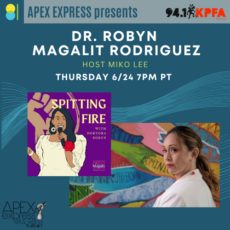
Host Miko Lee checks in with Dr. Robyn Rodriguez and we get to check out her podcast Spitting Fire: Doktora Robyn Speaks.
SHOW TRANSCRIPT
[00:00:00] Opening: Apex Express Asian Pacific expression. Community and cultural coverage, music and calendar, new visions and voices, coming to you with an Asian Pacific Islander point of view. It’s time to get on board the Apex Express.
[00:00:34] Miko Lee: Welcome to Apex Express. I’m your host, Miko Lee, and tonight I’m so excited to talk to my lovely colleague, Dr. Robyn Rodriguez. Robyn is such a powerful leader. She’s often called the people’s professor. She was a professor of Asian studies at UC Davis, and now runs the Reimagination Lab. She has created a farm that is a collective action space, and she is really thinking about new ways to reimagine our world. I’m so excited for you to learn more about Dr. Robyn and you’re gonna get to hear from her new podcast, which is called appropriately, Spitting Fire: Doktora Robyn Speaks. And I just love this, ’cause spitting fire is this term for women that can speak out and share their stories, and Robyn has so much to tell. So I’m gonna interview her, and then you’re gonna get to listen to her new podcast, Spitting Fire. Thanks so much for joining us on Apex Express.
[00:01:36] Welcome back Dr. Robyn Rodriguez to Apex Express.
[00:01:41] Dr Robyn Rodriguez : Oh, thank you so much for having me.
[00:01:44] Miko Lee: I’m so happy to have you with us once again. And I have asked you this before, but sometimes things change in the amount of years we’ve spoken to each other. So I’m gonna ask again, who are your people and what legacy do you carry with you?
[00:02:00] Dr Robyn Rodriguez : Yeah, who are my people? I think about folks of color broadly as my people. Whenever I refer to my people, I really do think about those of us who share intertwined and yet also distinct histories of colonization, empire, War, Violence. I think of all of us who’ve descend from peoples who’ve survived, fought back thrived, in spite of all that as my people and the legacy I hope to leave is lessons on continuing to not just dismantle the systems that caused harm on our ancestors and continue to cause harm for us now, but to offer also lessons on liberation and what it can look like and feel like so that we can continue to not just again, dismantle, but also build out the worlds we want.
[00:03:15] Miko Lee: Speaking of lessons, you have a brand new podcast series called Spitting Fire Doc. Robyn Speaks, and I wonder if you can talk to me about how this podcast came to be.
[00:03:27] Dr Robyn Rodriguez : You’re gonna laugh. Well, there are a couple of things I think that lead to the podcast. I’ve always wanted to do a podcast. I did college radio when I was an undergrad at UC Santa Barbara. I had a co-host for a show called WAR Women in the Act of Resistance, and we used to love to always say, we declare war on.
[00:03:53] Miko Lee: I love that.
[00:03:53] Dr Robyn Rodriguez : Whatever it is that we, yeah,
[00:03:58] Miko Lee: that’s so good.
[00:03:59] Dr Robyn Rodriguez : I, I, yeah. So I, I love doing college radio and have always, you know, people would joke or I don’t know if it was a joke, but compliment me on having a kind of good radio voice. I don’t know how true that is.
[00:04:16] Miko Lee: Very true, true.
[00:04:16] Dr Robyn Rodriguez : But I’ve always had a, an interest in, podcasting as a platform. I think in general I prefer the long form platform. I prefer storytelling and, uh, there’s something really powerful about podcasts is I think for me, really connected to radio programming. I don’t see them, I guess, in very different ways. So I’d always wanted to do podcasts even when I was still teaching at, uc Davis, in Asian American Studies. I always thought podcasts are a really, really powerful way to share the knowledges of ethnic studies beyond the classroom. So I’d actually clipped on a recorder while I was lecturing and had uploaded a bunch of a raw unedited audio to what used to be iTunes University. So in some ways that might have been like the first podcast in a way. And then the funny thing about, uh, Spitting Fire it was kind of launched a little sooner than I was ready to be honest. I basically messed up on what was supposed to be a Zoom video. I don’t know exactly what happened, but we only had audio and I thought, you know what? We’re slapping that together, editing it and putting it out there, because I thought that the conversation that we had over Zoom was so, just really powerful and informative, and I didn’t want to not have it circulate in the world. And so I’ve sort of tried to proceed in that way. I, I guess I see podcasting alongside YouTube videos and other long form and even just more written essays as the sets of long form digital media that I tend to prefer and also recognize as an educator that people learn in so many different ways. Some people are able to learn better, by listening closing their eyes and listening and are able to kind of absorb knowledge differently in that way. Others respond better to a kind of visual medium. Others like to read. And as an educator too, I feel like each of the mediums can be really effective in terms of conveying and transmitting knowledge. But again, I have a preference if I have to use digital media for the long form. I do worry that the sort of clipped, abbreviated, kind of versions of digital media that is social media, whether it’s TikTok or Instagram and other sorts, or just, I don’t know that they serve us in the way that, especially as an educator, that I
[00:07:08] Miko Lee: Thank you for sharing. I’m wondering how you ended up selecting this lovely title. You went from WAR in college to Spitting Fire. Tell me about where this title comes from.
[00:07:19] Dr Robyn Rodriguez : You know, I think it must have been a student, honestly, who had said, oh, look at Dr. Rob Spitting Fire after some talk. And I, I was sort of drawn to that. I think too, honestly, as an Asian American woman I think I was kind of playing a little bit with these stereotypes of Asian American women as kind of dragon ladies. And, but trying to kind of remake that in a way to kind of paint a picture of sort of fierce Asian American woman who is unafraid to speak truth to power. I think I’ve been feeling as and in my interactions with younger generations of women, I do feel as if younger Asian American women, and again, maybe it has to do with social media maybe the permanency of that. The circulation of media and how rapidly it spreads. Cancel culture. I feel that there is a kind of timidness that I’m encountering with younger Asian American women who are a little bit reluctant to speak up and speak out without really taking a moment to first compose themselves. Edit and then maybe post or share. And I guess I, I had hoped that image of spitting fire might conjure up a different way of being, as a kind of Asian American, woman, and activist, and organizer. And that’s even why I think I was really drawn to just not over editing any of the content. You know, if there were was content that I could pull from other conversations I was having, that might have been like originally a Zoom for instance, but might you know, be conveyed better to somebody who Is more of a listener than a a watcher or a viewer that could invite, people or women in particular feeling like it’s okay to not be perfect. It’s okay to be able to stand by a thought and recognize that are the things that we, we say in a particular moment have history and context and need to be understood in that way. So it plays with that image of, I think the dragon lady, Asian American woman, dragon leader lady. And also, you know, I always talk about my middle name. It’s such an important part of who I am and my identity, but my middle name, which I get from my mother. Was my mother’s maiden name means to be angry in Filipino, and I’ve always loved it because it was actually a made up name. It was a name that my great-great-grandfather claimed for himself. Changing his name from De Los Reyes, which means of the kings to Magalit to be angry because he was a revolutionary against the Spanish. And I’m so fiercely proud of this revolutionary lineage that I hold. And I think in a way, Spitting Fire also reflects that lineage of ancestors who’ve never been afraid to stand up, speak out and again, speak truth to power.
[00:10:54] Miko Lee: Ooh, that was such a lovely answer. I really appreciate reclaiming the dragon Lady is furious and powerful and a revolutionary figure. I think that’s so lovely because usually we just think of the dragon lady as this evil villain, but dragons in Asian culture are creatures that are to be revered and are powerful and lucky too.
[00:11:19] So, I so appreciate that. I really, I wonder,
[00:11:21] Dr Robyn Rodriguez : you know, that too.
[00:11:23] Miko Lee: I’m wondering, you, you said that you feel like young women are timid today and I was like deep sigh of that because I feel like still really now with, I don’t know, I just, that’s that. Um, do you find that in the students that you’re working with now, that they’re still Asian, young women are still being timid?
[00:11:46] Dr Robyn Rodriguez : I mean, honestly, I don’t think that this is a uni. You know, this is certainly not true for all of the young women I encounter. No, that would be unfair, but I also feel as if the boldness that might be out there I feel is often highly curated. A lot of it is expressed through social media. And again, if we understand social media, the reality of Instagram is it’s never so instant. There is a much time and effort put into filters, into kind of visualizations aimed to draw a more attention. Really careful framings, and accompanying captions. I mean, I, you know, even for posts, ’cause I think a lot of, I think political conversation and discourse is happening, I would say on Instagram, I’ve decided to opt out of TikTok. I know that’s also a place, but that’s all to say that I think that these become a kind of shield or crutch. And then I’ve found and often been surprised. When I meet people in person, such a disconnect between a persona and, how one actually moves in the world with other people. And, that’s where I’ve seen some surprising timidness and caution. And it does worry me a bit. I mean, I, and ’cause I think that there are maybe competing notions. I think some people in my generation feel this generation to be very brave. And I’m not, you know, I hate to say this, I’m not a hundred percent certain that’s true sometimes, at least in sometimes the young people that I’ve encountered. I think social media has. I guess I’m not convinced that social media is the modality or the mechanism by which change will happen. And we make change in our relationships with actual, kind of, with everyday people. With people. And in relation to the land and kind of the resources of the earth. And yeah, that’s where I feel like that kind of boldness and bravery needs, you know, makes more lasting impact than the kind of illusory, fleeting, and very superficial for me trade and visuals and words over social media. So, yeah, I do, I do worry about it. I, I feel like I’ve seen it too often, a hesitance to speak up.
[00:14:32] Miko Lee: This is so interesting. I just did an interview uh, with NAKASEC about the new study that they released on Asian American men and the Manosphere, and how more and more Asian American men are being persuaded by right wing media in the Manosphere. But I wonder about Asian American women as you bring this up. And I, I think back to that many years ago, that documentary film that. Slaying the dragon. Do you remember that from years past
[00:14:58] Dr Robyn Rodriguez : that? Oh my gosh, yeah. It’s a while.
[00:15:00] Miko Lee: Yeah. That was all on the, you know, the on representation of Asian American women and that, and that was maybe 20 years ago. So I wonder how much that’s changed
[00:15:10] Dr Robyn Rodriguez : maybe more. Yeah,
[00:15:11] Miko Lee: maybe more. Right? So, but I wonder how that’s changed with, because that was pre-social media and if Asian American men are being pulled in the manosphere, what are Asian American women being pulled into?
[00:15:24] Dr Robyn Rodriguez : Yeah, I do worry. I worry again, just, I mean, my goodness, you know, the proliferation of just the growth of the beauty industry.
[00:15:35] Miko Lee: Yeah.
[00:15:35] Dr Robyn Rodriguez : Um, the casualness, by what I mean, just in terms of cosmetic surgery becoming so even normalized
[00:15:45] Miko Lee: for young people very young people .
[00:15:48] Dr Robyn Rodriguez : Absolutely. Absolutely. And our kind of television series through streaming platforms you know, even movies. I mean, it’s, it’s clear that there are, you know, real investments in cosmetic surgery by many of the women that we hold up, across race. And yeah, this sort of, it’s just, it’s, I’ve been shocked by how, how, I mean, just the other day, I, I’m like a very loyal client. Well, when it comes to my hairstylist, I go, I travel two hours to Sacramento from our farm to get my hair cut every six months from one woman. I, I just, I could not believe just the conversations I was hearing women including Asian American women in the seats next to me around injections, fillers, I remember seeing flyers posted all around the salon. For a session being held by a, a cosmetic, I don’t even know the terms, but there’s now a proliferation of job titles even associated what is it? Medical aesthetician. But yeah, I, I do worry. Right. Trading in the visual. Maybe that’s why too, the podcast feels like a way where people can. Especially if I, you know, am in conversation with others or for myself even to just kind of show up without having to worry about you know, what I look like or what others look like. Or there’s, you know, people don’t have to worry about, the talking heads and kind of can pay attention more to the knowledges or the stories being shared. But I feel like that is a pull, I mean, if there was, if we’ve always, I think as as Asian American women, our bodies, right? Subject to just, these representations, right? The hypersexualization of Asian American women, which is really at the core of, I can recall of slaying the dragon. I think that has gotten worse. And we’re being more actively recruited into our own participation in this kind of hypersexualization on one hand, or being recruited into participating in these what are ultimately white aesthetics and remaking our bodies. To conform to notions of beauty and it’s all being cast as if it’s empowering and liberating somehow. And I, I’ve heard that and, and witnessed that, that somehow, no, these are not aesthetic choices that have to do with whiteness. I just wanna look pretty. Without any interrogation around what are the standards of beauty based on and even why, like, what is it about you know, desirability, youthfulness and all of that. That I think is definitely a co a concern I have and why I’ve pulled away from social media. I don’t know that I’ve looked on Instagram for I don’t know how many months. It’s been quite a bit of time, so much so that, Instagram is now sending me emails to remind me of all the messages and posts I’m missing. Facebook was doing that as well. But. I get troubled by the things that I am seeing. And I do worry for not just kind of younger generations of Asian American women, I think this is also a worry for all younger women of color.
[00:19:20] Miko Lee: It’s interesting they cast it almost as colorblindness in terms of the beauty standards, but it’s laced in white supremacy because the whole, the very basic of the standard of beauty is based in whiteness. That’s quite powerful and interesting.
[00:19:40] Dr Robyn Rodriguez : Yeah. And it’s also deeply rooted in kind of capitalist consumption, right? The notion that the only thing that is of value is a thing that is new and novel. Anything else has zero value. And we’re seeing that right where women are terrified. Terrified of getting older. I mean, I was in conversation with a few women, you know, in, in my circles, not even 30. Who are being policed by their peers about their frown lines, watching how they express themselves because they’re approaching 30 and another woman in her early thirties you know, just commenting too that, well, the procedures now are so good. They’ve gotten so good at it that you can’t even tell. But you know, just this, that it’s happening at such a young age and, and you know, women, we already have to deal with all of these demands on our bodies, right? Some that are external, some that we internalize around, reproduction if we’re straight or if we desire children, even if we’re not, you know, just these pressures around that. And I mean, I feel like what woman is, especially younger women, you know, really, really worried about whether they’ve met certain milestones at at every age. I mean, I hear it with young women. Oh my god, I’m 25 now. I’m a quarter century. This is huge, right? Oh, I’m 30, three decades in, where am I at? So there are all these other demands around achievement, professional achievement. Scholastic achievement, nevermind, you know, your body, whether it comports to the thing that is di desirable and is doing the thing it needs to do, that it’s athletic and that it’s light, that it’s, it can make babies. So it just it’s a lot. And I feel like if we were went through it as, as younger women the intensity is, even greater. and I noticed it myself. It’s probably part of the reason why I’ve, I had to pull away from social media, you know, I’m 53, you know, and feeling like I don’t see many representations of myself too in social media. That is, I don’t know that it’s a space for me either. And you can’t help when you’re in these spaces. Even the most, kind of radical critical of us you know, can fall prey to, the intrusive thoughts of patriarchy around our bodies and aging and our utility. So yeah, it’s worrying, it’s really worrying to me.
[00:22:05] Miko Lee: So I wanna flip the switch on that and ask you, as a 53-year-old, what do you feel most powerful about?
[00:22:13] Dr Robyn Rodriguez : I personally have experienced so much personal loss of people, beloved people. I’ve also witnessed too many people who have not had the opportunity and privilege to reach this age. I think what makes me powerful or what, what makes me feel powerful, or maybe less the term, I don’t know if powerful is the term, but just I feel deep gratitude that my body has, allowed me to live in this form, to this age to have the range of experiences that I’ve been able to experience in this body. Looking at the world through these eyes experiencing it, you know, with this skin. And I just, that is, I guess, a source of power because of the wisdom that it offers. The I think empathy, you know, and compassion that it makes possible. Because you’ve experienced and witnessed so much. I think that there’s a lot that I have also, let go of. I think there were so many kind of insecurities that I think I struggled with as a younger woman that I no longer experience and that feels very empowering. To come to a place. And, and it really comes with life experience, I think. And that you are able to get perspective on things that might’ve, felt as personal failures in the past, but then you can look at differently as just lessons. Along this journey, in life. And I think I’ve just also been blessed with elder women in my life who you know, just are so, unapologetic about who they are, what they think, and how they move in the world. And so I have really great models. That make me excited about the prospects of continuing to, to get older and and being able to kind of experience and learn new things along the way. There’s a power there.
[00:24:26] Miko Lee: Thank you for sharing. Yeah. As somebody who’s 60 this year, I feel like it’s lessons that I’ve learned, but also I don’t care. I don’t care as much I don’t obsess over the little things. I just, and I say what I feel because why not? We’re at a phase in life where, you know, I’ve done a lot of things. I’ve experienced hardship, and I’m just gonna say how I feel where I’m at what’s going on right now? So there’s a freedom to that, that I think is very different from being young. What would you like your podcast audiences to understand?
[00:25:01] Dr Robyn Rodriguez : Yeah. You know, I think my podcast audiences need to understand that I am really approaching the podcast from a place of embracing my role as a elder or a young elder. I think it’s a role that, I was struggling a bit with and again, I’m not immune to as much as I feel empowered by being older, I also am not immune to all of the, the messages around youthfulness and value that I think we’re constantly being barraged. But I do recognize that there is a really special role to be played by women in middle age, which I am. And I think that’s what I want audiences to understand, that I am coming into this podcast, doing this podcast from a very specific vantage point. A vantage point that offers insights that on, you know, and of course I’m coming in as me, right? Somebody who still considers herself a scholar, if not necessarily one based at a university. Somebody who’s been a really sort of radical thing and shift by becoming a farmer and doing land based work. That, yeah that they’re going to be hearing, a perspective, you know, from somebody who has been an organizer, continues to do that work, but is also experimenting and risk taking in different ways. They get the chances to hear from a yelder who’s lived a little. Who has a very unique perspective, not just from a particular vantage point in terms of age, but also somebody who’s you know, done the work, studied the thing when it comes to kind of the Asian American experience done the thing it, and when it comes to Asian American, organizing. It’s continued to grow by stepping away from previous ways of being, uh, by doing this work on our farm. You know, I feel like it’s a unique set of perspectives that I’m hoping can offer inspiration or lessons for the moment. But yeah.
[00:27:33] Miko Lee: So last time we talked was a few years ago and you were just getting your farm set up and now you actually have this whole farm. Can you share a little bit more about your connection to the land and what it’s like being a farmer now?
[00:27:48] Dr Robyn Rodriguez : Yeah, no, thank you. You’re right. I recall, I think we had literally just moved in when I was in conversation with you, and now we’re at the start of season four. It has been an amazing journey. I’m actually right now and I hope to be able to talk about it on the podcast. I’ve come, I’m in the process of finishing, a book, reflecting on my experiences over the last four years in this transition from university professor to farmer. there’s so much that I’ve learned. One of the major things I’ve, learned especially as an organizer, to differently appreciate all of the metaphors we use in organizing. cause we use them a lot, right? How do we describe certain kinds of organizing? We, we describe it as grassroots. How do we talk about the ways we might be building our, you know, struggles of resistance? We think about ourselves as sowing seeds. More and more people talk about, you know, mycchorizal networks. There are all of these metaphors that proliferate when we’re thinking about, struggles for justice. And there is something that shifts when you do land-based work and really understand and learn at the knee of mother nature around all the things that are required for cultivating life, which for me, I think is what activism and, organizing really is about. You know, we live in a system that ultimately thrives on death. I mean, war, empire, capitalism, disposability, you know, all of that is, is a system that thrives actually on, on death. And I think that when we’re organizing as folks who are activists, social justice activists, ecological and environmental justice activists and organizers, what we’re doing is we’re in the business, so to speak, of cultivating life. But how best to learn about how to cultivate life, if not at the knee of of Mother Nature. And so I’ve learned a lot about that. Learned about you know, how long it can take. In fact for, plant sowing a seed a seed can only germinate, you know, and there’s the right kinds of conditions and even the right kind of conditions can’t be fully predicted. You tend to that ground, that soil anyhow, you know, seeds being so small and nearly invisible to the eye and yet, we know them to be there and we, we support their growth. Seeds when under the right conditions germinate and grow can become these healthy, mature plants. One singular plant can feed so many, I mean, all of those lessons when you understand them in deeply embodied ways, I think allow you to approach organizing and activism differently. I think especially now, there seems to be an urgency to everything. Everything feels urgent. Um. Something needs to be responded to, you know, immediately it feels like all the time. and that not responding somehow is being complacent or enabling. But I think what I’ve learned as a farmer is that transformation in life takes time and we need to tend to that. And I mean, I feel like I think organizers would benefit a lot from, doing land-based work. Not only because the earth needs us to do this work of regeneration and restoration, but I think we would have better perspective around, what liberation would look like and require, from these systems of domination and power if we, you know, humbled ourselves a bit and learned from. Mother Nature, and the ways that, you know, she’s endured through it all and, you know, adapted through it all. I think, I think there are important lessons there, but lessons that I think that really require a work of embodied learning and knowledge.
[00:31:56] Miko Lee: So you speak of your farm as this, as a place that’s cultivating growth, and can you talk a little bit more about that, cultivating the mind? Because I know you’re also doing work on your farm with organizers, with nonprofits, with students. So can you talk a little bit more about the cultivation of people on your farm?
[00:32:15] Dr Robyn Rodriguez : Yeah, absolutely. Yeah. I mean, so much of what we do isn’t just about the food that we grow, which we do, and I shouldn’t name that, you know, a lot of. our aim with food growing is not just to feed, you know, sort of a community of people who’ve opted in to get food from us, which, you know, we do have a CSA, a Community sourced agricultural program, but we’re also working with native communities here to support in addressing their food needs. So that’s. Important, piece of what we do that I wanna name in terms of food and plant production. But yes, in terms of cultivating people, I think a lot of what we do here is about facilitating this reconnection to land. I grew up a very urban, suburban existence. I think it always as an organizer and activist, valued ecological and, environmental justice. But I don’t know that I centered it in the way that I do now, in part because I didn’t. Have a relationship with the land in the way that we do now. I really think that our work is to help cultivate that relationship. I think we need that relationship to fully appreciate what’s at stake when we talk about climate change. It’s one thing to kind of know the facts. It’s another thing to be in relation to the land, and I think it takes a certain set of conditions to be able to, to be in relation to the land. So yeah, we, we hold space for lots of organizations, educational institutions, nonprofits, community-based organizations, other folks, who also are feeling that there is a need to be in relation to the land. Not only to be in a relationship, but to be in a right relationship with the land. So we, we hold space for a lot of that. And of course that process is also deeply healing. There is something really healing about learning from the land. just understanding there’s something really magical like, for example, when you come out of winter and you start to see new growth, I think that cycle of growth offers a kind of hope and reassurance when we’re feeling especially despairing, which I think a lot of people feel tremendous despair now. And yet, you know, being bearing witness to that is it can be super just powerful and can kind of keep and sustain the fight.
[00:34:37] Miko Lee: And lastly, can you share more about your school for Liberating education?
[00:34:42] Dr Robyn Rodriguez : Sure. So the School for Liberating Education is an online platform through which I share all of the ethnic studies knowledge that I was teaching at the university. Most recently at the University of California Davis, you know, always believed ethnic studies was never intended to be just another academic field like anthropology, sociology, political science. But that, it is a form of knowledge that is meant to raise our consciousness to inspire and to provide us real skillsets and pathways to taking that knowledge and doing the work of changing our world for the better. And so, you know, the School for Liberating Education I set up so that people can have access to that knowledge without having to go through. All of the, the, hoops that are required for, you know, getting into a four year university, even all of the kind of bureaucracy it takes to get even to a community college, which is not as easy as one would think. But also a very unapologetic, form of ethnic studies. I think part of what’s happening at colleges and universities now is, these are battlegrounds. The, right wing has taken it upon itself to really attack ethnic studies in various institutions. They’ve been very successful in gaining, Support. University administrations have also been very easily bent not only kind of grassroots right wing movements because they’re really organized at the grasses, but certainly the series of executive orders that Trump passed, you know, within days after inauguration. Effectively illegalizing ethnic studies and of course we know what he’s trying to do in terms of, the Department of Education and, its, effective dismantlement. But this is meant as a place to offer the knowledge that our forebearers and fought really hard for the university, but can’t really fully thrive there either. And so, I wanted to make sure that there was a place where this knowledge can be accessed, to anybody with the interest and desire.
[00:36:55] Miko Lee: Thank you so much for chatting with us today. I’m wondering if there’s anything you would like podcast listeners to prepare themselves for before they bust out Spotify and listen to Spitting Fire.
[00:37:10] Dr Robyn Rodriguez : Well, it’s just, you know, to, you’re gonna get a lot of raw, unedited audio. And so, um, you’re gonna kind of get just, you know, as the, the host of the, show me in a very unedited, very unfiltered form, which can be, I hope enjoyable for folks. But, you know, I think people will, will learn a lot, and a lot of the topics are rooted in the things that I care about. Certainly social justice issues certainly even, you know, the work we’re doing at the farm. So, you know, I, I mean, it’s broadly, uh, the podcast is around social and ecological justice. But very much from the lens of somebody who, again, is a yelder, somebody who’s taught ethnic studies, continues to teach, although not at the university. Um, somebody who does the work of kind of social and ecological justice organizing and is doing land-based work. So, you’re getting all of the, the things that connect to all of the ways that I, I’m moving in the world right now.
[00:38:15] Miko Lee: Thank you so much Dr. Robyn for joining us today on Apex Express.
[00:38:20] Dr Robyn Rodriguez : Thank you so much again for having me.
[00:38:38] Welcome everybody, to Resistance, Defiant Love, and Radical Care. Today we are launching, uh, the pre-registration for my new activism course, my course on Asian American activism, and it will be drawing on my book, co-edited with Diane Fujino, uh, Professor Diane Fujino, entitled Contemporary Asian American Activism: Building Movements for Liberation.
[00:39:09] I’m really, really excited that the book is coming out, but probably even more excited that I’ll be able to launch a mini course that draws from that book, as well as other work on Asian American activism, and that I’ll be able to offer a mini course that really looks at Asian American activism in the coming months.
[00:39:30] And I’m very, very, very, very pleased to be joined by Artnelson Concordia. Artnelson and I actually hopped on earlier and we went back to, to just recollect when we met and how long ago, and I’ll talk about that in a moment. But, um, oh, I guess I might as well just say, Art and I have known each other for exa- almost exactly half of our lives.
[00:39:54] Um- So we first met when we were only 12. Just kidding. We met when we were 25 years old. We, uh, so that was half of our lives. You do the math. Um, and, uh, it, it’s just so wonderful, uh, to, to be able to reconnect, uh, with Artnelson in this way. But we go back, and as we’ll talk about later on, we go back, um, 25 years ago, uh, where we, when we first met, uh, through, uh, our work, uh, in, in activist spaces.
[00:40:27] But Artnelson Concordia was born and raised in the Echo Park neighborhood of Los Angeles. The son of working class Filipino immigrants, he earned BAs in political science and history at the University of California in Los Angeles, so UCLA. Artnelson is a longtime educator who got his start in San Francisco and was a founding teacher of the San Francisco Unified School District’s Ethnic Studies program that was the focus of a 2014 Stanford University study that highlighted the academic benefits of the district’s ninth grade ethnic studies course.
[00:41:02] That’s Artnelson. Currently, he coordinates Santa Barbara Unified School District’s ethnic studies program. Artnelson is the father of four Brown boys, four beautiful Brown boys, and is in cahoots with his wife to raise them to have deep knowledge and love of self and community, as well as to be active disruptors of the white supremacist, patriarchal, heteronormative, imperialist hegemony.
[00:41:29] Yeah. He and his family have the great privilege to live in the beautiful town of Oxnard, California, which is unceded Chumash territory. And this fall marks the beginning of his 23rd year in education. And as I was saying before, Art and I go way, way back. We met right after we had both graduated from college.
[00:41:52] And yeah, as… Art and I are here to talk story a little bit about our shared activist path, because really, uh, it ma- it seems it’s so appropriate to talk about our shared path as activists and educators because this pivot for me to offering, uh, courses through the School for Liberating Education has everything to do with my activism and everything to do with my deep, deep belief that education, uh, and a critical education, uh, can be so vital for, uh, movement building, for building the world that we want.
[00:42:29] So I’m gonna just hand it over to you, Art. And we can just start. But it’s so great to see you and have this chance to chat.
[00:42:37] Artnelson Concordia: Right on. What a, what an introduction, uh, hearing that coming from you. Um, and- Reflecting on the time and how quickly that really does fly. And I think it’s actually more than 25.
[00:42:50] We’ve known each other more than 25 years. Um, and I think, yeah, that’s more than half of our lives. But I think the moment that we, we met each other, we were already on our journey to, to really committing ourselves to figuring out, you know, what the hell is going on with this world. I mean, beginning with our own lived experiences and what’s, what was happening with our communities.
[00:43:18] Um, but yeah, education has always been central, and I think my, my path to really focusing in on that was in, in organizing spaces before I became a teacher. It was so key in bringing people to to support and be a part of whatever issue. Like, it was, well, how do we move people? Well, w- we tell them the truth.
[00:43:47] We, we tell them the… an all-rounded kind of breakdown of how it will impact them and why they should get involved. And the, the, the think, um, really that is, was my introduction to organizing. Um, I think in community college, uh, I got to meet, um, a long time Filipino American, uh, organizer-activist, Royal Morales, was really my first introduction to Filipino American history and identity.
[00:44:23] And from there, it just really took off. Like, so much of the suffering, struggling, and questions I had about my own life was answered. I mean, of course over time, but it kept, it kept, it kept, uh, bringing me along, bringing me along, and I was hooked. I was hooked after that. Um, yeah, the power of education to really transform lives is, has been a theme throughout.
[00:44:53] Uh, and I’m sure for you as well. I, I- Yeah … the, the spaces that we, we shared were always about, like, getting to root problems and how everything is related inside.
[00:45:06] Dr Robyn Rodriguez : Yeah. No, absolutely. It’s funny, I was just thinking, I don’t… You know, I think we might have first encountered each other indirectly around the, the fight against Proposition 209.
[00:45:19] Oh. Uh, you know, right? And maybe even before that, around Proposition 187. 187. Y- yeah. And so for people who don’t know, and actually I end up writing… I ended up writing a chapter on, uh, student organizing, specifically around 187 and 209, in this book. So, you know, the book itself, um, so, you know, Professor Fujino, who happened to, happened to be my professor as an undergrad, so she’s now my collaborator.
[00:45:47] But, um, Diane, uh, and I kind of pulled a, a whole range of organizers together to contribute to this anthology, but I also ended up contributing a separate chapter to it, and it was a reflection on the ’90s, and specifically our campus organizing across the UC system- Mm-hmm … around first 187 and 209. And for people who aren’t familiar with it, you know, 187 was this, uh, this terrible, um, voter initiative that ended up being passed by the state of California that would essentially criminalize, um, undocumented Californians.
[00:46:24] And not just that, it was really going to, uh, m- make- teachers and, uh, and social workers and anybody who worked for the state of California stand in as border agents.
[00:46:37] Artnelson Concordia: Right. ‘
[00:46:38] Dr Robyn Rodriguez : Cause basically it would be their, their responsibility as employees of the state of California to report on anybody seeking out service or that they’re encountering in the space of their jobs, to report them if they were, if, if they suspected that these individuals, if they suspected these individuals- Yeah, yeah
[00:46:58] were, um, undocumented. And so, you know, uh, Art and I and so many other UC students, uh, were, you know, going, um, were organizing in, in, in partnership with community organizations to, of course, try to stop Californians from, from, from voting for 187. W- they did, and of course that ended up not becoming law because it got, you know, challenged in, in the courts.
[00:47:24] Right. But nevertheless, we were part of the resistance movement. And then, uh, after 187 was Proposition 209, which essentially eliminated affirmative action programs, um, in, in, uh, the University of California system. And, you know, I know, you know, that was also something that was also meaningful for, for us.
[00:47:45] Artnelson Concordia: Yeah.
[00:47:45] Dr Robyn Rodriguez : You know, uh, as, as, as young people who were also very much recipients of affirmative action programs. Yeah. Um, some of our ethnic studies knowledge was not even necessarily coming through ethnic studies courses, but oftentimes through the counselors and, and other staff who worked in these affirmative action programs.
[00:48:06] And so, you know, that was, that was going to happen. Right. And it did, right? Had such a deep impact on us. Yeah. And we knew that, um, by making affirmative action, um, by eliminating affirmative action, it was going to have a major impact. Which it did, right? Mm-hmm. The Filipino, at least for Filipino Americans, our numbers at the UC system plum- plummeted after that.
[00:48:25] Plummeted. But I think that’s when we first met, and then, but it was really afterwards where, where we really connected more, right? When- Hmm … um, I think you and I both, because we, we, uh, found ourselves, uh, with the, the, the, the opportunity to connect with, uh, people who were really active in the anti-martial ma- law, the anti-martial law movement, right?
[00:48:48] Um, for both of us. Yeah,
[00:48:49] Artnelson Concordia: in the Philippines. Yeah.
[00:48:50] Dr Robyn Rodriguez : Yeah. They were people who, uh, were already active in, um, the movement against the dictatorship- had come to the United States fleeing the tyranny of the Marcos dictatorship. Mm-hmm. And then were really responsible in, uh, growing the, uh, anti-martial law movement in the US, and I think, you know, at the time we met, of course martial law had ended, but, but the conditions in the Philippines hadn’t changed. Still haven’t changed.
[00:49:17] Artnelson Concordia: Yeah.
[00:49:17] Dr Robyn Rodriguez : And so our elders saw us, we saw them, right? I think. I mean, I can’t even remember how I
[00:49:24] Artnelson Concordia: first met some of them. Looking for each other, I really feel.
[00:49:25] Dr Robyn Rodriguez : I think, you know, we, we end up gravitating to the same- Yeah … spaces, right? And we knew that that was something, you know, we wanted to be part of. T- maybe tell me about your story. How did you kind of find your way into that work and, and how did it resonate with you? But I know that that was really where we built together was- yeah … in the work around the Filipino, um, you know, liberation struggle.
[00:49:47] Artnelson Concordia: Yeah. Our, our paths definitely, um, crossed then, and my, my journey to that point really was through the Black liberation movement- Yeah where I, in undergrad, um, was exposed to the history of the Panthers, and I… And it was immediate, like in terms of the truth they were telling and how they resonated with me. I just swallowed text after text after text. Mm-hmm. Yeah. Um, To Die for the People, uh, uh, Huey’s Revolutionary Suicide, Elaine Brown’s, uh, Taste of Power- Mm-hmm
[00:50:25] Bobby Se- Seize the Time. I, I, I was so, um, I don’t know, kind of- Absolutely, like, fascinated and inspired and wanting to find, well, what’s the equivalent for, for Filipinos? Yes. And that was, that of course leads me from, um, Uncle Roy or Royal Morales, who’s really talking about Filipino-American activism in History.
[00:50:55] Mm-hmm. And I got a lot of the really incredible, um, participation and organizing with the farm workers, but it kind of just would stop, and I, and I was curious about, well, what is existing now? And it was my meeting, um, it was a, a brother mentor, Ed- Edwin Ha- Habaquan. Edwin. And he, uh- I went with Edwin at the same time.
[00:51:25] Yeah. He was the, the founder of this Filipino apparel company, right? Tribal Pinoy. Oh my gosh. And I, um, I worked for the Filipino American newspaper for Samahang Pilipino at UCLA, Tan- Tanawin, and I only wrote one, maybe, maybe two articles. But the one article I, I, I very much remember, and I, I, I need to go find that article now, was an interview with Edwin, um, about Filipino-American activism. And he was like, “Look, it didn’t just end with the farm workers. It continues today through this national liberation movement in the Philippines.”
[00:52:15] Ayame Keane-Lee: You just listened to a clip from Spitting Fire: Doktora Robyn Speaks from tonight’s guest, Dr. Robyn Rodriguez. This episode is called Resistance, Defiant Love, and Radical Care: Asian American Activism Course Launch with Artnelson Concordia. You can check it out in our show notes. Thank you so much for listening
[00:52:36] Miko Lee: Please check out our website, kpfa.org/program/apexexpress to find out more about our show and our guests tonight. We thank all of you listeners out there. Keep resisting, keep organizing, keep creating, and sharing your visions with the world because your voices are important. Apex Express is produced by Ayame Keane-Lee, Anuj Vaidya, Cheryl Truong, Isabel Li, Jalena Keane-Lee, Miko Lee, Miata Tan, Preti Mangala-Shekar and Swati Rayasam. Tonight’s show was produced by me Miko Lee, and edited by Ayame Keane-Lee. Have a great night