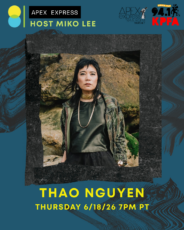
 A weekly magazine-style radio show featuring the voices and stories of Asians and Pacific Islanders from all corners of our community. The show is produced by a collective of media makers, deejays, and activists. Tonight on Apex Express, Host Miko Lee talk story with singer-songwriter Thao Nguyen. Hear about her new album Fossil, her short documentary, and about her artistic inspirations. Thao’s tour starts this week in North Carolina, so listen in to hear from the brilliant Thao, and then check out her website to catch a live show.
SHOW TRANSCRIPT
[00:00:00] Opening: Apex Express Asian Pacific expression. Community and cultural coverage, music and calendar, new visions and voices, coming to you with an Asian Pacific Islander point of view. It’s time to get on board the Apex Express.
[00:00:35] Miko Lee: Tonight on Apex Express, we talk story with singer-songwriter Thao Nguyen. Join me, your host, Miko Lee, as I talk with this multi-hyphenated artist. We get to hear about her new album, chat about her short documentary, and hear about her artistic inspirations. Thao’s tour starts this week in North Carolina, so listen in to hear from the brilliant Thao, and then check out her website to catch a live show.
[00:01:05] Ayame Keane-Lee: In today’s show, you’ll be listening to some songs from Thao & The Get Down Stay Down’s 2020 album, Temple. First off, let’s listen to “Pure Cinema.”
MUSIC
[00:05:44] That was “Pure Cinema” by today’s guest, Thao Nguyen. Let’s get to the interview.
[00:05:50] Miko Lee: Welcome Thao Nguyen to Apex Express.
[00:05:54] Thao Nguyen: Thank you. I’m so happy to be here.
[00:05:57] Miko Lee: I love talking with creative people and you’re such an amazingly talented singer and songwriter and imagination creator. I’m wanna start with the first question I ask all of my guests, which is, who are your people and what legacy do you carry with you?
[00:06:16] Thao Nguyen: Who are my people? Some of them include the family I was born into. I’m from Virginia. I was born and raised in Virginia. but I’m the daughter of Vietnamese refugees of war. And, I moved out to the Bay in 2006 after my first US tour. And, I’m so fortunate to have such a robust community here in the bay and all of my chosen family here.
[00:06:40] Miko Lee: And what legacy do you carry with you?
[00:06:43] Thao Nguyen: What legacy? I think the legacy I prioritize. I think, you know, [laughs] we inherit a lot and as time goes on and we get older, we realize everything is finite and you have to choose which legacies you choose to continue, and perpetuate and honor and what you have to leave by the wayside. And so the things I choose to continue and celebrate are that of a real ability to be very present and in the moment and available to joy and I think the people I come from are really good at metabolizing joy because they know the flip side of it so well.
[00:07:23] Miko Lee: Ooh, that’s so interesting. Can you speak more about what it means to metabolize joy?
[00:07:30] Thao Nguyen: [Laughs] uh, an ongoing practice? I think it is to be truly present and I believe, of course gratitude goes a long way, but I to fully metabolize it is to allow yourself to feel embodied in it. And, you know, there’s more somatic practice I think that to actually feel it course through your body, you are allowing it, you’re honoring it as completely as possible. And, do you have to acknowledge that it’s happening as it’s happening? You know, I think that’s having true presence with it.
[00:08:08] Miko Lee: Can you roll back with me in time and talk about your earliest childhood memories of being a singer or songwriting? What came first?
[00:08:18] Thao Nguyen: I loved music from a very early age, but I didn’t have a lot of access to it, to making it, it was more as a listener. The soundscape that I grew up with, there was a series called Paris by Night, which probably you’ve heard of within Vietnamese diaspora, uh, community and Culture. And it was this variety show that was, created by, people who had to flee Vietnam. And originally it was in Paris and it showcased A lot of singers and performers, who had fled, either before, during, or right after the fall of Saigon. And, it was this one gathering wherein. entertainers from the different generations, from my grandmother’s generation, from my parents were able to coalesce and exist together. And there was just this sampler platter of a lot of different sonic influences. And then you had the younger generation, which was reinterpreting what American pop music was at the time. So you’d have my grandmother who [sang] cải lương which was this incredibly, it’s like, almost like folk operatic, very dramatic, theatrical singing with a lot of pitch bending and, which I didn’t understand that I was absorbing it in such a way that I would recreate it later on in my playing, but I would go on to credit it to being from Virginia and saying it was more of like an Appalachian influence, which it was as well. But the origins, the true origins were within my soundscape before I understood what that was. You know, so you have that and then you have, an artist named Lynette who’s. basically in reinterpreting, like the latest Madonna song and has a cone bra on, so everyone’s existing act after act in the same, um, sorry for that ramble. Did I answer that question?
[00:10:13] Miko Lee: Yeah. Uh, I, so what was, do you remember the age or you just grew up hearing all these different kinds of sounds?
[00:10:20] Thao Nguyen: I mean, that was from before I knew what age I was, you know, that was just like, and that was such, um. For the community and within my family it was such an event every time one of these, you know, double VHS things were issued that people would be making copies, someone would drop it off at the house. You know, there, there was always one or two in circulation, but it was this. Event that you’d,
[00:10:43] Miko Lee: are these like bootleg copies?
[00:10:45] Thao Nguyen: Yeah, there’s like, wow, there’s bootleg. There’s also, there was one book in music store in Eden Shopping Center, which was like the hub of, of the Vietnamese community in, in, uh, Northern Virginia. And so someone would buy the original and then go and bootleg it. You don’t know how you ended up with what, but just like they would drop off some citrus and and Hennessy or whatever, and then the Paris By Night thing. And um,
[00:11:11] Miko Lee: I love that the combo citrus, Hennessy and some music.
[00:11:16] Thao Nguyen: Everything is a digestif, you know? And, um, so I would have that. But then of course, I, you know, I, I listened to the radio. That was what, that was my main resource and I listened to the oldie station the most, and I loved Motown. And I remember, in this I was like five or six, we had these large speakers that’s sat on the floor either side of, of this cassette deck, radio unit. And I would lay down and, every time Smokey Robinson came on, “You really got a hold of me” that was like my favorite song and I would tape it and then so either I would listen to it live or I would play the cassette and I would just lay down and get as close to the speakers as I could. But at that point, I hadn’t seen who Smokey Robinson was, and I imagined, because I also am a child of eighties and nineties. I imagined it was Crystal who was Roseanne’s best friend from the Roseanne show. You know, I didn’t know anything, but I felt all of it.
[00:12:20] Miko Lee: Wow. Yeah. I love that. So, I love that. And I was really wondering, I heard this story about you, that you actually did a rap for on Charlotte’s Web when you were in elementary school.
[00:12:33] Thao Nguyen: Okay. Okay. This is a deep cut. You’ve done some research.
[00:12:39] Miko Lee: Tell me about how that came to be. So you must have been introduced to rap pretty young to be doing that.
[00:12:44] Thao Nguyen: Oh, absolutely. This, so this was another, and this, I’m so glad you brought that up, because all of this is, every genre, every kind of music I, at this point is so vital to me, and it actually goes on to reflect the kind of music I make. And so I have an older brother who’s almost eight years older, and around this same time, he’s a huge hip hop fan, or that’s one of the things he loves, he loves like Duran Duran and like the Fat Boys, you know? And , when I saved money, the first cassette I ever bought was Salt-n-Pepa. And I, yeah, so I was listento the Fat Boys and Queen Latifah. And I loved, I loved every, I loved to hear the flow, the different cadences and in third grade I was voted best rapper. This, and, you know, not coincidentally. This is the year I, I do the book report, the Charlotte’s Web, you know, and they gave me the option. You can either write it or you can write a song or whatever. And so I wrote a rap about Charlotte’s Web, but I was too shy. I had recorded it and just played it in my presentation. I didn’t perform it live.
[00:13:51] Miko Lee: And how was it received?
[00:13:54] Thao Nguyen: I mean, I can still hear the roar. yeah, everyone, [laughs] I think the teachers
[00:14:01] Miko Lee: The crowd roared. The third graders roared.
[00:14:03] Thao Nguyen: Yeah. I mean, everyone’s standing on their desks. It’s rickety, you know, teachers are worried about child safety, it doesn’t matter. They’re like, Encore. I’m like, I don’t have anything else. Uh, you know, uh,
[00:14:15] Miko Lee: Wait for real?
[00:14:17] Thao Nguyen: No, no. [laughs] the teachers thought it was cute. Probably the kids thought it was funny. I actually don’t know because I was so nervous I even pressing play. I was so nervous. I don’t know if I registered what, how it was received.
[00:14:34] Miko Lee: That’s so sweet. Given your eclectic music knowledge and the music that was around you at the time as a musician, now you’ve been described with so many different categories, country tinge, indie folk, pop, blues. How would you describe your music?
[00:14:54] Thao Nguyen: I would describe it as. What’s embarrassing is I’ve been doing this a long time now and I’ve never figured out a way to describe it. I would, I, I generally just say it’s, you know, it’s under the umbrella of indie rock, but influenced by jazz and hip hop. And because I learned to play guitar by picking out country blues songs. And because I grew up in Virginia, there, there are these, like old time, Country blues picking patterns that I’ve used. I, you know, it’s, yeah. So that, I’ve never figured out a way to say it succinctly and I continue
[00:15:29] Miko Lee: and you don’t need to. That’s okay.
[00:15:31] Thao Nguyen: Thank you.
[00:15:31] Miko Lee: Is there a big Vietnamese population in Virginia?
[00:15:35] Thao Nguyen: Yeah, I, I think there is a very healthy population there. And it was one of the first places that people were settling when they were being resettled. And my parents met, in a refugee camp in Guam. And then they were sent to Arkansas. And then from there sponsored out to North Carolina. And then from there of a few friends that they had made, had found work with Metro, which is the public transportation train system in DC and found my dad work there. So that’s why people resettle, that’s why we ended up in Virginia.
[00:16:16] Miko Lee: So Thao & The Get Down Stay Down you released five studio albums and now you’re working primarily as a solo artist. Right?
[00:16:25] Thao Nguyen: Yes. Yeah. I will say I still work record and perform with a band. And a lot of the people who worked and performed with me in that iteration are still with me. it was more I wanted to, just use my name and move beyond what the get down stay down was, which I was never really sure. With things that you choose when you’re 22. As time goes, you know, it starts to, and you’re lucky if you can kind of shed things and not, not stay beholden too much.
[00:16:57] Miko Lee: Ah, what have you learned to shed?
[00:17:02] Thao Nguyen: Oh my gosh. Thankfully a great deal and it’s an ongoing exercise, but. I used to be so much heavier with the weight of what I thought a serious artist was what I thought a serious songwriter should be, who I thought, where I thought my, you know, different benchmarks of what success were. What I should be making versus what people wanted to hear versus what I wanted to hear. I actually never I wasn’t always all the way sure about what I wanted. You know, I, I think a lot of people encounter that, but I’ve thankfully been able to shed as much as I can. It’s an ongoing practice, but I, you know, one thing it. Is that I used to think, I can’t believe I’ve been doing this this long. And it’s, not necessarily, I didn’t understand what I was working towards, but only that I had not gotten there yet. And then, you know, I think pandemic and on, I’ve been just so and as I get older, the transition into being so sincerely grateful that I’m still here and I get to do this. this is what my job is, and however I can, and whatever I can do to sustain, being able to, to do this for my livelihood and maintain my integrity within it is the greatest gift. So as when I made that switch a a lot of things, a lot of the darkness left me.
[00:18:39] Miko Lee: Oh, that’s beautiful. Thank you for sharing.
[00:18:42] Ayame Keane-Lee: Next, let’s listen to Temple, the first track off of Thao’s album of the same name.
MUSIC
[00:22:56] That was Temple by Thao and the Get Down Stay Down. Back to her interview with Miko.
[00:23:01] Miko Lee: I’m wondering if you could talk a little bit about the 2017 documentary Nobody Dies, a film about a musician, her mom in Vietnam. How did that, and that’s a documentary that follows you and your mom as you go to Vietnam. I’m wondering how that project came about.
[00:23:17] Thao Nguyen: Yes, I’m happy to tell you about it. in 2015 I was invited by concert promoters in conjunction with the US Embassy based in Hanoi, to come perform for the, I guess at that point it was the 25th anniversary of the normalization of relations between the US and Vietnam, and I was able to bring my band and I was able to bring my mom, and she hadn’t been back in 43 years, and she used to work for the South Vietnamese embassy and was stationed in Lao, when Saigon fell. So she actually left Vietnam in 73, assuming she would go back after her time abroad and then was never able to return. So I was able to bring her, the struggle was would she actually come, you know, and we had, I had, a bear of the time initially convincing her it would be okay. And, it was like, just begging her to come. She’s like freaking out. She hangs up on me. I call back. She hangs up. You know, it was a back and forth that I’m trying to convince her of things that I’m not sure of where she’s like, I’m still on a list. I’m like, no, you’re not. But I don’t know that, you know who, how would I know that? But I told her she wasn’t on the list. Anyway, my, a friend of mine who’s a filmmaker, as this all was happening, he asked if he could come along and document all of it. And he and, his DP traveled with us and it was an incredibly intense trip, and it was beautiful and I am so glad it was documented. And then somewhere along the way I had a performance and, this was all in editing. And then I ran into Don Young at CAAM Center for Asian American Media. Oh, I know what it was. It was something for Sundance and Don Young and I were just in the same shuttle going to the airport and we were talking and I told him a little bit about this and then I sent him some footage and you know, and then CAAM and PBS were gracious enough to co-produce and, Make it so it could be, you know, a a half hour documentary that aired on PBS. Um,
[00:25:21] Miko Lee: so that that was on a bus ride.
[00:25:23] Thao Nguyen: That was on an airport shuttle.
[00:25:25] Miko Lee: Airport shuttle. I love it.
[00:25:26] Thao Nguyen: Yeah [laughs].
[00:25:28] Miko Lee: So was it hard to convince your mom, I know it was hard to convince her to go to Vietnam. Was it hard to convince her also then to be on film? What was her response to that?
[00:25:37] Thao Nguyen: Well, luckily for all of us, my mom loves to be on film and is, um, a total flirt and ham and. Oh,
[00:25:48] Miko Lee: so that was a bonus. That was like a,
[00:25:49] Thao Nguyen: that was a bonus. The camera loves her. As did the film director, my friend Todd, she loved it. And she just, she comes alive and she’s a true performer. And, it was really beautiful to see her in this element that I, I didn’t know if I’d ever, I actually. Never thought I’d get to see her this way. You know, I grew up, both my brother and I grew up translating for her, it is sort of at every, at every level. And, we’d go out to restaurants and it’s not that she, you know, it’s like she would get shy and then it would just easier, it always just became easier if we just did it for her. But, so we’d order for restaurants and, and to see her. not to say that she doesn’t I mean, she was a small business owner. She owned a laundromat, dry cleaners in Virginia and totally is the reason why everybody is alive, you know? But, to see her move so seamlessly and easily, I’m sorry, it’s emotional in the world was this, such a gift I didn’t know I’d get. And, You see her haggling with people, you know, and, and she’s directing as she’s pointing out. Yeah. It was just a really, no matter how long someone has been away from the place they were born, you know, to see them back there is, um, it was, yeah, it was just such a beautiful gift and I’m glad we have it on film.
[00:27:17] Miko Lee: Did you discuss that with your mom? How different that was for you to see her in a different way?
[00:27:22] Thao Nguyen: You know, not, not, um, not directly. I’ve written about it, but I’ve not, we don’t have the kind of, Yeah. That, that’s never come up in those ways. You know, we talk a lot. I basically, I try to call her at least, uh, almost every day, just ’cause she lives across the country. So I wanna just be sure that, you know, I’m just doing these like, casual wellness checks, but we don’t often get into those more philosophical conversations. Um, but she did, you know, the, the song Temple, Which would become the lead single of the album Temple was, inspired by this moment of candor that I had never experienced before and I would never experience again. It happened one night when we were in Vietnam and she just said outta nowhere. You have to understand what freedom is and you have to understand why a million people would risk their lives at sea, and I can’t. I can’t teach you that. I can’t help you with it. You have to know for yourself. And that’s what became, the song Temple where wherein she’s speaking to me about her life before, during, and after war.
[00:28:35] Miko Lee: That’s so powerful. Thank you for sharing. I, I appreciate that about your music, the personal, visions and dreams and pain that you experience putting that in. Is there another song of yours that really stands out to you?
[00:28:51] Thao Nguyen: Another one. Aside from that?
[00:28:53] Miko Lee: Aside from that.
[00:28:54] Thao Nguyen: There’s. You know, yes, there’s a, there’s definitely a few from this new album that is, that I just finished and it’s releasing in September. From that same album Temple there’s, the song Marrow. there’s a few. That album is as much, it was, it was this, I just had this, I knew that I had to make it both about, what my Vietnamese identity is and what it is to be queer in Vietnamese and stay in the culture, which is not something that I thought I could do. So yeah, I would say both Temple and Marrow encapsulate, this effort to fully align myself in ways that I hadn’t been able to.
[00:29:40] Miko Lee: And what is Marrow about?
[00:29:42] Thao Nguyen: Marrow is about what it means to fully accept yourself so that you could offer yourself to the rest of your life. You know, it’s, it’s like.
[00:29:54] Miko Lee: That’s all.
[00:29:56] Thao Nguyen: That’s all. And it’s, and it was against the backdrop of getting married. but it was more about me coming to terms with not even coming to terms, like even that language is so, disparaging. It’s, it was just about claiming myself and saying to my family, I need to be, you know, I, I need to be my full self and I believe I can be with you still. But you know, the lines are, It’s so funny. I sing it all the time and I can’t do that. The line I’m thinking of in particular is, at that point I’m apologizing to my partner at the time and saying, you know, I am basically, I couldn’t claim us because of this barrier, but I’m sorry to you and I’m sorry to me, and the, you know. I have grief in my marrow. Will you marry me still? So is it, that’s a roundabout way of explaining what that, what that song is.
[00:30:54] MUSIC
[00:34:24] Ayame Keane-Lee: You just listened to “Marrow” by tonight’s guest, Thao Nguyen.
[00:34:28] Miko Lee: You talk about Temple and how that was based on this trip you took in 2015, right? 2016. How long does it generally take you for a song to germinate?
[00:34:41] Thao Nguyen: You know, that one, um, that’s, that is an example of a, a longer, uh, gestation period because it was such an intense, because Vietnam was such an intense time. Uh, it was months, maybe it was two years before I could even think about it, honestly. And there are other things that happen. I wish things happened more instantaneously. It’s very rare that a whole song will just present itself. You know, temple, that song in particular, when I started writing it, it took maybe two hours, but it took me two years to get to the point where I could
[00:35:20] Miko Lee: And it just came to you in two hours?
[00:35:22] Thao Nguyen: Yeah. It just came, just the vision. All those, the imagery, everything that I’d wanted to say. It just, I understood how. To present it. And I think I had tried in other forms over that time, but it just wasn’t ready. Other songs, um, yeah, anywhere from it’s, it’s like the chorus or a hook or a verse will come very quickly, and then the time, the more arduous stuff is building around it to make sure that it, it, you know, it’s properly bolstered. Like I, if I believe in a hook, then I’ll, I’ll try to build the house around it.
[00:36:02] Miko Lee: And how, what do you do? Do you just record it straight up right when you get the hook, like on a small device or what’s your process?
[00:36:09] Thao Nguyen: It um, typically I’m playing an instrument, either guitar or piano or I’ve written, you know, sometimes I get bored, I write on other instruments, but primarily it’s guitar, piano, and, um. It’ll be the melodic hook only on the instrument, and then I’ll put words. But yeah, it’s, I, I just use voice memos and then as I’m building it, then I’ll move into pro tools and, and, and record a more proper demo.
[00:36:40] Miko Lee: And do you have a set working process or you just vibe it whenever you’re feeling it? And I ask because I always ask this of artists. Because I think it’s so interesting, what is the discipline it takes for your art form? And I remember I interviewed Isabel Allende years ago and she said, yes, I make myself go in my studio at 8:00 AM every day. And even if I can’t write, I sit there from this time to this time. So what, what is your process like? Or do you have a set process?
[00:37:05] Thao Nguyen: Yes. Absolutely. And it’s taken me so many years to figure out what my set process is and to have the discipline to really, really, um, I do believe it is a daily practice and it is a daily discipline and I’m so afraid of what happens when I slip out of it because I know what happens. I’ve tumbled into this very dark, deep well of despair and I don’t know. You, you start to question what your whole purpose is. It gets bad very quickly, right? So I’m always trying to stay on the side of not completely sliding down. Not to say it isn’t very joyful and I mean this a very lucky position to be in. One of the things that’s been going on for the last few years is I have multiple projects going on at once and I do have to figure out, I had an, um, the album is just finished thankfully, but I am developing a musical and I’m also writing a book. And so I have to figure out, I divvy out the days. I would like to say that I can work on all three in one day, not possible. So I have to choose, um. And it’s always, the morning time is the best for generating something from nothing. And then I try not to edit or revise or question it until that afternoon or later. Actually, you don’t question it within that same day. Like the main, I think the main priority for me is maintaining momentum and optimism. So I need to do whatever it is to thwart whatever part of me is trying to take it down. Um, so I’ll work in the morning for a few hours and then leave it, you know, and as writers say, leave it no matter if it’s songwriting or whatever, like leave it at a place where you, when you start again, you feel good about it and you know what the next step is.
[00:39:08] Miko Lee: Do you have a set time? It’s like just the morning from this time to this time. And then do you say musical today? Book today. Album today. How do you do that?
[00:39:17] Thao Nguyen: Well, it depends on the deadlines.
[00:39:21] Miko Lee: Of course.
[00:39:22] Thao Nguyen: I, yeah, I, I work to the deadline. ’cause there’s always, thankfully, there’s always at least one happening and yeah, I. I love this by the way, because I actually, when I’m stuck, I just look up different routines for writers and artists. It’s like my favorite thing to do. So I love to participate in this conversation. Um, but I wake up, I meditate, I try to do a little stretching, and then I do a walk. It depends on where I’m working. Okay? Here’s the thing. If I’m working on music, I have to work at home. If I can write, then I’m gonna go to a coffee shop or the library or my friends just opened up local economy, uh, that, that, so I’ve been going there and because writing is so lonely and miserable that I cannot be in the house, I, I, there’s no way I have to be in public. Um, and just at least feeling the energy of other life
[00:40:18] Miko Lee: With songwriting also?
[00:40:19] Thao Nguyen: With songwriting, I have to be home ’cause I’m making all this noise. So what? Yeah, with songwriting I’ll be at home, but that’s way less miserable ’cause I can just play guitar or piano or something and then, or I’ll be in studio with my friends that I’m making the album with. Um, now that I’ve finished the album and I’m moving and I’m more squarely in the book writing, um, I try to do two hours. You know, not, not solid. I will try, like, for a while, um, I was doing the timer with the, you know, 25 minutes at a time. And then that wasn’t, I wasn’t getting enough done and then, yeah, and then more than two hours. I, I just can’t, it’s not sustainable. Um, for me, I feel like I get a solid hour to two. Or maybe you hit like a two page, two or three page, um, quota or something, and then just don’t even look at it and then go, and then I go exercise and I need to be outside and, or go on a hike or something.
[00:41:34] Miko Lee: Okay. Tell us about this book. What is it about, what’s the timeline? No pressure.
[00:41:41] Thao Nguyen: I would love to tell you what it was about, if I knew better. Um, what it was. It’s, it’s a collection of essays and I’m calling it, so it’s, it’s, uh, it’ll be out on Gray Wolf, um, into, in spring of 27. And so it is due relatively soon ’cause they, it’s a longer lead time. I’m calling it a community memoir, um, because it’s a collection of essays from different, it’s all through my lens, but it’s to celebrate these characters that I grew up with in Foster Virginia, within my family, within the community that I, they’re so vivid to me and. Their stories. The quieter sides, the quieter moments of what it means to live in diaspora or what I wanna capture. And also what, you know, part of it is what shaped my musical life. And, and there are all these influences and elements that I, that I just wanted to celebrate and honor and. These people that I remember, but I, I’m, we’re all, you know, I’m, I’m turning 42. I’m like, I, we’re close to lo I’m close to losing the Hi-Fi detail of them, you know, and, and I don’t know who else, is in a position to capture it. You know, and, and also it’s this amazing opportunity to talk to my mom’s, brothers and sisters. You know, there are tales. There’s, of course, you grow up with, I think it’s really different to, I was raised, you know, in Virginia by my, primarily by my mom. My grandmother and my aunt didn’t come till I was five, but the stories that I heard. Mostly were from my mom who fled in, who left in 73, and her experience is so different than my grandmother, my aunt, all of my mom’s siblings who stayed, who had to stay through the fall and, and live in a different regime, you know?
And so to get to hear those stories of just like the more quotidian indignities of what is life after you’ve lost your. To them they’ve lost their country, but they’re still in it. You know, like, what is it to, with what were the rice rations like? Yeah. So, 50 years on what stays with people, you know, against the backdrop of the most devastating thing that can happen is that like the rice was so broken and it was so rationed and the quality of it was so infuriating and that they and my uncle talks about just for the 50th anniversary, I went back, I had an event, um, I think at the Smithsonian, and I went and I was staying with my uncle, and so I was able to ask them questions and he remembers buying meat on the black market. But you, you’d go to this market, you’d make eye contact with the person. They, you follow them to a behind the stall. They give you this meat wrapped in newspaper. You don’t even know what it is. You don’t, you can’t unwrap it till you get home, you know? Anyway, those are the things that I, I just am so fascinated by, and I, there’s just this kind of humanity and life in them that I wanna help. Um, record and if nothing else, just so that I know that it gives me an opportunity to ask these questions. Um, there’s stuff about, you know, I’m estranged from my father and I have a lot there, there are things that I, you know, it just, these essays are helping me, better understand and, and process. these open-ended. storylines that, that, have punctuated and haunted me.
[00:45:38] Miko Lee: And this is your first book, right?
[00:45:40] Thao Nguyen: It is, yes.
[00:45:42] Miko Lee: What made you decide to do a book format and also essays, I heard you say? Mm-hmm. Um, as opposed to another album or a series of songs.
[00:45:52] Thao Nguyen: Um, I’ve always wanted to be a writer. Bef I wanted to be a writer before I was a songwriter, before I wanted to do anything. And I think it scares me the most in my life. And, and it was time to, you know, the opportunity came up, um, very fortunately to get to write a book for Gray Wolf, which of which I’m a huge fan, you know, and, uh, it’s a true honor to be affiliated with them. And. Uh, I wanted to do it because it’s a lifelong goal and dream, that actually is way scarier to me than making music and performing music. So I, I kind of just needed to see that I, I needed to try.
[00:46:38] Miko Lee: And why an essay format?
[00:46:40] Thao Nguyen: Um, I think that’s what naturally. For this, for the first go, it, it, it is what naturally I’m drawn to and what happens most easily. Uh, and I think they’re similar to songs in that way. And I, I am very much as a writer, as a songwriter or any or prose writer, I want to try and just capture the, a moment and a feeling and I. Um, that’s my main prerogative and my main compulsion when I write. And so for this first go, I’m hoping that there will be more, but this, yeah. Is, is just the, the easiest way to package it.
[00:47:28] Miko Lee: I’m absolutely looking forward to reading it. Now share about a musical. Tell me more
[00:47:34] Thao Nguyen: Musical. I don’t know how much I can say besides, uh, it’s not been announced yet, but I do, I have been in, I do spend a lot of time in New York, um, and it’s an adaptation. Um, I. I shouldn’t have. I, I just wanted to mention that it was happening, but I know now that I sh I can’t actually say.
[00:47:56] Miko Lee: Okay. That’s okay. It’s secret, So how can our audiences find out more about you and your work? We’ll put a link to your website absolutely. On their webs, on our, program page. But are there other ways that folks can find out more and keep up to date with what you’re doing?
[00:48:11] Thao Nguyen: For sure there’s, um, well, all the social media, um, outlets were on there @thaogetstaydown. And um, I have a substack called THAO For The Record, which actually was just me sort of documenting my process of making this next record. Um, but that is my preferred way to be in touch in a more long form, um, less harried way. And the new album is coming out in mid to late September. And so I’m really excited about that. And we’re, we are gearing up for more touring, starting the summertime.
[00:48:54] Miko Lee: Excellent. Can’t wait to listen to you more and hear the new, piece. And thank you so much for joining us on Apex Express.
[00:49:02] Thao Nguyen: Thank you so much for having me. It was such a joy to speak with you.
[00:49:05] Ayame Keane-Lee: The last song we’re playing tonight is also the last on the album Temple. It’s called “I’ve Got Something.”
MUSIC
[00:53:51] That was “I’ve Got Something” by Thao & The Get Down Stay Down.
[00:53:55] Miko Lee: Thank you so much for listening tonight. Remember to reconnect to your ancestral technologies and hold in the power of tenderness.
Please check out our website, kpfa.org/program/apexexpress to find out more about our show and our guests tonight. We thank all of you listeners out there. Keep resisting, keep organizing, keep creating, and sharing your visions with the world because your voices are important. Apex Express is produced by Ayame Keane-Lee, Anuj Vaidya, Cheryl Truong, Isabel Li, Jalena Keane-Lee, Miko Lee, Miata Tan, Preti Mangala-Shekar and Swati Rayasam. Tonight’s show was produced by me Miko Lee, and edited by Ayame Keane-Lee. Have a great night.