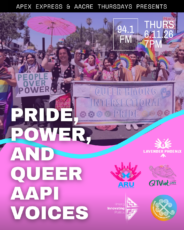
 APEX Express is a weekly magazine-style radio show featuring the voices and stories of Asians and Pacific Islanders from all corners of our community.
This Pride Month—queer and trans AAPI community strength.
On this episode, host Miata Tan is joined by guests from three organizations building queer AAPI community on their own terms. They explore what it’s like to find joy, organize together, and show up for each other in this moment.
QTViệt Cafe Collective Learn more about QTViệt Cafe Collective and their new documentary Đồng Quê: Of the Same Womb Website | Instagram | Join the Collective
Catch the film at an upcoming screening:
- June 14 — World Premiere | 22nd Annual Queer Women of Color Film Festival | Presidio Theater, San Francisco
- June 20 — Screening + Q&A with filmmaker Sage Tran | Hosted by the Q Corner | San Jose
Queer Hmong Intersectional Pride (QHIP) Learn more about QHIP and their upcoming workshops, events, and campaigns Instagram | Website | 5th Annual Elk Grove Pride
Lavender Phoenix (LavNix) Learn more about Lavender Phoenix and their Leadership Exchange program Website | Instagram | Leadership Exchange Program
Previous Episodes
- A Conversation with Lavender Phoenix: The Next Chapter — March 26, 2026
- Trans & Queer Hmong Rise: Organizing in Central California — October 24, 2024
- 8 Years of QTViệt Cafe! — August 22, 2024
Transcript
[00:00:00]
Miata Tan : Hello and welcome. You’re tuning in to APEX Express, a weekly radio show uplifting the voices and stories of Asian Americans and Pacific Islanders. I’m your host, Miata Tan. We’re nearly halfway through June, and Pride Month is in full swing. Pride is a time to celebrate, honor, and dig into the deep political history of queer and trans communities.
And tonight, [00:01:00] we’re zooming into a few distinct queer Asian American communities right here in Northern California. First, we’ll hear from a collective of queer and trans Vietnamese artists, activists, and organizers based in the Bay Area, who have a brand-new documentary out this weekend.
Then we’ll dive into the political organizing of queer and trans Hmong communities in Fresno and Sacramento.
And we’ll close out the show with a queer Asian American community leader and some different ways that you can get involved this summer. Okay, let’s get into it. First up, my conversation with QTViet Cafe Collective. And before you ask, no, QTViet Cafe is not a brick-and-mortar cafe that serves coffee.
They are a Bay Area-based creative cultural hub for queer and trans Vietnamese liberation through gatherings, art showcases, cultural programming, and more. QTViet Cafe is a part of Asian Refugees United, [00:02:00] and tonight we’ll be discussing their new documentary, Dong Hoi: Of the Same Womb. It is premiering this Sunday, June 14, as part of the 22nd Annual International Queer Women of Color Film Festival in San Francisco.
Dong Hoi asks viewers what it means to return to a homeland, to a community, to yourself. Here’s my conversation with the QTViet Cafe Collective.
Miata Tan: Thank you all so much for joining me today on APEX Express. Sage, perhaps you can start us off. would you be able to introduce yourself and share a little bit about what the QTViet Cafe Collective is?
Sage Tran: My name is Sage. I use they/them pronouns. One of filmmakers/digital archivists for QTViet Cafe Collective. we are a cultural hub where we focus on, diasporic themes around intergenerational Vietnamese and identity and queerness.
We do a lot our [00:03:00] events and workshops and gatherings around food, remembrance, and, our gay and they selves.
Miata Tan: Lovely. Jessie, who are you and what brought you to QTViet?
Jessie Nguyen: Sure, my name is Jessie, and my pronouns are they or Jessie, and I’ve been part of the collective since, 2018. I think I found the collective in a place in my life when I was really searching for ways to, bring an intersection to all parts of my identities, QTViet Cafe Just like Sage said, it’s a creative hub, it’s a cultural hub that is really dedicated to uplifting queer and trans Viet liberation through ancestral practices , different, forms of art and intergenerational connection. yeah, I just really appreciate the ways that QTViet Cafe has just been so dedicated to our, art and then also uplifting our art to really, bring forth community, organizing work, solidarity [00:04:00] work and our own, like, queer and trans Viet excellence
Miata Tan: Love that. Jean, could you share a little bit about yourself as well?
Jean Pham: Thanks for having us here. my name is Jean Pham. I use they/them pronouns. i’ve also been a part of QTViet Cafe since 2018 when I had first moved here to the Bay Area. Like Sage and Jessie had shared, QTViet Cafe is, it’s a really special space. I think as d- diasporic Vietnamese, speaking broadly, like culturally we experience being displaced on many different levels.
Um, when people say that it’s a cultural hub, really tangible in a, in a lot of the activities and things that we do. we’ve hosted like art residencies. We cultural dinners. We have language groups. QTViet Cafe, it really exists to fill a need. and I think part of that need brought us, to the culmination of this specific project, to bring us back into Vietnam
Miata Tan: Yeah, lovely.
And we can pick up from there your trip to Vietnam. this, was captured by Sage recently in a documentary. Sage, could you speak more about what, this new doco is about? where did this project come [00:05:00] from?
Sage Tran: this project emerged from a collective hunger for wanting to return
back to the motherland. for years of doing a lot of gathering here, specifically in the Bay Area, we’ve been able to stay rooted in the territories here. And, we all came to a consensus like , what would it be like to gather a bunch of us and connect with our siblings, brother, sisters, family, chosen fam out in the
motherland? that became a seed that we cultivated, planted, tend to, and we fundraised with a lot of community support to get about 13 of us out uh, Vietnam. maybe Jessie can talk a little bit more about this, but Hai and Ma are the, folks who founded QTViet Cafe Collective [00:06:00] Jessie, Ma, and Hai. They all three went to Vietnam in 2022 and built a lot of beautiful connections of like local drag artists, queer trans collectives out there. That’s kind of what birthed Dong Khoi.
Miata Tan: so
I’ve been lucky enough to, watch the film already. Donghui is the name of the documentary, but it’s also the name of the performance that came together Jesse, perhaps you can speak to this this journey more and I know QTViet C- Cafe’s been around since 2016, this project goes back, a few years as well
Jessie Nguyen: Yeah, sure. I can speak a little bit about that and just chiming into, like, what Sage already shared. there was a small group of collective members that that came up with the idea of, like, what would it be like for us as, queer and trans Viet diasporic folks to go to the homeland.
the original intent was for that trip to happen in 2020. And it [00:07:00] actually, because of the pandemic, I think obviously things were, logistically it just didn’t work, but that, dream, like, surfaced again, so the question came up about, like, what would it be like for us to travel together to the homeland as a collective and also share our art, to , connect with other Viets in Saigon.
You know, when we’re in the Bay, so much of our work is really centered around gathering communities around our food, our art, and our stories.
And so it really made sense for us to think about what would that look like in Vietnam. And so in 2022, as Sage was mentioning, me, Hai, and Ma,, went to Saigon and just kind of explored, like, what is the creative scene like and were able to connect queer and trans Viet artists who are doing insanely inspiring creative work.
we connected with folks from the Baxiu Collective, and they’re a group of, queer and trans Viet artists who are doing drag in different, performance spaces in queer bars in Saigon. And then I think in that moment we’re like, “Wait, we would love to [00:08:00] collaborate with you.” from that unfolded, a, a year-long , like, planning of, what would it look like for us to do a shared showcase together.
And so we identified built relationships with a queer bar in Saigon. and then so leading up to the homeland trip, we planned this showcase where it would be a mix artists from our collective and artists from their collective, and then a whole, a whole performance that unfolded.
And I think in the year of 2023, that year I think we ended up fundraising, about 50K in order to really subsidize and support the whole journey of getting us to Vietnam.
Like, stipending artists and creatives that we were collaborating with. it was, one of the biggest projects I think that QTViet has ever been a part of and really undertaken, and I think it definitely is, like, a huge highlight for, like, my time with QTViet.
Miata Tan: Lovely, and it’s so beautiful to see it all come together in the documentary. Jean, could you speak to your experience? I understand this was [00:09:00] your first time ever visiting Vietnam
Jean Pham: Yes, it was my first time visiting Vietnam. so I had a well of emotions in terms of the lead-up to it. Like Jesse was sharing, you know, originally the plan was we were gonna go in 2020.
That had to shift, you know, shelter in place and everything.
A lot of the work that we do is reconnection, right?
as diasporic Vietnamese being displaced from our ancestral land, as queer and trans people, um, a big rallying point for many of us is feeling displaced from our own families.
And so part of, like, returning back together is fighting against it. It’s like, what if we reconnect ? You know, what if we re- reunite?
You know, w- if we’re traveling together as queer community, we can really see and understand what it’s like to be uh, Vietnam for ourselves.
And so it was really, like h- it had this like gravity around it, and I think it made me really nervous but also excited. that being said, you know, a lot of other folks who are part of our cohort, even though they had gone to Vietnam before, a lot of them had also shared this is their [00:10:00] first time going without family, And we’re going specifically towards, queer and trans community in Vietnam, which is also a departure from their other experiences too.
Jessie Nguyen: Can I just add something? Because I just really loved what Gene shared. I just think that, yeah, I think that you really spoke to something there about how we can spend our whole lives, like, having this understanding of homeland that is actually quite disconnected from our queerness and our transness.
And similar to, like, many other folks in the collective, like, I have been to Vietnam, multiple times before, but never in the context of centering my queerness and transness because I just wasn’t sure, like, what felt safe. You know, without having, like, fluency in the language or even knowing, like, how to express my queerness in Vietnam.
Oftentimes it just felt… I felt pretty invisibilized there, you know, because, like, being there with family, I just show up as, like, a, a family member, There’s so much that is a part of me that is expressed through my queerness and my transness that [00:11:00] is that isn’t as visible.
And so I think that being in a space as a collective gave us permission to do and to feel deeply woven into our cultural experience was, like, in- in- incredibly liberating.
Miata Tan: Yeah. That’s really beautiful, Jessie. I also noticed in the film your aunt was also, part of it as well, so you were able to hold that familial side of yourself as well as the queer side.
Could you speak more to that?
Jessie Nguyen: Yeah. I was just watching the documentary yesterday too, and I was like, oh my gosh, I– it was so sweet that my aunt had a moment in that documentary. the thing that I was really interested in was trying to weave my connection with my family to, like, my connection with, like, my chosen queer family, And I think that became very possible when, we did the homeland trip.
I’m, I’m not fluent in Vietnamese, and I’m especially not fluent in trying to articulate what it means to be queer and [00:12:00] Vietnamese. And so the idea of inviting QTViets to my aunt’s home was, like, a way to be like, “Hey, this is who I and here are my– here’s my community.”
And maybe if I can’t actually, like, articulate that, like, I I want my aunt to, like, feel that sense of, like, care and connection of my community. And then to me that felt like a way of inviting my Vietnamese family to this part of my life.
I think that it’s, it’s oftentimes hard to even do that here in the Bay.
You know? Like, the connection that I have to my blood family and then my connection to my chosen family here in the Bay, like, can feel quite separate. keeps me coming back to QTViet is that we always make space for that intergenerational connection that doesn’t invisibilize our queerness and our gender identity .
Miata Tan: Sage, could you speak more to this theme of family? It seemed to be really core to the documentary tell us about how that felt as the director, like being behind the [00:13:00] camera but also part of the QTViet team on this trip?
Sage Tran: directing and being behind the camera had a lot of challenges. I think there’s something where I’m not sure if y- like folks can relate to this, but when you are filming something with your iPhone or on your camera, there’s a connection and a disconnection that happens at the same time.
You’re not able to fully present, but you are. I was straddling the line of like is this shot looking beautiful and also crying I think there was a moment where we were in a taxi or Grab car, and it was Hai, Jesse, and Jesse’s aunt, she was dropping some heavy moments, and I just remember we’re all crying in the car while the Grab driver is like blasting music, and it’s like a super bumpy road.
People are honking at us, and it was just like such a funny and rocky, symbolic, memory I just was like, “Wow, I can’t [00:14:00] believe I’m getting to document this” like historical moment, not only for Jesse, but just like for the collective and what does it mean for folks who are queer and trans that can’t have moments like this.
It’s just like kind of a reminder to slow down and being like, ” Okay,” am I getting to embody this moment while holding the stabilization of the camera?” And I think still I find that to be a challenge, but a, a really fun dance of filmmaking, directing and being there.
Miata Tan: Yeah, definitely. I can’t imagine trying to keep the camera still while you’re bawling your eyes out.
Sage Tran: Yes.
Miata Tan: Jean, we’ve talked a now about this connection of blood family and found family as well. could you speak a bit to the QTViet Cafe family that sort of came together on the trip, but also this wider, Vietnamese, queer community you were able to find over there in Saigon?
Jean Pham: Every step of the way it felt really [00:15:00] good because when, like, you know, we were traveling together as this, this giant mass of just gay people. and so I always felt like, oh, I could kinda be off guard, I understand that, like, for a lot of Korean trans people, w- when traveling we’re on high alert, there’s just a lot of unpredictability.
There is safety in numbers. There’s safety in communities. I felt like, you know, the QTViets have my back. There was a bigger group that came together in SFO, and we just t- all booked the same flights. And then there were some people who were coming, like, a little bit later. I had been with QTViets at that point for about six or seven years, and so there was a lot of trust already built.
With the Saigonese Viets, it, it was like a, just a natural kinship.
You know? It was like, it was also as if like we were just friends off the bat or there was just this shared understanding.
We had a gathering, and I think this is featured in the documentary. after gathering, people were just kind of, getting to know each other in in their flat, and they were teaching us how to walk in heels, and it was so lovely.
And I remember thinking like, “Oh gosh, what music do I play here? How do I set the mood?” But the, th- I think the reality is, [00:16:00] you know, Rihanna is like a common language, like among gay people. Everyone under like … It was, it was funny ’cause like, you know, I would, you know, I would play music that I would just listen to.
Like, they’re just, pop girlies that would play in the States. And, yeah, gay people, like, they, they just love a diva no matter where you are. And so that that was really nice.
But r- truly, like, the DIY drag scene in Saigon is huge, and it c- it’s, like, so varied. And, I do wanna shout out, like, all the queens and the Baxio Collective and all the trans artists who really helped, make our show and, like, really helped hone in our craft.
And they were pr- they were strict, you know? They were like, “You have to come here early, and you have to come in, like, days before. And we’re gonna have to practice over and over again.” And they had, like, really specific notes on how to make the show better. And so it was interesting as a culture exchange they were learning, how we were operating in terms of how we organize and a- I think a lot of the spoken word, slam poetry style that, like, some of our members were bringing.
And from them, we were [00:17:00] learning a lot of the theatrics on really how to, like, have a show and really think, holistically about all the different components.
Miata Tan: Jessie, could you speak more to the show? Uh, what did it look like? How did it feel?
Jessie Nguyen: So back in 2022 was when we discovered that there is actually one queer bar in Saigon, and it’s in District 4. this bar called Bar Zinga. And it’s, like, in this alleyway. It’s pretty divey.
And so when we were there in 2022, we actually spent uh, New Year’s there, and we got to know the owner, and we got to know, like, what they envisioned for the space, which is they’ve been using it as a space for, drag, drag performances, music sets, and things like that.
And we’re like, “Oh, wait. Maybe this could be a good spot for us to do something for QTViet.”
And So essentially the vision for the show was for us to collaborate with, Babel and Yat, who are the co-founders of Bạc Xỉu Collective, they are incredible, like, production artists and drag artists.
we [00:18:00] invited folks from the collective, if they wanted to share some of their art as well. And so we had… Let’s see. I remember Irene, who is one of the poets and also, like, OG QTViets, shared, some poetry, and then we had also Hai sharing some erotica. Me, Hai, and Lan did a ao dai fashion runway show.
and then there was, Oh, Judy and Hiroshi who did, like, a whole, like, lô tô, so that was, like, based off of, like, like a Vietnamese game, and they did a whole performance on that. yeah. So it was kind of, like, cool to be in this space and inviting folks from the community to come in, and it was a full house.
people were feeling so nervous, but the, also the energy of, like, I can’t believe this is happening. You know? that the art that we’ve created in the Bay, that we get to share it in Saigon.
Miata Tan: So beautiful. yeah, it’s really nice to see this, cross-cultural, international, connection that you’ve built with, the folks in Vietnam.
Sage, could you speak more to, the [00:19:00] documentary itself, what you hope viewers will take away from the film, and especially seeing depiction of, of queer joy in the performance?
Sage Tran: I think what I hope viewers take is like the power of remembering and the power of remembering with community. Cause I think like also editing this film, I’m like, I remember exactly what y’all said word for word. It’s like ingrained in my head.
I think there was something that, Jean, you said in… You said something where like it doesn’t matter if you’re Vietnamese, it doesn’t matter where you were born. It matters and it doesn’t, but also like there’s so many cross-cultural connections and parallels that, tie us all together.
And I think, on the theme of remembering and leaning into our joy and our creativity, there’s so much that can unlock with, just living our truths. I think, yeah, I think that’s what I hope viewers take away with
Miata Tan: Beautiful. and the documentary will be premiering, this [00:20:00] June, as part of QSMAP here in the city in San Francisco. We have A little bit of time here, so I’d love to talk about, uh, what else QTViet has on the horizon, campaigns, workshops, other performances.
Jean, Jessie, would either one of you be able to speak to this?
Jessie Nguyen: The only thing that is really on my mind around QTViet is that we are celebrating our 10-year anniversary in September. And I don’t know what that’s gonna look like, but I think that it definitely is gonna be a invite and just a opportunity for us to reflect on everything that we’ve been able to cultivate as a collective, and also just to notice, like, how much we’ve evolved.
I think that when so many of us joined in 2016 to 2018, we were, younger queers who were really looking for community and maybe felt pretty isolated. And I know that, like, where I am today, my connection to my Vietness and my queerness, like, feels so deeply ingrained. And a [00:21:00] huge part of that is because of having a container like QTViet.
I was also gonna talk about Ordinary People, because it’s actually a show that we’re doing a audio visual storytelling performance that is led by one of the QTViet members, Jop, uh, Nguyen.
And it’s gonna include, several other QTViet members that are gonna be, contributing as, like, a band.
there have been music and songs and videos and animations and, yeah, lots of different elements to really bring to life, like, what it feels like for our parents to, experience their homeland, their escape, their journey here, and then also how we really, how we connect to that story.
Miata Tan: Thank you for sharing, Jessie. Sadly, this interview is airing after the Ordinary People performance, but I’ll play a little snippet in a bit. Jean, final question. with this 10-year anniversary of QTViet Cafe, how do you see your recent [00:22:00] adventures informing your work? How you organize, how you gather
Jean Pham: I think after the trip, there was, like, a re-invigoration of, purpose honestly, like, a new wave of renewed energy and also new people who were joining the space.
we started practicing a lot more solidarity work. I think almo- almost immediately after returning, there were a few events that was in solidarity with, Palestine.
And as we were returning from the trip, last year was also the 50th anniversary of the war in Vietnam ending, and so we used that as an opportunity to draw connections between how, the conditions of the Vietnam War was truly, like, politically activating for a lot of young people in the ’60s, similarly to um, the genocide uh, Palestine was politically activating for people now, uh, and how, like, have a shared struggle.
with 10 years of QTViet Cafe, I think it’s more evident that QTViet is an, like, entity, a group that needs to exist. and we always invite people to join us. if anyone’s listening who is diaspora queer and trans Vietnamese, is looking [00:23:00] for community, you know, looking for language classes or, like, just, uh, ways to build, you know, we’re always more than happy to join people.
You know, last year, Jessie and a a couple other friends organized this amazing trip to New York. there was really this big energy around uniting all the different scattered parts of QTViets all over and coming together and understanding that, you know, we, we all, um, um, have a lot in common. and so I, I do think that was really uplifted and highlighted in our trip, this feeling of, like, you know, we’re not- we’re actually not so alone, and there’s so many of us, and we’re, like, we’re all so powerful.
Miata Tan: Beautiful. I think that’s a perfect place to end. Thank you all so much for joining me today
Jessie Nguyen: Yay. Thank you so much
Sage Tran: Thank you so much. Thank you.
Jean Pham: I know, this is so lovely. Thank you.
Miata Tan : That was Sage Tran, Jean Pham, and Jessie Nguyen with the QTViet Cafe Collective. Their new documentary, Dong Hue: Of the Same Womb, premieres this Sunday, June 14th at the Presidio Theatre in San Francisco.
That’s part of the 22nd Annual International Queer Women of Color [00:24:00] Film Festival, this year featuring 47 films, 10 world premieres, all totally free and open to the public. so if you’re in the Bay, this is well worth your time.
You can also catch QTViet Cafe’s new documentary in San Jose on Saturday, June 20th at a screening hosted by the Q Corner, followed by a Q&A with Sage Tran, the filmmaker that you just heard from. For links to these events and more about QTViet Cafe and how you can get involved in the collective, check out the show notes for this episode.
That’s on our website at kpfa.org/program/APEXexpress
Coming up next, queer and trans Hmong communities in California’s Central Valley.
But first, here’s a taste of Ordinary People, a recent live performance by QTViet Cafe recorded in Oakland last month.
Miata Tan : [00:25:00] [00:26:00] [00:27:00] That was a live recording from Ordinary People by the QTViet Cafe Collective, in Oakland last month. This is APEX Express, a weekly radio show uplifting the voices and stories of Asian Americans and Pacific Islanders. Tonight, in honor of Pride Month, we’re turning our attention to queer Asian American communities right here in Northern California: who they are, how they organize, and the future they are fighting for.
Miata Tan: My next guests are Shai Chang and Christine Thao from Queer Hmong Intersectional Pride, also known as QHIP. QHIP grows out of Hmong Innovating Politics, a grassroots advocacy group based [00:28:00] in Fresno and Sacramento, and focuses on building community and political power for queer and trans Hmong communities in California’s Central Valley.
Here’s my conversation with Shai and Christine.
Miata Tan : You both so much for joining me today on APEX Express. Could you share a little bit about yourself? Who are you, and what is your work with Hmong Innovating Politics?
Shai Chang: Hi, my name is Shai, pronouns are they and them. I’m trans, non-binary, also Hmong, located in Yokuts Valley, Fresno, California. the work that I do in Hmong Innovating Politics is that I am a community organizer.
I’m the Fresno Trans and Queer Community Organizer, I work specifically in the program called Queer Hmong Intersectional Pride, or QHIP, Q-H-I-P. And we do a lot of really great work with our trans and queer, in particular, like, intersectional folks, people of color within our, our communities and our members and our base to organize to fight, fascism, racism, also, like, transphobia and forms [00:29:00] of hate, moving us towards social justice and liberation.
Miata Tan : It’s really important work, and I’m excited to get into more of what, Queer Hmong Intersectional Pride looks like, Christine, could you share a little bit about yourself? who are you, and how long have you been with, HIP and QHIP?
Christine Thao : Thank you so much for inviting my name is Christine Thao. I use she/they pronouns, and I am currently here on Nisenan, occupied Nisenan land here in the South Sacramento area.
my role is the Sacramento, Trans Queer Community Organizer. And so I came into HIP, back in 2020, so during the COVID pandemic, and, um, I came on board as the administrative assistant. um, in 2024, I transitioned into the community organizer role.
Miata Tan : Lovely. Yeah. Can’t wait to get into the work that you do and the campaigns. to ground us in the history of, Hmong communities in America, Shai, could you speak to, who [00:30:00] the Hmong Americans are? I know that Fresno and Sacramento is home to some of the largest populations of Hmong people in the States.
Shai Chang: Yeah, definitely. so the Hmong communities are from Southeast Asia, very much like indigenous folks that live within the mountain ranges and the hills. and the reason why we came to America was because of the Secret War the war that happened in Southeast Asia. one of our community members General Vang Pao was involved within this war and then pulled in the rest of the Hmong community to be part of this it is to say that, like many of our young men during that time was pulled into the war, and they were 13, maybe even 14, 15, and younger who were, pulled into the war to fight for America, um, with the promise of that America was going to give them a place that they could call home it was in 1975 where the war ended and, that’s when the military went ahead and was able to, because of Ronald Reagan signed, um, a letter for immigration for, [00:31:00] these Hmong folks and refugees to come into the United States.
Miata Tan : Yeah, perhaps you can take us back to then, 2018 when, QHIP sort of came to life. what was the need that you were seeing for, queer and trans Hmong people in, in specifically Fresno and, and Sacramento where you all are based?
Shai Chang: the way Hmong communities have always existed was very much to be lay low, you know, not be sticking your head out.
And so to be very clear, it’s that we are still struggling,
economically. we are still very much struggling racially. The ICE attacks definitely impacted our communities we are still very much immigrants and still very much not necessarily having a place of home.
But internally is that the Hmong community still very much holds on to, like, the, the traditions.
And so they’re very patriarchal, um, very strict gender roles, and because of these things have then developed into, gender-based violence
[00:32:00] as, like, trans and queer folks, it’s that we definitely do experience another deeper layer of the oppressions, especially also in our community because there isn’t actually any language in Hmong to talk about what trans or queerness is, where there’s no exact word to describe, like, gay or lesbian and things like that.
So there is definitely, like, an erasure that also has happened, and in the Hmong community is actually very conservative. Uh, But HIP was already a very progressive organization. And so it was in 2018 because of Hmong innovating politics coming to Fresno. it was at the Hmong New Years, I saw them.
I was like, “Oh my gosh, I know who you are. I love you. Like, if there’s anything I can do, please let me know,” ‘ Mai Thao was able to pull me in. It was like, “Hey, I want you to do something with us.” and with- was then funded three thousand dollars through HIP, to be able to go ahead and organize for whatever it means for me to trans queer Hmong work.
during that time, it grew from, like, me, three people to having, like, fifteen people, [00:33:00] meet, once a week for three hours, and then another three hours we would go out and hang out. and so it really became this place for a social space for particularly, and, and I will name it, it’s that majority of the folks in that space was gay cis Hmong men.
And it wasn’t until a year later from that first time that we first met in 2018 to we had a really hard conversation about our future, about the political work that that we should be doing. and so I’ve been with HIP for four years, and we’ve officialized during that time QTPIP to be a program, within HIP, and yeah, it’s been really good. I don’t have to worry about funding and things and organizing around that front end, and HIP has been able to be s- very supportive in being able to see that, and we can really work on the ends of what does it mean for us to organize around liberation and being on the ground with our community
Miata Tan : Yeah, definitely.
It’s interesting to hear about the progression from [00:34:00] perhaps a group that was maybe more apolitical moving into that political space.
Shai Chang: we’ve also been, struggling still even now to land on what it means for us to fight more intersectionally. that’s where, like, QHIP and Queer Hmong and intersectional pride comes from, right? Is this word intersectional, coined by Kimberlé Crenshaw, is that We do have these cross identities that exist within ourselves. And so would love to have Christine talk more about what actually this issue is within not just Hmong communities, Hmong and trans queer communities.
Christine Thao : Thank you, Shy. so Queer Hmong Intersectional Pride, we officially launched the program back in 2024. our QHIP program,
It is open to young people between ages, 18 to 25. uh, young trans queer folks.
Some go to college. Some, currently looking to be employed.
Young people who are impacted, [00:35:00] young people who want to get involved, right, who, who do care about, this work, and who care about social justice,
it’s a eight-month program And our gatherings are, we call them our huddles, our QHIP huddles. And they’re, we do them about biweekly, I can speak a little bit for Sacramento. we’ve been meeting up at a cafe. We also use our office space. And, this is just a really a moment in time for our members to, bring up and have critical conversations about things that are happening in their lives or things that they’re seeing in their community.
Miata Tan : Perhaps you could speak more to the organizing piece. What does this look like? Um, what sort of work are y’all up to?
Shai Chang: Some of the ways in which we have organized, in our community is through the framework of BBB. It’s our belong, believe, become, and it sounds really cheesy, but this is really how we mobilize our people, we know as trans and queer people, especially as a person of color, we don’t know and have enough spaces of [00:36:00] belonging.
we actually have a, such a hard time believing in ourselves, and because of that, we have such a hard time in becoming. And this sounds like the story of literally just transitioning. when you Transition is that you really need to have a space of, believing in yourself. You need to have a space in which you can belong, where you are safe, and then through that you can actually become and this person that you have always wanted to be.
This is how we mobilize and organize our members and our community because once they start practicing this ability to be able to believe in themselves, have the spaces for them to organize and organize with other people. and to figure out, like, ,
what is our campaign strategy? What is the ways in which we wanna win in our community, right?
And Uh, in gender-affirming care in Fresno and the Central Valley was very, very hard. many of the times folks will have to go to, like, the bigger cities like LA SF to get their care that they needed.
We need actual, like, [00:37:00] materialistic wins for our communities so that way they can get to where they need to be.
when I’m talking about Materialistic things, it’s that, we need them to be housed.
We need them to have the affordable, uh, care. We need them to have, the affirming care that they are needing,
we know how hard it is for, in particular, trans and queer people to be able to afford literally anything. and it’s so much more harder for them to find a career or a job, in a place where they actually also can live and exist through their identities.
we’ve seen the, impacts of, ICE and immigration on our own communities these were, like, the works that were coming out constantly for our communities to fight for, these kind of justice issues, through these ways, we’ve been able mobilize and move our people to what does it mean for us to actually start thinking about a campaign strategy for us to win some kind of materialistic need
and, of course, we work with youths a lot, right? So where is our youth justice at? And this is literally our youth justice, right? We’re having our young people share their voices. We [00:38:00] have our young adults organizing in the community, um, doing protestings, and fighting against the system.
in particular, more recently, this, board of supervisor in Fresno County banned and denied, LBGTQ books in the Fresno County libraries. and we’ve organized to get people to show up to write letters and to really be there, and hundreds of people shown up and yet they still continue to, not hear their own constituency and their own community They continuously vote against us. that’s why HIP is political, right? Is that we have our civic engagement side, is that, okay, well, it sounds like we need to vote them out, right? And that’s what is it mean, and that’s what it’s about now.
Miata Tan : Yeah, I hear you. It sounds like you’re really helping to build political power within Hmong communities in, in Fresno and Sacramento.
I’m curious, what has wins look like, uh, for your groups there? how have, you perhaps helped to show those material, changes [00:39:00] for your young people?
Shai Chang: Uh, to be honest, it’s not much, We’re still very new into formed more as a social group in 2018, and just finally became, you know what? Let’s be political as f***. Let’s be authentic as f***, you know? y’all really wanna make trans and queer identities political, Then let’s be
political. and we’ve just started mobilizing, moving around those kind of things and identities only just more recently, right? As Christine mentioned, in
But the wins that we can really claim a name is that we have a 100% retention rate for our members. yeah. Um, we have tripled the amount of members that we had since then. and we are so excited for us to be able to, like, move and mobilize with our people intentionally and not just like, “Oh, we just need to be here for critical mass,” it is a two-part, right? It’s that, one, we need critical mass. We And the other part of this is that we [00:40:00] people to come in intentionally to be a part of this movement work. I actually went to present about QHIP more recently, and they asked, “Oh my gosh, is there any, like, open meetings that you have flyers about?
Like, when do y’all meet? And then, like, do you have a flyer for that? And I can share it with, my members.” And I was like, “Actually, we do meet, and it– we do meet biweekly on Fridays. The members themselves are holding the space for the meeting. and so I can ask them about that, but I also wanna let you know that it’s not necessarily an open invitation for folks to just come in whenever they want.”
We want people to come in intentional, and we want people to engage intentionally. And this is how we want us to move away from this autopilot into being able actively making changes and fights for our communities that will win us materialistic wins.
Obviously in this administration, in the Trump administration, um, it has not been easy. just two years ago, they actually closed, the only LGBTQ [00:41:00] homeless shelter in Fresno, and a lot of folks now have, like, a hard time understanding where to go and what and how to navigate it.
the Fresno, like, LGBTQ center also closed their doors for, like, the first time in, like, a long And so there is a lot of different impacts as impacting our community, from, like, LGBTQ centers closing, LGBTQ-serving organizations slowing down, And the way that our members and our community and our base have been organizing is As a community resource with one another is that like, ” Hey, I have an extra bed. Y’all can come sleep and crash ” there.” you hungry?” Let’s go get food.” Right? Really checking with each other and also being able to ask our community for funding as So HIP, we were able to organize and did a fundraiser back in March 50K.
That’s huge we also know there are impacts that also is beyond us, too. it was with this past, like, Hmong New Year [00:42:00] that we did, that we wanted to do a Hmong New Year action, an action to really fundraise for our families who were detained by ICE. And so we did a mutual aid fundraiser, asking our community members to donate money, and we were able to raise…
we only did it for, like, three hours, and we were able to raise $700. So we’re like, ” What if we kept going?” Right? And that’s where our fundraiser for 50K came from. so there is, like, ways in which we are trying to organize and mobilize our communities. And, to be very honest is that HIP and, QVIP is not necessarily a direct service organization and not necessarily in that way.
I think many of the times people see HIP as like, “Oh, you’re here to save us,” we’re not that, right? We’re really here to mobilize with our community, uh, we have our youth organization over in Edison High School, they were pushed into a small classroom, storage room, actually, for band and also, sports as well.
And so it, it was being disruptive a lot. one of our [00:43:00] previous, like, young adult members recognized that, and they were like, ” Sh-uh, Shy and HIP, Please, can y’all do something about this issue?” And we’re like, “No.” But we’ll do it with you, right?
and so we came in, we taught them about organizing, and literally those youths were able to organize themselves to have a classroom now, they remember that. They hold onto that, right? Regardless if we were here or not, they will still be able to know that and hold onto And so it’s very much like that as well with our members, is that we want them to be able to organize within among themselves without having the need of, of HIP and entities being able to, have the, have the solution for them
Miata Tan : mm, that makes a lot of sense. Really being able to work with community and give them tools so then they can continue to build is something really powerful that, you do at both HIP and QHIP.
I’m curious, with this very challenging political moment that we’re living through, not only for queer and trans folks, but immigrant communities as [00:44:00] well, how are you holding this, this pain alongside, trying to also celebrate and honor your communities, um, and especially your queer and trans community members? Shai or Christine,
Christine Thao : At HIP we have what is called third spaces, and third spaces are heart spaces.
these are, spaces where our young people, they continue to, build their organizing. They get to organize with one another and with HIP, to hold space to build community, to build belongingness, To show up, be present, make connections. is also a space where our young people, they get to decompress as well, in a world where it feels so chaotic, we do a lot of, the hard stuff with organizing, but then organizing can be so fun. and our young people, they get to see both sides, right, get to experience that.
What I’m holding onto is being [00:45:00] engaged and getting involved, it is, Um, How can we connect our young people, to our community partners, right? To make those connections, to build deeper,
this year it looks like us, being more intentional about our capacity and who we are, building out with, um… I’m on, I’m currently on the planning community for Elk Grove Pride, and so, uh, our young people are also a part of that, where they get to lead a role, and create, spaces of celebration, right?
there’s A lot of different opportunities our young people are also involved in,
and, it, it is that wanting our young people to, feel empowered to get involved in these spaces as well.
Miata Tan : Yeah. Lovely. Thank you so much, Christine.
It sounds like you’re really able to create, a beautiful space and community for your young people. Shy, uh, to close out, I’d love to know what’s on the horizon for QHIP. It’s Pride Month. unfortunately this episode is airing after Fresno Pride, but, perhaps you could [00:46:00] speak a little bit to that and what else is on the horizon.
Shai Chang: Sure thing. the first thing I need to say is Happy Pride Month. so Happy Pride Month, everyone. Fresno always hosts their Pride parade, always the first Saturday of, of the Pride month it is On Saturday, June 6. Pride parade over at Tower District in Fresno. it’s gonna be very fun. It’s super exciting. We will be marching in there all together, and the theme for this year is, Pride Without Border. we’re gonna be Extra powerful in calling out all of the different, struggles that our intersectional folks are all facing and being able to march together in liberation.
what’s also coming up next is, I- I’m foreseeing it to happen probably next month or in August, is that we will have a third space event to really celebrate Pride. we spend all our energy to be part of the Pride parade preparing our members and supporting them, but we haven’t necessarily celebrated QHIP’s [00:47:00] own Pride, you know, we work very politically in election works, and so we always have a bunch of these like, door hangers, Vote yes on Prop 3,” things like that, right? And so we have so much of those paper, and so what we usually do during this, like, Pride event that we do in QHIP is that we- we use these as an opportunity for us to do trash drag.
it’s an opportunity for us to get glammed out everyone gets to participate creating this, like, image through the trash drag. And so we’re excited to be able to do that, so please keep on the lookout.
Miata Tan : Sorry, why is it called trash drag? I’d love to know.
Shai Chang: It’s because, like, we had s- you know, this much f- okay, we, we have a lot of flyers from the our elections, And especially this year. You know how in, in the mail you’ll get so much, like, ” Vote for this person, vote for this person.” all of this is all paper that is then thrown away without any second thought.
and we will make them, and we’ll make, like, thousands of copies , right? But we never are able to pass it all out. what we do is that we will go ahead and reuse them one last time for [00:48:00] them to have an opportunity for them to shine, We’ll have them split up into teams, and then use all the different trash that they can gather and use, and glue them, tape them , staple them to make a dress, to make an outfit for this one person that they’re gonna designate to be the drag mother for their team.
Miata Tan : I love that. That sounds like so much fun.
Shai Chang: Yeah. We’re gonna be doing it in Fresno and also in Sacramento, so we’ll figure out a ways for everyone to be involved.
Miata Tan : Oh, how wonderful.
Christine, could you speak to what events are coming up in Sacramento for us?
Christine Thao : We are also having, um, Elk Grove Pride on June 20th. It’s from 5:00 to 9:00. it’s gonna be at the Elk Grove Laguna Town Hall. And so community is very welcome to attend. It is a free event. Think of it like, kind of like a resource gathering with, um, some really amazing performances we have, a lot of like, BIPOC TQ, artistes, and then also vendors [00:49:00] as well.
So please show up and, would love to, to meet folks and connect with folks in these spaces.
Miata Tan : Beautiful. Thank you so much for sharing, Christine, and we’ll be sharing all the details of how you can get involved and learn more about QHIP and HIP at the end of this episode as well.
Thank you both so much for joining me today.
Shai Chang: Thank you so much for having me.
Miata Tan: That was my conversation with Shai Chang and Christine Thao at Queer Hmong Intersectional Pride, also known as QHIP
Miata Tan : this is APEX Express on 94.1 KPFA, a weekly radio show uplifting the voices and stories of Asian Americans and Pacific Islanders.
To close out tonight’s show, I have one final guest.
Cynthia Fong is the lead organizer at Lavender Phoenix, also known as LavNix,
A Bay Area organization building power for queer and trans Asian and Pacific Islander communities. You may have heard of them. Their new executive director joined us on [00:50:00] air just a few months ago.
Here’s a short conversation with Cynthia Fong on Queer Joy, community power, and what LavNix has coming up this summer
Cynthia Fong: Thank you so much for having us. My name is Cynthia. I use they/them pronouns, and I’m here with Lavender Phoenix. Lavender Phoenix, we build trans, non-binary, queer API power through organizing in the Bay Area. We work with our members to demand true solutions to care and safety, and we’re excited to be here with you all.
Miata Tan : I’m so excited to close out the episode with you. And as we’re in Pride Month, I hoped you might be able to share a little bit about queer joy and how Lavender Phoenix is celebrating that at the moment, honoring each other.
Cynthia Fong: Yeah, absolutely. Especially in times like this, times of escalated violence against our communities, we know that queer joy, queer resistance, and queer power are truly antidotes to the systems that are making us sick.
For us, that means in our work, we fight for care not cops, [00:51:00] we fight for budgets that truly reflect the needs of our people, we fight for a free Palestine, and we fight to abolish ICE. If you agree with all of the things that I just said we also do a lot of leadership exchange programs, and that is where we really cultivate that belonging and community in our trans and queer API community.
Miata Tan : Oh, I love that. Could you share a little bit more about the leadership exchange with our listeners?
Cynthia Fong: Yeah, absolutely. This is one of our time-honored traditions. It’s called the Queer Leadership Exchange, it’s also known as LEX. And this program will run for two weekends in July. we aim to provide training on fundamental organizing skills, trans and queer history in the Bay Area, and really to provide an opportunity for trans and queer Asian and Pacific Islanders to connect with, with each other in a space that’s made by and for us.
We invite you to apply if you are trans or queer [00:52:00] and if you identify as Asian or Pacific Islander. Our deadline is July 1st. And in these two weekends, we usually gather with about 20 to 30 folks, and it’s really interactive. We have a mix of activities that we invite people to, to skill up on and, and really to become the leaders that our movements need.
Miata Tan : Love that. Could you share a little bit about some leaders you’ve seen come out of these programs? Like, what does that look like? How are they, helping to, to organize community?
Cynthia Fong: the folks who graduate from our LEX program, it, it’s really a wide range of people, whether it’s trans and queer APIs at work in other nonprofit sectors.
It’s also our folks who may be supporting our community in other ways, like as artists, as students, educators, as therapists. We see a lot of people take these skills and translate them into a variety of different sectors that we know trans and queer API people… we’re everywhere, more and more so now.
And we would [00:53:00] love every single one of us to be grounded in our histories when we do that work. And not only our histories, but also in a firm sense of belonging with one another, to know that we’re not alone, to know that there are other trans and queer Asians and Pacific Islanders here in the Bay Area, all of whom share these values of wanting to build working class power.
Miata Tan : that’s so nice, a more multi-generational, multi-sector,
Cynthia Fong: And, you know, we take it as an opportunity, too, for us to build with other organizations and people who, who are like-minded. We don’t take it for granted. We know the Bay Area is a place where it’s very diverse, where We are actively fighting for what values we believe in and whose agenda we are willing to put in power. And so we really welcome a wide range of people. No matter where you are, the real important thing is you, you share our values. you believe in true solutions to care and safety that are not rooted in systems of policing or incarceration
Miata Tan : [00:54:00] That’s really powerful.
to close this out , Could you share a little bit more about what’s on the horizon for Lavender Phoenix later in the year? You mentioned a few of the campaigns, Care Not Cops. perhaps if you wanna dive into some of those.
Cynthia Fong: Yeah, absolutely. Um, we are joining a really big coalition of people from Alameda to Sacramento to San Francisco, all of whom are paying a lot of attention to our budgets, when you say Care Not Cops, we see our budgets to really be that moral document that show us where our priorities are.
For us, June is Pride Month, but it’s also budget season, Um, it gives us a really big opportunity to be as loud as we can about what we believe. and in San Francisco with $16 billion, it’s quite shameful that we have our community partners like the San Francisco Community Health Center, Lyric, our youth programs being defunded, all the while new jails are being opened, all the while the police are getting new toys, they’re [00:55:00] showing us that the money exists but it’s not for us.
And so we join the voices that are demanding for a people’s budget, and we know that that’s gonna be an ongoing fight. We’ve been in it for a few years now, and we plan to continue.
In terms of our organization, we’re actually super excited to say we have 100% of our membership really diving into what the next five years looks like for us. Folks may remember we came onto APAICS to announce a name change a few years ago. We were formerly known as API Equality Northern California. We came on APAICS a few years ago to share that we’ve changed to Lavender Phoenix, and we anticipate some new changes on the horizon being announced at the end of the year as well, hopefully with deeper clarity about what the next five years will look like for us.
Miata Tan : Ooh. Interesting. It’s not a new name change, is it?
Cynthia Fong: No, no. We, we’re gonna stay… We’re keeping the t- we’re keeping our name. We love our name. We love the history in our name. But it’s really just the theory of [00:56:00] change, you know? I think our moment today is very unique, very different, very politically tumultuous, and we wanna be sharp.
We wanna know what we’re organizing for, what we’re organizing against, and, and what it means for us to build power.
Our last theory of change process is what resulted in us focusing on leadership programs, leadership development.
It is also where we decided that healing is really important for our people. It’s also where we decided that safety is really important for our people. And so I anticipate that it’s gonna be a deepening not, not a change, but a deepening of how we orient to this bigger picture of our movement for liberation and justice.
Miata Tan : So beautiful. Thank you so much for sharing, Cynthia. Um, it was really lovely to speak with you.
Cynthia Fong: Yeah, absolutely. Thank you so much. I, hope to come Back soon.
Miata Tan : That was Cynthia Fong with Lavender Phoenix. If you want to learn more about LavNix, we sat down with their team earlier in the year. Find that episode and their leadership exchange program in the show notes.
Tonight, we also heard [00:57:00] from the QTViet Cafe Collective and Queer Hmong Intersectional Pride. Links to all of these organizations and their upcoming work are at kpfa.org/program/APEXexpress. This is APEX Express KPFA, airing every Thursday evening at 7:00 PM. Thank you for tuning in tonight
APEX Express is a proud member of the Asian Americans for Civil Rights and Equality, a network focused on long-term movement building, capacity infrastructure, and leadership support for Asian Americans and Pacific Islanders committed to social justice. Learn more at aacre.org.
This program produced by Ayame Keane-Lee, Anuj Vaidya, Isabel Li, Jalena Keane-Lee, Miko Lee, Miata Tan, Preeti Mangala Shekar and Swati Rayasam.
Tonight’s show was produced by me, Miata Tan.
Get some rest y’all.