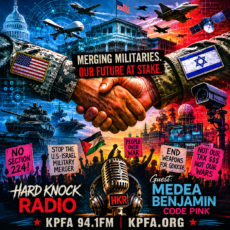
On Hard Knock Radio, host Davey D spoke with peace activist and Code Pink co-founder Medea Benjamin about what she described as a dangerous effort to deepen military ties between the United States and Israel through a provision in the National Defense Authorization Act (NDAA).
Benjamin explained that for years the United States has provided billions of dollars in military aid to Israel through agreements that guarantee long term support. She argued that growing public opposition to these expenditures, from both progressives concerned about Palestinian rights and conservatives questioning foreign aid spending, has led supporters of Israel to pursue a new strategy. According to Benjamin, Section 224 of the NDAA would move beyond financial assistance and create a framework for deeper military cooperation, including joint weapons production, artificial intelligence development, surveillance technology, and defense coordination.
Davey D questioned whether this proposed arrangement could evolve into something resembling a new military alliance and what it might mean for domestic policing and civil liberties. Benjamin responded that while NATO remains important to U.S. military interests, Israel has become a major force in the global weapons market. She noted that Israeli weapons manufacturers have expanded their influence by marketing technologies that have been tested in conflicts in Gaza, Lebanon, and elsewhere.
The conversation also explored concerns about police militarization. Davey D pointed to longstanding training relationships between U.S. law enforcement agencies and Israeli security forces, raising questions about how tactics developed in occupied territories could be applied domestically. Benjamin acknowledged those concerns while emphasizing that U.S. policing already has deep roots in its own history of repression and militarization.
Later in the interview, Benjamin discussed the political support behind the NDAA provision and encouraged listeners to contact their congressional representatives to oppose Section 224. She expressed disappointment that some Democrats, in addition to Republicans, have backed the measure.
The conversation concluded with a discussion of Cuba. Benjamin criticized U.S. sanctions and what she described as escalating economic and military pressure on the island nation. She warned of worsening humanitarian conditions, highlighted efforts by international allies to provide aid, and urged listeners to support congressional efforts aimed at preventing military intervention. Davey D closed by stressing the importance of recognizing the human impact of sanctions and policies that inflict suffering on ordinary people.
Throughout the discussion, Benjamin and Davey D framed the issues of military expansion, foreign policy, and economic sanctions as interconnected struggles that demand public awareness, civic engagement, and accountability from elected officials.