
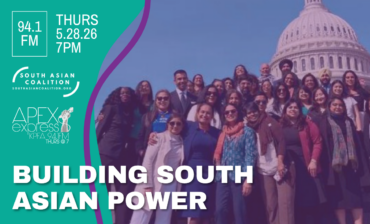
 APEX Express is a weekly magazine-style radio show featuring the voices and stories of Asians and Pacific Islanders from all corners of our community. The show is produced by a collective of media makers, deejays, and activists.
On this episode, host Miata Tan is joined by guests from the South Asian Coalition, an emergent national network committed to collective liberation and solidarity.
Together they explore what it means to build South Asian political power in this moment—and how cross-movement solidarity can shape a more just, multiracial future.
Learn more about the South Asian Coalition
Website | Instagram | Policy Priorities
The South Asian Coalition was convened in October 2024 by:
Manavi, Alliance of South Asians Taking Action, Muslims for Just Futures, and Raksha.
Transcript
[00:00:00]
Miata Tan : Hello and welcome. You are tuning in to APEX Express, a weekly radio show uplifting the voices and stories of Asian Americans and Pacific Islanders. I’m your host, Miata Tan. Tonight, we’re focusing on South Asian communities and the organizers working to build political power. South Asians are one of the fastest-growing racial groups in the United States, Over six million people [00:01:00] and roughly a quarter of the Asian American population.
South Asian is used as a broad umbrella term for people with roots in countries such as India, Pakistan, Bangladesh, Nepal, Sri Lanka, and sometimes Afghanistan. Though exact definitions can vary across communities and organizations. And as we’ll talk about tonight, within the South Asian diaspora who call the United States home, you have a mix of nationalities, religion, immigration status, and more.
Tonight, I’m joined by four people working to address the issues impacting South Asian communities in the US and beyond.
At a time when questions of belonging, safety, and political power continue to shape immigrant communities across the country, South Asian organizers are building new forms of solidarity while also grappling with the diversity and complexity within their own communities.
The first voice you’ll hear is Sabiha Basrai Sabiha is the daughter of Muslim Gujarati immigrants and has been [00:02:00] organizing with the Bay Area-based Alliance of South Asians Taking Action, or ASATA, since 2009. Here’s Sabiha helping us to understand how South Asian political organizing has evolved in the United States, especially in the post 9/11 era
Sabiha Basrai: Thanks for the opportunity to do some reflection this year marks the 25th anniversary of 9/11, which was a real a political flashpoint that absolutely changed my life because I was a 19-year-old college student trying to figure out a lot of things about how the world works and my place in it, and my own identity and the multiple identities I hold.
Uh, and also where my responsibilities lied in solidarity, not just with other Muslims who were being targeted, but our broad immigrant diasporas and allies, uh, who have experienced discrimination in different forms from the state. So thinking about the ways in which- organizing happened in the, months and years after 9/11 to support immigrant [00:03:00] rights that was really a time in which new projects formed, um, or existing projects kind of found a new focus.
ASATA as an organizing project, as a group of volunteers, has both done things like shown up to support folks being called up for the NCR’s Special Registration Program and also participate in direct action protests in solidarity against the war, and has continued to be part of coalitional work regionally in the Bay Area.
And, you know, more recently, uh, when we think about the ways in which our communities under, are under increased pressure with the Trump administration’s immigrant policies, there have been also opportunities to build more relationships and make sure that as we advocate for our community’s rights, we’re doing so in formation with others, not just focusing on one particular bad piece of legislation, but connecting that to a larger story, to really build towards liberation for all of us.
I’ll [00:04:00] just add, too that those relationships that were kind of seeded and invested in in that moment of crisis and anxiety and fear have endured in many ways to now.
The fact that that very ecosystem is actually growing in this moment is a testament to the relationships that were built in those days.
Miata Tan : That was Sabiha Basrai grounding us in the history of South Asian political organizing in the US. As she mentioned, for many South Asians, 9/11 marked a particularly mobilizing moment, one that helped our communities organized and built solidarity. To help us better understand how that moment influenced the evolution of progressive South Asian activism, we now turn to Deepa Iyer,
South Asian American writer, strategist, and lawyer.
Deepa leads projects on solidarity and social movements at Building Movement Project and brings more than 25 years of experience in Asian American organizing and advocacy
Deepa Iyer: I think that I would say that there [00:05:00] were, looking back, a couple of trends and themes that we can pull out from that time. one is that there was definitely a shift in the general consciousness of South Asian communities about our place in American society, our understanding of racism, Islamophobia, and also the role of the state.
And so we had a situation where both hate violence and state violence were actually being endured by South Asian, Muslim, Arab communities. And so I think that there was a shift in the ways in which our communities began to think about ourselves in the United States. A second piece is the growth of a field, an ecosystem of South Asian organizations in the wake of the attacks and the global war on terror.
So we began to see a lot of groups that were actually formed or becoming more staffed up in the weeks and months after 9/11. For example, the Sikh [00:06:00] Coalition was actually birthed the evening of the attacks, and an organization that I was close to, SALT, was also emerging and forming in the months after 9/11 as well.
So we began to see that a, a field was growing. And the third, sort of theme I would point out that Sabihah alluded to is this sense of solidarity, that instead of sort of being siloed as, you know, South Asians working within just our communities and just talking about certain specific issues, there was real sense that we needed to collaborate and build bridges with Arab, Muslim, Sikh, and, Black communities in the United States to understand the trajectory of racism and xenophobia, and how they were all kind of coming together in the weeks after 9/11. Those three themes and trends are what, when I look back, I see coming up over and over again in our messaging and in our advocacy.
Miata Tan : [00:07:00] That was Deepa Iyer, as you heard from Deepa, collaboration across movements was essential in helping South Asian communities to understand and respond to the waves of xenophobia in the wake of 9/11.
Now we turn to Rajiv Narayan and Farah Mahesri, who lead national policy work at the Alliance of South Asians Taking Action, or ASATA
together they launched and now co-lead ASATA’s new political base building group, ASATA Power. Rajiv begins by reflecting on what South Asian communities are facing today and what has and hasn’t changed since 9/11.
Rajiv Narayan: I think unfortunately many of the challenges present in the early 2000s remain today. They take new form. Some have evolved and transformed, but they were ex- existed in, in much the same form following 9/11. One of the, the instances in which I, I learned about that is at the recent South Asian Coalition convening where we did this exercise in mapping a number of [00:08:00] historical and present day events, as well as a future vision of things that are important to our organizations and to our movements.
And something that we reflected on together in the convening is that a number of these attacks on our communities have waxed and waned, uh, at different periods in time, dating back to the, the 1960s and truly at, even at the beginning of, you know, the 19th century and the late 18th century. And so, to answer your question specifically, in the early 2000s, like Deepa and Sabihah mentioned, we’ve dealt with, uh, an incredible expression of Islamophobia of, uh, anti-Brown and anti-Black racism and hate speech.
There was a, in, in general a skepticism and unwelcoming of South Asian communities. And unfortunately with the current federal administration and political discourse in our country, uh, a number of those same themes are relevant today and take on similar forms, whether they’re in [00:09:00] response to what the federal administration is doing in countries like Iran or previous administrations have done in Afghanistan or Pakistan.
I think all of those events underscore all the more so that it’s important for our organizations to, organize together, much as we did in the early 2000s, to address these harms, to remember what they look like at previous stages of history, and to fight to prevent them again from happening in the future.
Miata Tan : Farah, perhaps you could speak a bit to the organizing. What did that look like, a few years ago, and what does that look like today? How has that changed?
Farah Mahersi: Rajiv and I started ASATA Power a couple of years ago specifically to be able to look forward to practice radical imagination, and fight for not just protection of our communities, which we will always do.
That is built into our DNAs. It’s what we know. It’s how we move. And also to fight for things that we want, to build the world that we want to live in so that we’re not constantly caught in these cycles. And as we’re doing [00:10:00] that, we are learning a lot about how organizing is happening today, the BLM movement, Black Lives Matter, and incredible street power, but also that movement’s ability to change our national discourse and change what is baseline, what we should be demanding, and how we are visioning a future that is built on policies governance and hard material changes in our lives is profound.
beyond that, also the Palestine solidarity movement over the last couple of years has rewritten every book about organizing. And so I think that it is an interesting moment of both a little bit of sadness, to be honest, that we are still fighting some of these same fights and we are still in some of these same dynamics that we have been for 25 years, and the profound opportunity that we have to build power and to look forward, and I think that is, more true in the Bay Area than it is almost everywhere else.
Uh, because of what our workforce looks like, because of the sheer [00:11:00] amount of wealth that is accumulated in this little corner of our world, and also when you look around at the political power and people who hold political power or are running for political power and elected office around the Bay Area, you could really start to see not just how South Asians are increasingly politicized and increasingly looking to build electoral and political power, but also s- very specifically progressive political power.
And so when you look to Congress now, The progressive caucus is full of South Asian progressives who are leading the charge, who are doing some of this critical work, that’s part of our organizing strategy, is to be part of those conversations and to continue to push and to continue to, again, advocate for policies and changes at that big level to make the future we want possible.
Miata Tan : I love that. Coming together to dream and really fight. Rajiv, you are leading this work at the Alliance of South Asians Taking Action. Can you speak more to why the Bay Area [00:12:00] is a, like, a distinct microcosm in this progressive South Asian movement?
Rajiv Narayan: Of course. So Farah and I, we both work together at ASATA Power, and ASATA is sort of political power building project within the auspices of, uh, ASATA which has been operating in the Bay Area for more than 25 years now. I think what makes the Bay Area a microcosm of the South Asian diaspora is a tremendous amount of diversity and, uh, a set of interrelated intersectional challenges.
So you have, uh, folks of South Asian descent with all different immigration histories. So I’m, for example, a person, um, who has birthright citizenship in the United States as I was born here. But there are folks who immigrated here, like my parents and had to attain their citizenship uh, through the, the US legal system, and folks beyond that who are refugees or asylees or are undocumented due to a variety of political and social and economic pressures.
And so we all coexist in this same space across an economic gradient. So there are folks [00:13:00] who are very well compensated in the tech sectors and healthcare sectors sometimes, uh, characterized, uh, as part of a, a model minority myth, um, as representatives of the South Asian diaspora, um, within the San Francisco Bay Area and the United States broadly.
And then there are whole variety of South Asians who are working in less well-compensated, often quite exploited industries. For example, in, care industries as people who are providing childcare or senior care services, people who are working in the restaurant industry folks who are lesser compensated within healthcare as well as in tech industries and other ways.
Of course, those economic positions interact with the political and legal system. So for example, even if a person might be, um, well-compensated in a tech job in the Bay Area, um, which they attained by way of an H-1B visa that person might be subject to exploitative labor conditions based on the, uh, the legal configuration of how H-1B [00:14:00] visas are treated.
For example, that you depend on your employer for your immigration status in this country, which changes the worker-employer relationship in a way that makes it very difficult to identify workplace abuses. beyond that, we also have a diverse range of South Asians across the age gradient. So we have folks who are quite young, who are in Gen Z, and are entering politics in a completely different way than somebody like myself or Deepa entered politics at, in earlier in, in our lives and experience it today, which provides an opportunity for us to learn from earlier generations and to also share lessons from our political experience.
So like with many things, the Bay Area has it all, the good and the bad, and ASATA and ASATA Power work within that, that space to identify opportunities for solidarity.
Miata Tan : That was Rajiv Narayan and Farah Mehestri. Through their work with the Alliance of South Asians Taking Action, or ASATA, Rajiv and Farah are helping to build South Asian political power here in the Bay Area and [00:15:00] nationwide.
The ASATA team and all four of our guests tonight are connected through the South Asian Coalition, a network of local and national organizations focused on advancing policy issues affecting South Asian communities and building shared spaces for strategy and collaboration.
To better understand this evolving movement of progressive South Asian action, let’s return to Deepa Iyer, who shares how and why this coalition came together
Deepa Iyer: Yeah. I really appreciate Rajiv bringing up, um, how- what is happening in the Bay Area is part of a larger movement. And what I would say about this ecosystem, this field that I talked about earlier, and I’ve been able to understand this through the course of the work I’ve done, but also a book I’ve written about post 9/11 America, is that so much happens on the coasts, and we often forget that there are organizations and are communities that are really [00:16:00] growing in other parts of the country, right?
You know, I grew up in Kentucky, um, and there are places like Kentucky and Indiana where you are seeing, um, more South Asians settle and build their lives there. So one of the things that I think has been important in thinking about as we come up on this 25th anniversary of 9/11 is how our coalition of South Asian groups, how that field has grown with these additional organizations, in geographic areas that are different, as well as the ways in which folks are organizing. So now we’ve got, for example, groups that are working with Bhutanese refugees or Nepali-speaking community members, or groups that are organizing around the exploitation of community members based on caste.
These are, um, really important movement interventions and organizations that are growing. one of the key aspects of network infrastructure is the ability to connect with each other, [00:17:00] not to flatten our experiences and say we’re all the same, but to actually find some threads of commonality in our shared struggle and our experiences, and to also know that together as collectives, as Farah mentioned earlier, we can actually build the futures that we wanna see.
One of the really, I think, inspiring pieces of coalition building that I’ve been fortunate to work with and support along with, um, everyone here is the South Asian Coalition, which is this emergent network of now 35 organizations around the country, and this coalition really seeks to build relationships and strengthen relationships, engage in peer learning and skills building, make it clear that there are certain policy issues that we need to uplift and to advocate around, and to create opportunities and pathways for solidarity with larger movements. This coalition and the infrastructure that it’s been [00:18:00] creating is a way for us to look at our ecosystem of South Asian organizing in this moment, and to really see what happens when we galvanize our power collectively.
Miata Tan : and Deepa, can you share a bit about the various co-conveners that make up the South Asian Coalition?
Deepa Iyer: So the South Asian Coalition, um, as we’ve mentioned, is this emergent network of groups that address various issues but are aligned around shared values. And the groups that really came together to co-convene it include Asad the Power, as well as Muslims for Just Futures, Raksha, which is an organization in the South, and Manavi, which is based in New Jersey.
And these four organizations really had the vision to set up the structure for the coalition. the organization where I work at, Building Movement Project, supports the coalition through infrastructure, so providing facilitation, providing resources, policy analysis, and creating the container to support [00:19:00] movements in that way, which is so critical for coalitions.
Miata Tan : That was Deepa Iyer a South Asian American writer, strategist, and lawyer. after the break, we’ll hear more from organizers and advocates working to address issues shaping South Asian communities today. Stay with us
[00:20:00] [00:21:00] that was “Phenom” by Thao and the Get Down Stay Down. You are tuned into [00:22:00] APEX Express on 94.1 KPFA, a weekly radio show uplifting the voices and stories of Asian Americans and Pacific Islanders. I’m your host, Miada Tan. Tonight, I’m joined by four people who are working to address the issues impacting South Asian communities in the US and beyond.
Back in March, organizers, advocates, and community leaders from across the country gathered in Washington, DC, for a national convening focused on the challenges and possibilities facing South Asian communities today.
Here’s Sabiha Basrai with the Alliance of South Asians Taking Action, or ASATA. She speaks about how this coalition of progressive South Asian groups formed and why this moment called for it.
Sabiha Basrai: So this new emergent South Asian Coalition had its first convening in Washington, DC in March, and this was, the culmination of, a little over a year of monthly Zoom calls which started because [00:23:00] we knew we were on the verge of a Trump re-election.
Uh, we knew that there was this ecosystem of South Asian activism and organizing across the country. Some of us knew each other from previous collaborations, but some of us didn’t. New organizations were forming, and there was this recognition that we need each other in order to face what’s coming, and we are stronger together.
And we know that being South Asian is not a monolith, uh, that we deal with within our own communities based on labor exploitation, caste discrimination, anti-Muslim violence. And when we talk to each other, when we connect, we give ourselves the best chance at being able to move through those pieces of pain and build towards a future where we can all feel a sense of belonging, feel represented, and an agency in shaping that future together.
So what started with a few conversations with a few folks, grew steadily [00:24:00] and, um, and through some intentional work to, to kind of invite each other in, which is of course an ongoing process, we were able to unite under this umbrella called the South Asian Coalition. Uh, we committed to some shared political points of unity and kind of community agreements to really set some expectations with one another on how we could move well in formation.
And, made sure we had pathways to share information with each other so that someone like me working in Oakland could understand what, uh, someone working in Texas or in Georgia was facing, what local policy positions they were needing to, to navigate. And, uh, we could give each other advice, give each other moral support, and also sharpen our political understandings.
So, uh, these kind of, uh, regular check-ins was one way of just understanding what we were all facing and feeling connected. But, actually being together in person was remarkable. I cannot overstate how much of a difference it makes to be able to share [00:25:00] space and see each other as whole people and not just representatives of a particular organization or a particular issue area, and, have those in-between moments where we actually build, build some friendships.
One of the things that was also really important for me to understand when we met together was just how important that intergenerational work is. we had folks in the room who were, in their 50s and 60s who had been doing this work for decades. And we had folks in the room who were in their 20s for whom 9/11 was, something that happened in history. The conversations that were happening across generations informed the way that we think about ourselves as a coalition and helped me also to let go of some of the constraints that, kept my imagination small about what we were capable of.
I was really grateful that so many people attended and chose to prioritize that work. It’s hard, you know, to take a pause from The daily work to leave, fly to [00:26:00] DC take those risks as well because for many of us, uh, going through TSA is no small thing.
There’s a lot of harassment and racism that still permeate, you know, these institutions. So not to minimize just the effort that ta- it takes to convene and really make the most of our time together. One of the things that we did while we were in DC together was hold a congressional briefing to really, uh, amplify and share the issues that were coming up for our communities that folks were already working very hard on.
Miata Tan : That was Sabiha Basrai with the Alliance of South Asians Taking Action, or ASATA. Now let’s return to Rajiv Narayan, another member of the ASATA team and co-lead of their political action group, ASATA Power. Rajiv will take you inside the congressional briefing that Sabiha mentioned and how South Asian organizers from across the country shared the issues shaping their communities and what support is needed now
Rajiv Narayan: We in ASATA Power worked in [00:27:00] collaboration with a number of the organizations in the South Asian coalition, to put together a congressional briefing on the issue of South Asians and immigration in the heart of Washington, DC, in the halls of Congress in Capitol Hill.
And we were fortunate to do so in collaboration with Representatives Pramila Jayapal and Grace Meng. we had a number of, speakers representing, different perspectives and political struggles within the South Asian, uh, space in the United States, especially as it relates to immigration.
So, for example, we had representatives from the Dalit Solidarity Forum talking about the plight of oppressed workers, caste-oppressed workers, in New Jersey working in a Hindu temple.
Dr Roja Sunganthy-Singh – Dalit: I stand here as a Dalit, formerly known as an untouchable in India’s caste system, speaking for over two hundred skilled Dalit artisans who were brought to the US from India to build the largest Hindu temple in New Jersey.
In their words, ” We are the Indian stone workers of America, workers [00:28:00] rescued by the FBI in twenty twenty-one from forced labor conditions constructing the BAPS temple in New Jersey. we were brought to the US on R one visas and compelled to perform construction labor for over eighty-seven hours a week and paid just a dollar twenty an hour.
Rajiv Narayan: We heard from, um, the executive director of the Sikh Coalition talking about Sikh truck drivers and religious workers and their experience under the federal regime’s, uh, rule-making efforts.
Harman Singh – Sikh Coalition: Uh, Punjabi Sikhs began entering the US trucking industry in large numbers during the nineteen eighties, and Sikh truck drivers and business owners have played a critical role in addressing driver shortages over the past several years.
Unfortunately, Sikhs in this critical industry have become the subject of harmful rhetoric and policy from this current administration.
These drivers are being excluded solely because of their specific immigration status and regardless of their driving histories, skills, knowledge, or English proficiency.
Rajiv Narayan: We heard from, the executive director of Asian Refugees United, who [00:29:00] spoke about the experience of Bhutanese refugees who have been rendered stateless by the current administration’s, deportation efforts
Robin Gurung – ARU: Because of the ethnic cleansing campaign of Bhutan government, more than hundred thousand Bhutanese citizens were forced to flee the country.
For twenty years, I lived in a refugee camp in Nepal. In 2008, the government of this country came to rescue us. We were promised safety and security. But last year, that promise was broken. As of March 2025, over seventy of our community members are deported to Bhutan, the same country that persecuted us and made us refugees.
These community members are kidnapped from their homes and jobs. They have been taken from their routine ICE check-ins. We know due process was not followed.
Rajiv Narayan: We also heard from the executive director of Raksha, a domestic violence organization based in the Southern United States that has played an instrumental role in supporting South Asians who have been the victims [00:30:00] and who are now survivors of domestic and intimate partner violence, about the needs for supporting these kinds of organizations, with federal dollars and through the grant-making systems conditions.
Aparna Bhattacharyya – Raksha: For thirty years, we have supported community members in navigating interpersonal violence, but also waves of racism and policy backlash.
South Asian and Indo-Caribbean survivors need safe places to turn, safe places that speak their language, understand their unique immigration and cultural needs.
Raksha recently had $700,000 in OVC grants terminated by DOGE.
additionally, we are still waiting for OVW sexual assault cultural funds for five months, where we have gotten no determination of whether we’re getting that funding or not. Five months.
Rajiv Narayan: We also heard from, the director of the South Asian American Justice Collaborative, which is currently, before the US Supreme Court in the birthright citizenship case, and [00:31:00] filed this foundational amicus brief detailing the story of South Asians in the United States going back to the 1600s.
Klapana Peddibhotla – SAAJCO: Our brief pushes back against this notion that we are forever foreign.
South Asians actually arrived on these shores in the sixteen hundreds, and by the seventeen hundreds, South Asians were already asserting their rights here.
In an Afghan immigrant actually fought in the Civil War in the Union Army. by the late nineteenth century, the largest farming group in Central California was formed by Punjabis.
Today, South Asians are one of the largest immigrant populations in the US, but many families are caught in immigration backlogs that last for decades and make them vulnerable to the President’s executive order restricting birthright citizenship.
Rajiv Narayan: Across all of these speakers, you know, the, the, the message became very clear that we have so many different struggles, but they’re all [00:32:00] united by a sense of solidarity for each other’s political experiences under the same system of exploitation and oppression, and that there, there’s so much that Congress can do in this moment to support the South Asian diaspora in the United States and, and even abroad in some cases. for ASATA Power’s part, we, had the opportunity to put together over the course of the last year a policy brief on undocumented South Asians, and it was during the congressional briefing that we shared some pretty startling statistics that we, collected and collated from a number of public sources.
And so what we were able to identify for the room is that there are about eight hundred thousand to nine hundred thousand undocumented South Asians in the United States, and because there are only six point five million South Asians in the US, both those who are undocumented and those who have birthright citizenship or are otherwise naturalized, refugees, asylees, and, and everyone in between.
Of those six point five million South Asians One in eight of [00:33:00] them is undocumented, which is shocking and not something that somebody would understand at the outset given these problematic narratives like the model minority myth and whatever you see these days on X or Twitter about South Asian immigrants.
So it’s important for us not only to, to set the narrative straight and to identify both the diversity and opportunity for solidarity across our struggles, but to do so in the halls of power and to speak that truth to power directly.
Miata Tan : That’s Rajiv with ASATA Power reflecting on a recent congressional briefing in Washington, DC he helped to organize alongside other progressive South Asian leaders, organizers, and activists. Here’s a snippet of Rajiv’s opening remarks at the briefing
Rajiv Narayan: I want to draw your attention to the slide behind me,
they’ll show a couple of images of South Asian community members who’ve been impacted recently by the horrific policies and practices of the federal administration. These members include Sheraz Fatehali Sachwani, a forty-eight-year-old citizen of Pakistan who died in ICE [00:34:00] detention last December. They include seventy-three-year-old Harjit Kaur, who was arrested during a routine ICE check-in, separated from her family, and deported to India without notice.
I should say, I grew up seeing Harjit Kaur behind the counter at Sari Palace in Berkeley. She would help my mom try on saris. Her home was here. Her community was here. You know, these are just some of the names and stories of community members who have been affected by immigration policy as of late, and we hope that you will keep them in mind as you hear from our speakers today.
There are many more we were not able to picture or name, but their stories are just as important.
We’ll be making many asks over the course of today’s briefing. Some of those include the following: Congress should not increase funding for ICE or Border Patrol, including providing funds for detention facilities, especially in this funding moment.
We have to remember that ICE is not a long-standing American institution. It was created in two thousand and two, recently, as part of the Homeland Security Act following nine [00:35:00] eleven.
Miata Tan : That was Rajiv Narayan with ASATA Power speaking at a recent congressional briefing in Washington, DC.
The briefing was part of a larger national convening organized by the South Asian Coalition, bringing together progressive South Asian groups from across the country.
Now let’s return to Deepa Iyer, who leads projects on solidarity and social movements at Building Movement Project here’s Deepa reflecting on her takeaways from the congressional briefing
Deepa Iyer: I think that there were so many pieces in that briefing that maybe people didn’t know about that organizations are struggling with, and part of it is that, um, our communities, and Sabihah said this earlier, are not a monolith, right?
And there are so many different ways in which we are experiencing what is happening right now in the United States, the fractures and the fissures that we’re seeing. Rajiv spoke so well about the community needs and issues. One thing I’ll lift up is actually the impact on nonprofit [00:36:00] organizations.
Several of the groups that were, uh, speaking at the briefing noted how the attacks on nonprofits that are specifically working on issues like immigration in terms of losing federal funding and grants, being forced to certify that they are not addressing issues work that deal with undocumented immigrants, as well as the ways in which, um, nonprofit organizations are being, in some ways, seen as doing risky and un-American work.
there is the, the exploitation of domestic terrorism as a frame that is being used right now to target certain nonprofit organizations. This is something that I think is not necessarily known to many people in terms of the ways in which national security, immigration issues are also affecting the nonprofit sector as a whole.
And where I work at the Building Movement Project, we really look at the nonprofit sector and the health of the nonprofit sector, and we’re [00:37:00] seeing that these types of external threats, the spotlight on organizations that are on the front lines, including South Asian groups, um, Muslim groups, Palestinian groups, that are working with, um, immigrant communities, queer and trans community members that are providing- Vital language access, service provision, community safety are really under threat right now, and this includes many of the organizations that were present at the, coalition’s convening.
So that’s something that I also wanna lift up, that in addition to our communities who are facing the impact of the current moment in really acute ways, our nonprofit sector and our organizations are also dealing with a range of constraints and threats and difficulties. So that is one thing that came up over and over again.
Miata Tan : That was Deepa Iyer with the Building Movement Project, highlighting the pressures facing the nonprofit sector right now, [00:38:00] especially as it relates to South Asian organizers, advocates, and communities.
Let’s return to Farah Mahesri with ASATA Pawa.
Farah Mahersi: One of the other things that I am very proud of for this congressional briefing that we did was that it was us telling our own stories and us presenting our own policy recommendations. There was no need to have, like, an expert come in and talk on behalf of our communities or try to represent our communities.
We were the experts in the room, and we were really recognized and seen as that. As Rajiv mentioned, you know, there, the room was packed with Hill staffers and congressional staffers who were taking diligent notes as we spoke our truths
Miata Tan : That was Farah Mahesri with ASATA Pawa reflecting on the recent congressional briefing she helped to organize, one that brought greater visibility to the experiences of South Asian immigrants. You’ll hear more on how South Asian activists, organizers, and community groups [00:39:00] are mobilizing after this. Stay with us
Miata Tan : [00:40:00] [00:41:00] [00:42:00] That was Lion on the Hunt by Thao and the Get Down Stay Down. You are tuned into APEX Express on 94.1 KPFA, a weekly radio show uplifting the voices and stories of Asian Americans and Pacific Islanders. I’m your host, Miata Tan. Tonight, we’re talking about South Asian organizing in the United States and how community leaders are responding to immigration challenges, political representation, and the shifting landscape of civil rights
back in March, organizers and advocates from across the country gathered in Washington, DC for a national convening focused on the challenges and possibilities facing South Asian communities today.
Here’s Rajiv Narayan with the Alliance of [00:43:00] South Asians Taking Action, or ASATA, reflecting on the importance of honoring both the diversity of the South Asian diaspora and the shared struggle that connects these communities
Rajiv Narayan: Something I appreciate about, your work, Miata, at APEX Express, is to highlight both that diversity of the South Asian diaspora and the many struggles and experiences that unite our political experiences and our commitment to social justice.
It, it used to be, and in, in some places it still is the case, that folks will use an over-broad group to represent all of the South Asian diaspora. For example, talking about all Brown people as Indian or Desi or to, to collapse all the differences in our community. And part of the power of the congressional briefing is that we are able to show that what it means to be South Asian is at once an incredibly diverse expression and at the same time a collective expression of solidarity.
We can do two of these things at the same time. We can recognize our differences and fight for each other. One of my [00:44:00] favorite takeaways that I, I heard from Deepa at the briefing is that there are some staffers that came up to her and said, “I’ve never heard my story, my experience, my political struggles represented in a panel in this building in front of other congressional staffers.”
And that’s something that we can do, and we should do more of. There are so many ways in which we can tell the stories and highlight the campaigns of folks from different parts of the South Asian diaspora who are all fighting for a better life for all of us.
Miata Tan : That was Rajiv Narayan with ASATA, in the recent congressional briefing that Rajiv helped to organize through the South Asian Coalition, organizers also pointed toward the future of South Asian organizing in the United States and the role of a new generation shaping it.
back to Deepa Iyer with Building Movement Project. Here,
Deepa Iyer: Some of the young folks that are entering or working at nonprofits now, supporting South Asian nonprofits don’t have a living memory of 9/11 and the global war on terror, [00:45:00] and they have been politicized in different ways, right, over the last eight years, for example, the pandemic global wars, et cetera.
And so there are a couple of ways in which I’ve been thinking about how we can support South Asian young people. so for example, how can we share historical analysis and political analysis so that young people understand that they are part of a trajectory of South Asian activism that actually started well before 9/11, before the 1960s, right, and that continues to today, so they don’t feel fragmented.
So that’s something I’ve been sitting with a lot.
Another is around pathways into public service and community service and into the nonprofit sector. So how could we support young people in terms of building their skills, in having pathways open to them into our nonprofit organizations? And then finally, how do we support them, um, so that they, can do this work for the long run?
You know, we all struggle with burnout, we all [00:46:00] struggle with sustainability. what are some lessons learned that we can pass on? What are some best practices? that’s something that’s been sitting with me quite a bit since the gathering that we had, and I hope that the coalition will really think about, supporting young people’s leadership and finding different avenues and pathways to do that.
Miata Tan : That was Deepa Iyer reflecting on how movements can better support the next generation of South Asian organizers. Within the South Asian coalition, that work also means building long-term infrastructure for better collaboration. Now back to Sabiha Basrai with ASATA.
Sabiha Basrai: I’m also really appreciating that the South Asian Coalition is this model for creating a container for many, many organizations to unite as a group while maintaining regional focus and individual issue priorities. I also wanna name that the place where I first learned how to do national coalition work was as a member of the National South Asian Coalition that ASATA had been part of.
[00:47:00] It was facilitated by a group called SALT which played such a critical role in the post 9/11 era and continued to then work on DACA, creating resources for undocumented South Asians, along with other issues facing our diverse diasporas. And SALT closed a few years ago. It was a decision that I don’t understand and was- has really left me with a lot of sadness and confusion.
but I al- I know that sometimes institutions do end, but that the work does not end and the relationships do not end. And the South Asian Coalition is this emergent space that, um, is not led by any one organization. it is a space that is being invested in collectively, and we’re really moving at the speed of trust so that we can be really laying that strong foundation that supports the work ahead.
I’m really sitting with the ways in which sometimes this labor of Building the container, creating the container, [00:48:00] investing in the network.
It’s sometimes invisible labor, but it is the most critical because without it we can have moments of mass mobilization, but then that wasn’t actually building any power over the long term. And I’m really looking forward to all of the very good work ahead, because I trust the relationships and the containers that we’re building.
Miata Tan : That was Sabiha reflecting on the collaborative infrastructure that the South Asian Coalition is helping to build. Now let’s return to Deepa Iyer. I asked Deepa what campaigns are on the horizon for the coalition, especially as this year marks 25 years since 9/11.
Deepa Iyer: As Sabiha mentioned, the coalition is a space for invested leadership, and so there are lots of different campaigns that groups within the coalition are eyeing and taking on. One of them Rajiv mentioned already is the fight around birthright citizenship. And so there are groups like SACHCO and others that showed up with a South Asian [00:49:00] delegation at the Supreme Court on April 1st when that case was being heard, and it was really great to see so many South Asians out there in a delegation along with other communities, to raise their voices on this really vital, pivotal issue.
And so that is a campaign that some of the groups within the coalition are going to continue to be lifting up as we get the results of that case and moving forward. Another one that you mentioned, is around the 25th anniversary of 9/11, and there are groups that are considering, along with others in other movement spaces what does narrative strategy look like as we go into this time period?
How do we think about the fact that we’re marking the 25th anniversary in the same year that we’re marking the 250th anniversary of the United States, right? how do we use 9/11 and its anniversary as a lens through which we understand empire, through which we understand the ways in which domestic [00:50:00] policies are being recirculated against other communities?
And also this piece around awareness and education. this is an opportunity to share some of the personal experiences that many of us have around that moment in time, but also the ways in which our communities have built up themselves as well as the solidarity with other communities. So I think there are lots of ways in which organizations are thinking about that anniversary and how they can, utilize that moment, to draw greater attention to our community’s experiences.
Miata Tan : Rajiv, Farah, would you like to add anything about upcoming campaigns and how you’re thinking about the South Asian political power movement moving forwards?
Rajiv Narayan: Yeah, I’m happy to talk about one sort of continuing campaign, which is that, like I mentioned, we put together this policy brief on undocumented South Asians, and we had this great opportunity to circulate and talk about it on Capitol Hill in DC.
But it’s also important for us to bring that story home. And so part of [00:51:00] what we’ll be doing, um, for the remainder of, of this year is identifying opportunities to do town halls both, with community members and potentially with elected officials to help educate, do political education about the nature of undocumented peoples in the South Asian community.
A large part of what we did in that policy brief is to collate all these numbers to tell you, how many folks might be undocumented, what is the proportion of undocumented people in the South Asian community. But an important, equally important contribution of that report is the nature of undocumented experiences.
Why do people become undocumented? What are the factors that put them in that position, and what does it mean for a person to become undocumented? How can we support them, not just in different policy prescriptions, but also the ways that we talk about undocumented people and the South Asian community as a whole?
So that’ll, that’ll be, um, a focus that we have, uh, and a contribution that we hope to make both in the, the Bay Area and beyond.
Farah Mahersi: I’ll add to that, that it is election year. It is [00:52:00] a… I feel like we say every election is a critical election, and I do believe that that is very true this year. And so ASATA Power, as a political organization, will be making endorsements and talking through not just that it is important to vote, but it is really important and critical for us in this moment to vote for progressive candidates who are part of our, what is often called like a build coalition, who are here to help us build this world that we are dreaming of, who are aligned on policy positions.
The other thing that we are working on locally and nationally is around the war budget. So as a group that has been so directly impacted by the global war on terror 4.5 million Muslims around the world who have been killed by US war-making in that global war on terror, and just watching kind of what the United States foreign policy in particular over the last couple of years has been, we have a particular point of view and a particular interest on tracking and watching things like the [00:53:00] largest, request for a defense budget in US history.
How are those dollars being spent, And how those dollars that are being spent abroad to do war-making are also having a boomerang effect and coming back to impact our communities at home. So the same technologies that were developed and used in war-making through the global war on terror that impacted, uh, so many of our communities around the world for 25 years, a lot of that is the same technology that ICE is now using to go after undocumented South Asians in the United States, right?
And so that’s another way in which we really see our struggles are interconnected, and that we are wanting to dismantle als- a lot of these systems of harm, and also, again, at that intersection between both hate violence and state oppression that’s happening.
Miata Tan : That was Farah Mahestri with ASATA and ASATA Power. As she shared, ASATA Power is focused on the midterm elections and how war spending and post 9/11 policies continue to affect South Asian communities today.
[00:54:00] To close out, we return to another ASATA organizer, Sabiha Basrai.
Sabiha Basrai: So I wanted to bring the conversation back locally to the Bay Area again, and just thinking about, the Alliance of South Asians Taking Action, which is, part of a network of AAPI and Asian organizing in the Bay Area as a space where South Asians progressive South Asians can actually build community, sharpen our political analysis, embrace our responsibilities here in the Bay Area in this political moment.
And just also, lifting up that ASATA currently is working on things like the Oakland Arms Embargo or local community defense against ICE , environmental justice projects, and also looking for more ways to fight supremacist ideologies of Hindutva but in collaboration with anti-Zionist Jewish community activists.
these are opportunities that we have here in the Bay Area. And also thinking about ways that we participate in mobilizations. Like, we show up for Reclaim MLK Day, [00:55:00] International Working Women’s Day, May Day, the Trans March every year because we understand our responsibility to show up and to show up consistently.
And so when I think about the South Asian Coalition and this moment of, okay, we’ve been trying to- we’ve built- been building towards this convening and this congressional briefing, and now we’re on the other side of this moment, and we are kind of reflecting and coming back together around how we maintain this energy.
Also wanted to highlight, Some of the amazing work that many of our coalition members are, are already doing. One is Savaira, so Savaira United Against Supremacy is actually a coalition of work as well, they focused, their energy on addressing Hindu nationalism and and Hindutva ideology and the, and the many ways in which, the supremacist ideology is kind of insidiously part of institutions, policy even cultural work, uh, within our diaspora.
they’re so committed to both, like, [00:56:00] resisting the tides of hatred but also combating all forms of supremacist politics and the intersections between them. so their, their work has been a big part of my political education, and I’m really glad that they’re part of this coalition. Every member of the coalition is bringing analysis and experience that cross-pollinates to the rest of us.
So I’m looking forward to just more of that also considering what ASATA’s role is and how ASATA working in the Bay Area alongside so many other amazing organizing projects here can be strengthening those relationships nationally.
Miata Tan : That was Sabiha Basrai with the Alliance of South Asians Taking Action, or ASATA.
This is APEX Express on 94.1 KPFA, a weekly radio show uplifting the voices and stories of Asian Americans and Pacific Islanders. APEX Express airs every Thursday evening at 7:00 PM. And with that, we’re at the end of our time here [00:57:00] tonight.
We really appreciate you for tuning in to listen, and a huge thank you to our wonderful guests. For a transcript of tonight’s episode, please visit our website. That’s kpfa.org/program/apex-express
We’ve also added links on the episode page for tonight’s show so you can learn more about the South Asian Coalition, ASATA, and all of the organizations we’ve talked about tonight, along with their upcoming campaigns as well.
APEX Express is produced by Ayame Keane-Lee, Anuj Vaidya, Isabel Li, Jalena Keane-Lee, Miko Lee, Miata Tan, Preeti Mangala Shekar and Swati Rayasam.
Tonight’s show was produced by me, Miata Tan.
Get some rest y’all.