A weekly magazine-style radio show featuring the voices and stories of Asians and Pacific Islanders from all corners of our community. The show is produced by a collective of media makers, deejays, and activists.
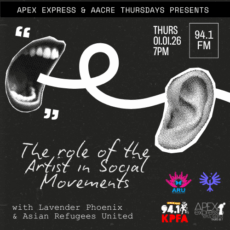
Tonight’s show features Asian Refugees United and Lavender Phoenix in conversation about art, culture, and organizing, and how artists help us imagine and build liberation.
Important Links:
- Lavender Phoenix: Website | Instagram
- Asian Refugees United: Website | Instagram | QTViệt Cafe Collective
Transcript:
Cheryl: Hey everyone. Good evening. You tuned in to APEX Express. I’m your host, Cheryl, and tonight is an AACRE Night. AACRE, which is short for Asian Americans for Civil Rights and Equality is a network made up of 11 Asian American social justice organizations who work together to build long-term movements for justice.
Across the AACRE network, our groups are organizing against deportations, confronting anti-blackness, xenophobia, advancing language justice, developing trans and queer leaders, and imagine new systems of safety and care. It’s all very good, very important stuff. And all of this from the campaigns to the Organizing to Movement building raises a question that I keep coming back to, which is, where does art live In all of this,
Acts of resistance do not only take place in courtrooms or city halls. It takes place wherever people are still able to imagine. It is part of how movements survive and and grow. Art is not adjacent to revolution, but rather it is one of its most enduring forms, and tonight’s show sits in that very spirit, and I hope that by the end of this episode, maybe you’ll see what I mean.
I;d like to bring in my friends from Lavender Phoenix, a trans queer API organization, building people power in the Bay Area, who are also a part of the AACRE Network. This summer, Lavender Phoenix held a workshop that got right to the heart of this very question that we’re sitting with tonight, which is what is the role of the artist in social movements?
As they were planning the workshop, they were really inspired by a quote from Toni Cade Bambara, who in an interview from 1982 said, as a cultural worker who belongs to an oppressed people, my job is to make the revolution irresistible. So that raises a few questions worth slowing down for, which are, who was Toni Cade Bambara?
What does it mean to be a cultural organizer and why does that matter? Especially in this political moment? Lavender Phoenix has been grappling with these questions in practice, and I think they have some powerful answers to share. So without further ado, I’d like to introduce you to angel who is a member of Lavender Phoenix.
Angel: My name is Angel. I use he and she pronouns, and I’m part of the communications committee at LavNix. So, let’s explore what exactly is the meaning of cultural work.
Cultural workers are the creators of narratives through various forms of artistic expression, and we literally drive the production of culture. Cultural work reflects the perspectives and attitudes of artists and therefore the people and communities that they belong to. Art does not exist in a vacuum. You may have heard the phrase before. Art is always political. It serves a purpose to tell a story, to document the times to perpetuate and give longevity to ideas. It may conform to the status quo or choose to resist it.
I wanted to share a little bit about one cultural worker who’s made a really big impact and paved the way for how we think about cultural work and this framework. Toni Cade Bambara was a black feminist, cultural worker, writer, and organizer whose literary work celebrated black art, culture and life, and radically supported a movement for collective liberation.
She believed that it’s the artist’s role to serve the community they belong to, and that an artist is of no higher status than a factory worker, social worker, or teacher. Is the idea of even reframing art making as cultural work. Reclaimed the arts from the elite capitalist class and made clear that it is work, it does not have more value than or take precedence over any other type of movement work.
This is a quote from an interview from 1982 when Toni Cade Bambara said, as a cultural worker who belongs to an oppressed people, my job is to make revolution irresistible. But in this country, we’re not encouraged and equipped at any particular time to view things that way. And so the artwork or the art practice that sells that capitalist ideology is considered art. And anything that deviates from that is considered political, propagandist, polemical, or didactic, strange, weird, subversive or ugly.
Cheryl: After reading that quote, angel then invited the workshop participants to think about what that means for them.
What does it mean to make the revolution irresistible?
After giving people a bit of time to reflect, angel then reads some of the things that were shared in the chat.
Angel: I want my art to point out the inconsistencies within our society to surprised, enraged, elicit a strong enough reaction that they feel they must do something.
Cheryl: Another person said,
Angel: I love that art can be a way of bridging relationships. Connecting people together, building community.
Cheryl: And someone else said.
Angel: I want people to feel connected to my art, find themselves in it, and have it make them think and realize that they have the ability to do something themselves.
Cheryl: I think what is rather striking in these responses that Angel has read aloud to what it means to make art that makes the revolution irresistible isn’t just aesthetics alone, but rather its ability to help us connect and communicate and find one another to enact feelings and responses in each other. It’s about the way it makes people feel implicated and connected and also capable of acting.
Tony Cade Bambara when she poses that the role of cultural workers is to make the revolution irresistible is posing to us a challenge to tap into our creativity and create art that makes people unable to return comfortably to the world as is, and it makes revolution necessary, desirable not as an abstract idea, but as something people can want and move towards
now I’m going to invite Jenica, who is the cultural organizer at Lavender Phoenix to break down for us why we need cultural work in this political moment. .
Speaker: Jenica: So many of us as artists have really internalized the power of art and are really eager to connect it to the movement.
This section is about answering this question of why is cultural work important.
Cultural work plays a really vital role in organizing and achieving our political goals, right? So if our goal is to advance radical solutions to everyday people, we also have to ask ourselves how are we going to reach those peoples? Ideas of revolution and liberation are majorly inaccessible to the masses, to everyday people.
Families are being separated. Attacks on the working class are getting worse and worse. How are we really propping up these ideas of revolution, especially right in America, where propaganda for the state, for policing, for a corrupt government runs really high.
Therefore our messaging in political organizing works to combat that propaganda. So in a sense we have to make our own propaganda. So let’s look at this term together. Propaganda is art that we make that accurately reflects and makes people aware of the true nature of the conditions of their oppression and inspires them to take control of transforming this condition.
We really want to make art that seeks to make the broader society aware of its implications in the daily violences, facilitated in the name of capitalism, imperialism, and shows that error of maintaining or ignoring the status quo.
So it’s really our goal to arm people with the tools to better struggle against their own points of views, their ways of thinking, because not everyone is already aligned with like revolution already, right? No one’s born an organizer. No one’s born 100% willing to be in this cause.
So, we really focus on the creative and cultural processes, as artists build that revolutionary culture. Propaganda is really a means of liberation. It’s an instrument to help clarify information education and a way to mobilize our people. And not only that, our cultural work can really model to others what it’s like to envision a better world for ourselves, right? Our imagination can be so expansive when it comes to creating art. As organizers and activists when we create communication, zines, et cetera, we’re also asking ourselves, how does this bring us one step closer to revolution? How are we challenging the status quo? So this is exactly what our role as artists is in this movement. It’s to create propaganda that serves two different purposes. One, subvert the enemy and cultivate a culture that constantly challenges the status quo. And also awaken and mobilize the people. How can we, through our art, really uplift the genuine interests of the most exploited of people of the working class, of everyday people who are targets of the state and really empower those whose stories are often kept outside of this master narrative. Because when they are talked about, people in power will often misrepresent marginalized communities. An example of this, Lavender Phoenix, a couple years ago took up this campaign called Justice for Jaxon Sales.
Trigger warning here, hate crime, violence against queer people and death. Um, so Jaxon Sales was a young, queer, Korean adoptee living in the Bay Area who went on a blind like dating app date and was found dead the next morning in a high-rise apartment in San Francisco. Lavender Phoenix worked really closely and is still connected really closely with Jaxon’s parents, Jim and Angie Solas to really fight, and organize for justice for Jaxon and demand investigation into what happened to him and his death, and have answers for his family.
I bring that up, this campaign because when his parents spoke to the chief medical examiner in San Francisco, they had told his family Jaxon died of an accidental overdose he was gay. Like gay people just these kinds of drugs. So that was the narrative that was being presented to us from the state. Like literally, their own words: he’s dead because he’s gay. And our narrative, as we continue to organize and support his family, was to really address the stigma surrounding drug use. Also reiterating the fact that justice was deserved for Jaxon, and that no one should ever have to go through this. We all deserve to be safe, that a better world is possible.
So that’s an example of combating the status quo and then uplifting the genuine interest of our people and his family.
One of our key values at Lavender Phoenix is honoring our histories, because the propaganda against our own people is so intense. I just think about the everyday people, the working class, our immigrant communities and ancestors, other queer and trans people of color that really fought so hard to have their story told. So when we do this work and think about honoring our histories, let’s also ask ourselves what will we do to keep those stories alive?
Cheryl: We’re going to take a quick music break and listen to some music by Namgar, an international ethno music collective that fuses traditional Buryat and Mongolian music with pop, jazz, funk, ambient soundscapes, and art- pop.
We’ll be back in just a moment with more after we listen to “part two” by Namgar.
Cheryl: Welcome back.
You are tuned in to APEX express on 94.1 KPFA and 89.3 KPFB B in Berkeley and online at kpfa.org.
That song you just heard was “part two” by Namgar, an incredible four- piece Buryat- Mongolian ensemble that is revitalizing and preserving the Buryat language and culture through music.
For those just tuning in tonight’s episode of APEX Express is all about the role of the artist in social movements.
We’re joined by members of Lavender Phoenix, often referred to as LavNix, which is a grassroots organization in the Bay Area building Trans and queer API Power. You can learn more about their work in our show notes.
We talked about why cultural work is a core part of organizing. We grounded that conversation in the words of Toni Cade Bambara, who said in a 1982 interview, as a cultural worker who belongs to an oppressed people, my job is to make revolution irresistible.
We unpacked what that looks like in practice and lifted up Lavender Phoenix’s Justice for Jaxon Sales campaign as a powerful example of cultural organizing, which really demonstrates how art and narrative work and cultural work are essential to building power
Now Jenica from Levner Phoenix is going to walk us through some powerful examples of cultural organizing that have occurred in social movements across time and across the world.
Speaker: Jenica: Now we’re going to look at some really specific examples of powerful cultural work in our movements.
For our framework today, we’ll start with an international example, then a national one, a local example, and then finally one from LavNix. As we go through them, we ask that you take notes on what makes these examples, impactful forms of cultural work. How does it subvert the status quo? How is it uplifting the genuine interest of the people?
Our international example is actually from the Philippines. Every year, the Corrupt Philippines president delivers a state of the nation address to share the current conditions of the country. However, on a day that the people are meant to hear about the genuine concrete needs of the Filipino masses, they’re met instead with lies and deceit that’s broadcasted and also built upon like years of disinformation and really just feeds the selfish interests of the ruling class and the imperialist powers. In response to this, every year, BAYAN, which is an alliance in the Philippines with overseas chapters here in the US as well. Their purpose is to fight for the national sovereignty and genuine democracy in the Philippines, they hold a Peoples’ State of the Nation Address , or PSONA, to protest and deliver the genuine concerns and demands of the masses. So part of PSONA are effigies. Effigies have been regular fixtures in protest rallies, including PSONA.
So for those of you who don’t know, an effigy is a sculptural representation, often life size of a hated person or group. These makeshift dummies are used for symbolic punishment in political protests, and the figures are often burned. In the case of PSONA, these effigies are set on fire by protestors criticizing government neglect, especially of the poor.
Lisa Ito, who is a progressive artists explained that the effigy is constructed not only as a mockery of the person represented, but also of the larger system that his or her likeness embodies. Ito pointed out that effigies have evolved considerably as a form of popular protest art in the Philippines, used by progressive people’s movements, not only to entertain, but also to agitate, mobilize and capture the sentiments of the people.
This year, organizers created this effigy that they titled ‘ZomBBM,’ ‘Sara-nanggal’ . This is a play on words calling the corrupt president of the Philippines, Bongbong Marcos, or BBM, a zombie. And the vice president Sara Duterte a Manananggal, which is a, Filipino vampire to put it in short, brief words.
Organizers burnt this effigy as a symbol of DK and preservation of the current ruling class.
I love this effigy so much. You can see BBM who’s depicted like his head is taken off and inside of his head is Trump because he’s considered like a puppet president of the Philippines just serving US interests. Awesome. I’m gonna pass it to Angel for our national perspective.
Angel: Our next piece is from the national perspective and it was in response to the AIDS crisis. The global pandemic of HIV AIDS began in 1981 and continues today. AIDS is the late stage of HIV infection, human immunodeficiency virus, and this crisis has been marked largely by government indifference, widespread stigma against gay people, and virtually no federal funding towards research or services for everyday people impacted.
There was a really devastating lack of public attention about the seriousness of HIV. The Ronald Reagan administration treated the crisis as a joke because of its association with gay men, and Reagan didn’t even publicly acknowledge AIDS until 19 85, 4 years into the pandemic. Thousands of HIV positive people across backgrounds and their supporters organize one of the most influential patient advocacy groups in history.
They called themselves the AIDS Coalition to Unleash Power or ACT up. They ultimately organize and force the government and the scientific community to fundamentally change the way medical research is conducted. Paving the way for the discovery of a treatment that today keeps alive, an estimated half million HIV positive Americans and millions more worldwide.
Sarah Schulman, a writer and former member of ACT Up, wrote a list of ACT UPS achievements, including changing the CDC C’S definition of aids to include women legalizing needle exchange in New York City and establishing housing services for HIV positive unhoused people. To highlight some cultural work within ACT Up, the AIDS activist artist Collective Grand Fury formed out of ACT Up and CR and created works for the public sphere that drew attention to the medical, moral and public issues related to the AIDS crisis.
Essentially, the government was fine with the mass deaths and had a large role in the active killing off of people who are not just queer, but people who are poor working class and of color. We still see parallels in these roadblocks. Today, Trump is cutting public healthcare ongoing, and in recent memory, the COVID crisis, the political situation of LGBTQ people then and now is not divorced from this class analysis. So in response, we have the AIDS Memorial Quilt, this collective installation memorializes people who died in the US from the AIDS crisis and from government neglect. Each panel is dedicated to a life lost and created by hand by their friends, family, loved ones, and community.
This artwork was originally conceived by Cleve Jones in SF for the 1985 candlelight March, and later it was expanded upon and displayed in Washington DC in 1987. Its enormity demonstrated the sheer number at which queer folk were killed in the hiv aids crisis, as well as created a space in the public for dialogue about the health disparities that harm and silence our community.
Today, it’s returned home to San Francisco and can be accessed through an interactive online archive. 50,000 individual panels and around a hundred thousand names make up the patchwork quilt, which is insane, and it’s one of the largest pieces of grassroots community art in the world.
Moving on to a more local perspective. In the Bay Area, we’re talking about the Black Panther Party. So in October of 1966 in Oakland, California, Huey Newton and Bobby Seale founded the Black Panther Party for self-defense. The Panthers practiced militant self-defense of black communities against the US government and fought to establish socialism through organizing and community-based programs.
The Black Panthers began by organizing arm patrols of black people to monitor the Oakland Police Department and challenge rampant rampant police brutality. At its peak, the party had offices in 68 cities and thousands of members. The party’s 10 point program was a set of demands, guidelines, and values, calling for self-determination, full employment of black people, and the end of exploitation of black workers housing for all black people, and so much more.
The party’s money programs directly addressed their platform as they instituted a free B Breakfast for Children program to address food scarcity Founded community health clinics to address the lack of adequate, adequate healthcare for black people and treat sickle cell anemia, tuberculosis, and HIV aids and more.
The cultural work created by the Black Panther Party included the Black Panther Party newspaper known as the Black Panther. It was a four page newsletter in Oakland, California in 1967. It was the main publication of the party and was soon sold in several large cities across the US as well as having an international readership.
The Black Panther issue number two. The newspaper, distributed information about the party’s activities and expressed through articles, the ideology of the Black Panther Party, focusing on both international revolutions as inspiration and contemporary racial struggles of African Americans across the United States.
Solidarity with other resistance movements was a major draw for readers. The paper’s international section reported on liberation struggles across the world. Under Editor-in-Chief, David Du Bois, the stepson of WEB Du Bois, the section deepened party support for revolutionary efforts in South Africa and Cuba.
Copies of the paper traveled abroad with students and activists and were tra translated into Hebrew and Japanese. It reflected that the idea of resistance to police oppression had spread like wildfire. Judy Juanita, a former editor in Chief Ads, it shows that this pattern of oppression was systemic. End quote.
Paper regularly featured fiery rhetoric called out racist organizations and was unabashed in its disdain for the existing political system. Its first cover story reported on the police killing of Denzel Doel, a 22-year-old black man in Richmond, California. In all caps, the paper stated, brothers and sisters, these racist murders are happening every day.
They could happen to any one of us. And it became well known for its bold cover art, woodcut style images of protestors, armed panthers, and police depicted as bloodied pigs.
Speaker: Jenica: I’m gonna go into the LavNix example of cultural work that we’ve done. For some context, we had mentioned that we are taking up this campaign called Care Not Cops. Just to give some brief background to LavNix, as systems have continued to fail us, lavender Phoenix’s work has always been about the safety of our communities.
We’ve trained people in deescalation crisis intervention set up counseling networks, right? Then in 2022, we had joined the Sales family to fight for justice for Jaxon Sales. And with them we demanded answers for untimely death from the sheriff’s department and the medical examiner.
Something we noticed during that campaign is that every year we watch as people in power vote on another city budget that funds the same institutions that hurt our people and steal money from our communities. Do people know what the budget is for the San Francisco Police Department? Every year, we see that city services and programs are gutted. Meanwhile, this year, SFPD has $849 million, and the sheriff has $345 million.
So, honestly, policing in general in the city is over $1 billion. And they will not experience any cuts. Their bloated budgets will remain largely intact. We’ve really been watching, Mayor Lurie , his first months and like, honestly like first more than half a year, with a lot of concern.
We’ve seen him declare the unlawful fentanyl state of emergency, which he can’t really do, and continue to increase police presence downtown. Ultimately we know that mayor Lurie and our supervisors need to hear from us everyday people who demand care, not cops. So that leads me into our cultural work.
In March of this year, lavender Phoenix had collaborated with youth organizations across the city, youth groups from Chinese Progressive Association, PODER, CYC, to host a bilingual care, not cops, zine making workshop for youth.
Our organizers engaged with the youth with agitating statistics on the egregious SFPD budget, and facilitated a space for them to warm up their brains and hearts to imagine a world without prisons and policing. And to really further envision one that centers on care healing for our people, all through art. What I really learned is that working class San Francisco youth are the ones who really know the city’s fascist conditions the most intimately. It’s clear through their zine contributions that they’ve really internalized these intense forms of policing in the schools on the streets with the unhoused, witnessing ice raids and fearing for their families. The zine was really a collective practice with working class youth where they connected their own personal experiences to the material facts of policing in the city, the budget, and put those experiences to paper.
Cheryl: Hey everyone. Cheryl here. So we’ve heard about Effigies in the Philippines, the AIDS Memorial Quilt, the Black Panther Party’s newspaper, the Black Panther and Lavender Phoenix’s Care Cop zine.
Through these examples, we’ve learned about cultural work and art and narrative work on different scales internationally, nationally, locally and organizationally. With lavender Phoenix. What we’re seeing is across movements across time. Cultural work has always been central to organizing.
We’re going to take another music break, but when we return, I’ll introduce you to our next speaker. Hai, from Asian Refugees United, who will walk us through, their creative practice, which is food, as a form of cultural resistance, and we’ll learn about how food ways can function as acts of survival, resistance, and also decolonization. So stay with us more soon when we return.
Cheryl: And we’re back!!. You’re listening to APEX express on 94.1 KPFA, 89.3 KPFB in Berkeley. 88.1. KFCF in Fresno and [email protected]. That was “Juniper” by Minjoona,
a project led by Korean American musician, Jackson Wright.
huge thanks to Jackson and the whole crew behind that track.
I am here with Hai from Asian Refugees United, who is a member QTViet Cafe Collective. A project under Asian Refugees United. QTViet Viet Cafe is a creative cultural hub that is dedicated to queer and trans viet Liberation through ancestral practices, the arts and intergenerational connection.
This is a clip from what was a much longer conversation.
This episode is all about the role of the artist in social movements and I think Hai brings a very interesting take to the conversation.
Hai (ARU): I think that what is helping me is one, just building the muscle. So when we’re so true to our vision and heart meets mind and body. So much of what QTViet Cafe is, and by extension Asian refugees and like, we’re really using our cultural arts and in many ways, whether that’s movement or poetry or written word or song or dance. And in many ways I’ve had a lot of experience in our food ways, and reclaiming those food ways. That’s a very embodied experience. We’re really trying to restore wholeness and health and healing in our communities, in our bodies and our minds and our families and our communities that have been displaced because of colonization, imperialism, capitalism.
And so how do we restore, how do we have a different relationship and how do we restore? I think that from moving from hurt to healing is life and art. And so we need to take risk and trying to define life through art and whatever means that we can to make meaning and purpose and intention.
I feel like so much of what art is, is trying to make meaning of the hurt in order to bring in more healing in our lives. For so long, I think I’ve been wanting a different relationship to food. For example, because I grew up section eight, food stamps, food bank. My mom and my parents doing the best they could, but also, yeah, grew up with Viet food, grew up with ingredients for my parents making food, mostly my mom that weren’t necessarily all the best. And I think compared to Vietnam, where it’s easier access. And there’s a different kind of system around, needs around food and just easier access, more people are involved around the food system in Vietnam
I think growing up in Turtle Island and seeing my parents struggle not just with food, but just with money and jobs it’s just all connected. And I think that impacted my journey and. My own imbalance around health and I became a byproduct of diabetes and high cholesterol and noticed that in my family. So when I noticed, when I had type two diabetes when I was 18, made the conscious choice to, I knew I needed to have some type of, uh, I need to have a different relationship to my life and food included and just like cut soda, started kind of what I knew at the time, exercising as ways to take care of my body.
And then it’s honestly been now a 20 year journey of having a different relationship to not just food, but health and connection to mind, body, spirit. For me, choosing to have a different relationship in my life, like that is a risk. Choosing to eat something different like that is both a risk and an opportunity. For me that’s like part of movement building like you have to. Be so in tune with my body to notice and the changes that are needed in order to live again. When I noticed, you know, , hearing other Viet folks experiencing diet related stuff and I think knowing what I know also, like politically around what’s happening around our food system, both for the vie community here and also in Vietnam, how do we, how can this regular act of nourishing ourselves both be not just in art, something that should actually just honestly be an everyday need and an everyday symbol of caregiving and caretaking and care that can just be part of our everyday lives. I want a world where, it’s not just one night where we’re tasting the best and eating the best and being nourished, just in one Saturday night, but that it’s just happening all the time because we’re in right relationship with ourselves and each other and the earth that everything is beauty and we don’t have to take so many risks because things are already in its natural divine.
I think it takes being very conscious of our circumstances and our surroundings and our relationships with each other for that to happen. I remember reading in my early twenties, reading the role of, bring Coke basically to Vietnam during the war. I was always fascinated like, why are, why is Coke like on Viet altars all the time? And I always see them in different places. Whenever I would go back to Vietnam, I remember when I was seven and 12. Going to a family party and the classic shiny vinyl plastic, floral like sheet on a round table and the stools, and then these beautiful platters of food. But I’m always like, why are we drinking soda or coke and whatever else? My dad and the men and then my family, like drinking beer. And I was like, why?
I’ve had periods in my life when I’ve gotten sick, physically and mentally sick. Those moments open up doors to take the risk and then also the opportunity to try different truth or different path. When I was 23 and I had just like crazy eczema and psoriasis and went back home to my parents for a while and I just started to learn about nourishing traditions, movement. I was Very critical of the us traditional nutrition ideas of what good nutrition is and very adamantly like opposing the food pyramid. And then in that kind of research, I was one thinking well, they’re talking about the science of broths and like soups and talking about hard boiling and straining the broth and getting the gunk on the top. And I’m like, wait, my mom did that. And I was starting to connect what has my mom known culturally that now like science is catching up, you know? And then I started just reading, you know, like I think that my mom didn’t know the sign mom.
I was like, asked my mom like, did you know about this? And she’s like, I mean, I just, this is, is like what ba ngoai said, you know? And so I’m like, okay, so culturally this, this is happening scientifically. This is what’s being shared. And then I started reading about the politics of US-centric upheaval of monocultural agriculture essentially. When the US started to do the industrial Revolution and started to basically grow wheat and soy and just basically make sugar to feed lots of cows and create sugar to be put in products like Coke was one of them. And, and then, yeah, that was basically a way for the US government to make money from Vietnam to bring that over, to Vietnam. And that was introduced to our culture. It’s just another wave of imperialism and colonization.
And sadly, we know what, overprocessed, like refined sugars can do to our health. And sadly, I can’t help but make the connections with what happened. In many ways, food and sugar are introduced through these systems of colonization and imperialism are so far removed from what we ate pre colonization. And so, so much of my journey around food has been, you know, it’s not even art, it’s just like trying to understand, how do we survive and we thrive even before so many. And you know, in some ways it is art. ’cause I making 40 pounds of cha ga for event, , the fish cake, like, that’s something that, that our people have been doing for a long time and hand making all that. And people love the dish and I’m really glad that people enjoyed it and mm, it’s like, oh yeah, it’s art. But it’s what people have been doing to survive and thrive for long, for so long, you know?
, We have the right to be able to practice our traditional food ways and we have the right for food sovereignty and food justice. And we have the right to, by extension, like have clean waters and hospitable places to live and for our animal kin to live and for our plant kin to be able to thrive.
bun cha ga, I think like it’s an artful hopeful symbol of what is seasonal and relevant and culturally symbolic of our time. I think that, yes, the imminent, violent, traumatic war that are happening between people, in Vietnam and Palestine and Sudan. Honestly, like here in America. That is important. And I think we need to show, honestly, not just to a direct violence, but also very indirect violence on our bodies through the food that we’re eating. Our land and waters are living through indirect violence with just like everyday pollutants and top soil being removed and industrialization. And so I think I’m just very cognizant of the kind of everyday art ways, life ways, ways of being that I think that are important to be aware of and both practice as resistance against the forces that are trying to strip away our livelihood every day.
Cheryl: We just heard from Hai of Asian refugees United who shared about how food ways function as an embodied form of cultural work that is rooted in memory and also survival and healing. Hai talked about food as a practice and art that is lived in the body and is also shaped by displacement and colonization and capitalism and imperialism. I shared that through their journey with QTV at Cafe and Asian Refugees United. High was able to reflect on reclaiming traditional food ways as a way to restore health and wholeness and relationship to our bodies and to our families, to our communities, and to the earth.
High. Also, traced out illness and imbalance as deeply connected to political systems that have disrupted ancestral knowledge and instead introduced extractive food systems and normalized everyday forms of soft violence through what we consume and the impact it has on our land. And I think the most important thing I got from our conversation was that high reminded us that nourishing ourselves can be both an act of care, an art form, and an act of resistance. And what we call art is often what people have always done to survive and thrive Food. For them is a practice of memory, and it’s also a refusal of erasure and also a very radical vision of food sovereignty and healing and collective life outside of colonial violence and harm. As we close out tonight’s episode, I want to return to the question that has guided us from the beginning, which is, what is the role of the artist in social movements?
What we’ve heard tonight from Tony Cade Bambara call to make revolution irresistible to lavender Phoenix’s cultural organizing here, internationally to Hai, reflections on food ways, and nourishing ourselves as resistance.
It is Really clear to me. Art is not separate from struggle.
It is how people make sense of systems of violence and carry memory and also practice healing and reimagining new worlds in the middle of ongoing violence. Cultural work helps our movements. Endure and gives us language when words fail, or ritual when grief is heavy, and practices that connect us, that reconnect us to our bodies and our histories and to each other.
So whether that’s through zines, or songs or murals, newspapers, or shared meals, art is a way of liberation again and again. I wanna thank all of our speakers today, Jenica,
Angel.
From Lavender Phoenix. Hi, from QTV Cafe, Asian Refugees United,
And I also wanna thank you, our listeners for staying with us. You’ve been listening to Apex Express on KPFA. Take care of yourselves, take care of each other, and keep imagining the world that we’re trying to build.
That’s important stuff.
Cheryl Truong (she/they): Apex express is produced by Miko Lee, Paige Chung, Jalena Keane-Lee, Preeti Mangala Shekar. Shekar, Anuj Vaidya, Kiki Rivera, Swati Rayasam, Nate Tan, Hien Nguyen, Nikki Chan, and Cheryl Truong
Cheryl Truong: Tonight’s show was produced by me, cheryl. Thanks to the team at KPFA for all of their support. And thank you for listening!