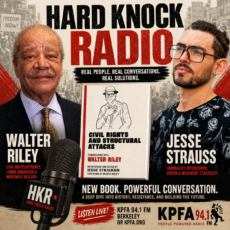

On Hard Knock Radio, host Davey D sat down with community activist and journalist Jesse Strauss and longtime civil rights attorney Walter Riley to discuss their new book, Civil Rights and Structural Attacks: Conversations with Walter Riley. The conversation explored Riley’s decades of movement work, the importance of preserving radical history, and the lessons today’s organizers can draw from past freedom struggles.
Strauss explained that the book is not simply a memoir or archive. It is an intergenerational conversation with a movement elder who remains active in the fight for justice. He described Riley as someone who has been deeply involved in civil rights, labor, anti war, Black liberation, and community organizing efforts, while never treating movement work as something confined to the past.
Riley reflected on the current political moment, saying he was not surprised by the rise of authoritarian politics, though he did not expect it to take its current form. He connected today’s crisis to earlier political betrayals, especially the Reagan era, when he felt liberal institutions failed to defend working people, poor people, and communities under attack.
A major theme of the interview was historical erasure. Riley spoke about growing up in Durham, North Carolina, in a community shaped by sharecropping, segregation, and the living memory of slavery. He recalled how his family and community carried traditions of resistance, dignity, and self defense. One striking story involved his father confronting sheriffs who were threatening the family after Riley married a white Freedom Rider during the Jim Crow era.
The conversation also challenged sanitized versions of the Civil Rights Movement. Riley argued that activists were not simply trying to “integrate” into white society. They were attacking the structure of white supremacy and asserting their full humanity. He emphasized that working class Black communities played a central role in direct action movements, though their contributions are often minimized.
Riley also shared memories of working with Floyd McKissick and meeting Malcolm X as a 19 year old organizer. Strauss highlighted chapters on nonprofit imperialism, Haiti solidarity work, and movement capture in Oakland after Oscar Grant.
By the end, the book emerged as more than a historical record. It is a call to study, organize, build solidarity, and keep movement culture alive. As Strauss put it, the goal is not nostalgia. The goal is to win.